Wine tasting in Crmnica: family wineries near Virpazar
Where can you taste wine near Lake Skadar, and do you need to book ahead?
Crmnica, the hill country around Virpazar and the village of Godinje, has a cluster of small family wineries pouring Vranac and Krstac, usually with prsut and cheese included. Most are working households rather than businesses with a shop front, so a call or message the day before, or a slot on an organised tasting tour, is normal practice rather than a formality.
The hill country behind Lake Skadar
Crmnica is not a single village, it is the stretch of terraced hillside between Virpazar and the ridge above Lake Skadar, roughly 20 to 25 minutes of narrow lanes from the lakeshore road. It has been vine country for a very long time, and it still is: small plots of Vranac and Krstac climb the slopes behind stone farmhouses, most of them owned by families who have been making wine here for generations rather than businesses built around tourism.
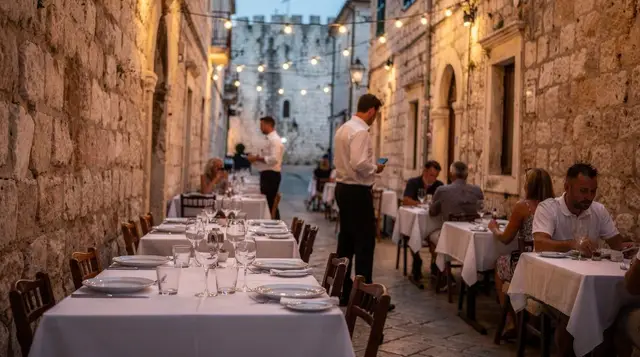
That distinction matters for what a visit looks like. On the coast, at Budva or Kotor, wine tourism mostly means a bottle on a restaurant list or a shop selling a handful of national brands. In Crmnica, it usually means sitting at a family’s own table, being poured what they made this year and last, with a plate of prsut and cheese put down alongside it. It is smaller, slower, and considerably less polished than a coastal tasting room, which is exactly the appeal for anyone who has already done the commercial version.
Godinje and the other wine hamlets
The best-known cluster of wineries sits around Godinje, a stone-built hillside village a short drive above Virpazar with vine terraces that in places run centuries old. Godinje itself is tiny and has no real centre, no café strip, nothing that functions as a sight in the way a town square does. What it has is households that have made wine here long enough that a handful of families are locally known for it, and a handful more are starting to open their doors to visitors as word spreads.
Similar smallholdings sit scattered through the wider Crmnica hillside toward Rijeka Crnojevića, and the general pattern repeats down toward the lakeside villages of Murići and Karuč, though the wine producers proper cluster more tightly around Virpazar and Godinje than along the water itself. None of this is signposted the way a wine route in western Europe would be; there is no tasting map handed out at a tourist office, and the wineries that do welcome visitors mostly rely on being found through word of mouth, a tour operator, or increasingly a listing online.
What a tasting actually involves
A Crmnica tasting is rarely a formal flight with tasting notes and a spittoon. It is closer to being invited into someone’s courtyard or cellar and given a seat at a table. Expect three to five wines poured through the session, almost always a Vranac (the workhorse red grape of the whole region, see the Montenegrin wine guide for more on the grape itself) alongside a rosé or a Krstac white, plus whatever the household happens to have on hand that year.
Food comes with it as standard rather than as an add-on: prsut, a hard local cheese, olives, bread, sometimes a plate of ajvar or a simple cold cut. It is not a full meal in most cases, though some producers will do one on request, and it is not fine dining presentation either. Sessions typically run 45 minutes to an hour and a half, longer if the conversation runs on, which at a family table it often does.
| What you get | Typical detail |
|---|---|
| Wines poured | 3 to 5, usually Vranac plus a rosé or Krstac |
| Food included | Prsut, cheese, olives, bread (standard); full lunch on request at some producers |
| Duration | 45 minutes to 1.5 hours |
| Price per person | Roughly 10 to 20 EUR for tasting and food; more for a full meal |
| Group size | Small, often under 10 people at a family cellar |
| Booking | Advance notice expected, same day or day before at minimum |
For an organised tasting with transport handled, a wine and food tasting at a traditional Virpazar winery covers the pour-and-plate format described above without needing a car or a Montenegrin phone number to arrange it.
Why booking ahead matters here
This is the point worth repeating: these are working households, not commercial tasting rooms with fixed hours and a member of staff on the door. A family producing a few thousand bottles a year from a few hectares of vines does not keep someone on standby for passing visitors. Turning up unannounced at a Godinje address found online can mean nobody is home, the wine that is open is not what they would have chosen to pour, or the family simply is not set up that day to sit a group down.
A message a day or two ahead, either directly to the producer if you have a contact, or through a booked tour that already has a relationship with a specific winery, is the reliable way to do this. It is a minor extra step compared with walking into a coastal tasting room, and it is also most of the reason a Crmnica visit feels genuine rather than staged: the family is genuinely expecting you, not running a rotating door of unscheduled arrivals.
Getting to Virpazar and around Crmnica
Virpazar sits at the lake’s western edge, about 1 hour 15 minutes from Kotor by road via Cetinje, on the same route that continues down toward Podgorica. There is no direct bus service from Kotor to Virpazar, and once in Crmnica the lanes up to Godinje and the other hillside hamlets are narrow, occasionally unsigned, and not the sort of place a taxi driver unfamiliar with the area will find quickly. A rental car (see the car rental guide) gives by far the most flexibility if the plan is to visit more than one producer or combine wine with a stop at Rijeka Crnojevića or a lake viewpoint on the same day.
For visitors without a car, an organised tour that includes both transport and a pre-arranged winery stop removes the two main obstacles at once: finding the address and being expected when you arrive. Several operators pair a Virpazar-based tasting with a short walk or boat leg on the lake itself.
Combining wine with Lake Skadar
Virpazar doubles as the main gateway to boat trips on Lake Skadar, and several tours now pair the two directly, a couple of hours on the water followed by a tasting on land, or the other way round. a Lake Skadar boat tour that includes swimming stops and a wine tasting is a straightforward way to see the lake’s backwaters and reed channels and still get the Crmnica cellar experience in the same outing, useful if a day trip from Kotor only has room for one booking rather than two separate ones.
Cycling is another way locals and increasingly visitors cover the gentler stretches of Crmnica, and a cycling tour around Lake Skadar with a wine tasting stop works well for anyone who would rather move through the vineyards at a slower pace than a car allows, with the tasting itself as the reward at the end rather than the whole point of the trip.
How this compares with coastal wine tourism
Kotor, Budva and the coastal towns generally sell wine as a restaurant list item or a shop shelf, dominated by the same three or four national producers whose bottles turn up everywhere from Perast to Petrovac. That is not a criticism of the wine itself, Vranac from a recognised producer is a reasonable, often good, glass, but it is a different experience from Crmnica, where the wine on the table was made in the room next door and the person pouring it grew the grapes.
The trade-off runs the other way too. Coastal tasting rooms and wine bars keep predictable hours, take walk-ins, and speak fluent tourist English as standard. Crmnica producers vary: some hosts speak good English, others less, and a tour with a guide bridges that gap more comfortably than turning up solo with no shared language and no notice given.
When to go
Harvest, roughly mid-September to mid-October, is the most interesting window if timing allows it, with picking and pressing visible at some smaller cellars and the whole hillside smelling of it. Outside harvest, late spring through early autumn is when most producers are set up and willing to host, in line with the broader coastal season (see best time to visit and the seasonal guide). Winter tastings are possible at some households but need more advance notice, since fewer visitors are around and producers are not necessarily set up for it day to day.
Budget-wise, a Crmnica wine afternoon is one of the cheaper food experiences in the Kotor Bay area relative to what it includes; see the daily budget guide for how it stacks up against a coastal restaurant meal. For a lighter, slightly more polished alternative that leans on presentation rather than a working farmhouse, a sunset paint-and-sip session in Virpazar with unlimited wine is a different kind of evening entirely, closer to a class than a farm visit, but it is worth knowing the two are not the same thing before booking either.
If Crmnica is one stop on a longer day out from the coast, it slots naturally alongside a wider Lake Skadar day; see how many days to allow in Kotor and the bay for where a Virpazar detour fits into a shorter or longer itinerary, and the food and drink category for other tastings and meals around the bay.
Wine tasting near Virpazar and Lake Skadar: FAQ
Do Crmnica wineries need to be booked in advance?
Yes, in almost all cases. These are family cellars, often a handful of hectares of vines and a few thousand bottles a year, not commercial tasting rooms with regular opening hours. Turning up unannounced can mean no one is home, or a rushed pour instead of the usual sit-down tasting with food. A message the day before, through the winery directly or via a booked tour, is the reliable route.
What does a tasting in Crmnica actually include?
Typically three to five wines, most often a Vranac and a rosé or Krstac, poured alongside prsut, a hard cheese, olives and bread on the same table. It is closer to being a guest in someone’s courtyard than a formal flight with tasting notes, and it usually runs 45 minutes to an hour and a half depending on how the conversation goes.
How much does a tasting cost?
Expect roughly 10 to 20 EUR per person for a food-and-wine tasting at a small producer, sometimes more if it includes a full lunch. Organised tours that bundle transport, a boat leg on Lake Skadar or a Virpazar base and a winery stop typically run 35 to 65 EUR per person.
Is Crmnica wine actually different from what is sold on the coast?
Grape-wise, no: Vranac and Krstac dominate both. The difference is scale and distribution. Coastal restaurants and shops mostly carry the handful of larger producers with national distribution, while Crmnica’s family cellars sell most of what they make locally or direct to visitors, so the same grape varieties show more variation from one household to the next.
How far is Virpazar from Kotor, and can you get there without a car?
About 1 hour 15 minutes by road via Cetinje. There is no direct bus from Kotor to Virpazar, so most independent visitors either self-drive or join an organised tour that includes transport; a rental car gives the most flexibility for stopping at more than one winery.
What is Godinje, and is it worth visiting on its own?
Godinje is a stone-built hillside village a short drive above Virpazar, known for centuries-old vine terraces and several of the best-regarded family wineries in Crmnica. It is small and quiet, with no real centre to speak of, so it makes more sense as a wine stop than a sightseeing destination in its own right.
When is the best time to visit for wine tasting?
Harvest, roughly mid-September to mid-October, is the most atmospheric period, with picking and pressing visible at some cellars. Late spring through early autumn works for tastings generally; winter is possible but many family producers scale back and prefer more notice.
Kotor food & drink tours on GetYourGuide
Verified deep-linked GetYourGuide tours. Book through these links and we earn a small commission at no cost to you.
GetYourGuide does not provide a product photo for this activity — the image shows the meeting point, photographed by us.