Oysters and mussels of Boka Bay
Where do Boka Bay's oysters and mussels come from, and where can you eat them?
Most of the bay's oysters and mussels are farmed on ropes and rafts in the sheltered inlet around Ljuta, between Risan and Perast, where a freshwater spring meets the salt water of the Adriatic. A handful of small, family-run restaurants along the shore between Kotor and Perast serve them the same day they're pulled from the ropes.
A local tradition, not a copy of the French one
Ask a waiter in the old town for oysters and they’ll usually bring you shellfish farmed a short drive up the coast, not flown in from Brittany or the Bassin d’Arcachon. The Bay of Kotor has its own oyster and mussel farming tradition, small in scale and mostly unknown outside the region, built around the sheltered water and freshwater springs of the inner bay. It has nothing to do with the branded French oyster names most travellers already recognise, and that’s part of the point: this is a genuinely local product, sold within a few kilometres of where it grows, at prices that reflect a small regional industry rather than an export brand.
The farming itself is unglamorous to look at. Ropes and floating rafts sit low in the water off villages most people drive straight past on the way from Kotor to Perast. Mussels and oysters grow attached to the ropes, suspended in the water column rather than dredged from a seabed, which keeps them relatively clean and easy to harvest by hand from a small boat. It’s closer in method to how mussels are farmed on ropes elsewhere in the Adriatic than to a flat oyster bed, and it has been done this way around the bay for generations, long before Kotor’s old town filled up with cruise-day crowds.
Where the oysters and mussels actually grow
The commercial heart of the bay’s shellfish farming sits in the inner curve of the water between Risan and Perast, on the stretch some maps and locals still call the Bay of Risan, the innermost and calmest of the bay’s connected basins. The water here is more sheltered than the open channel off Kotor itself, with less boat wash, less depth, and slower currents, all of which suit shellfish farming better than exposed coastline.
The specific area growers point to most often is around Ljuta, a small settlement on the coast road between Risan and Perast. It isn’t a town with its own centre so much as a stretch of shoreline and a handful of houses, easy to miss if you’re driving through without stopping. What makes it notable is underground, not on the surface: a freshwater spring rises here and flows into the bay, mixing with the seawater right at the point where much of the local farming happens.
Fresh water meeting salt water
Growers and locals in the area credit that freshwater input with giving the bay’s oysters and mussels their particular character: a milder, less aggressively briny taste than shellfish farmed in fully saline water. The theory, repeated by more than one small operator along this stretch of coast, is that the mix of fresh spring water and seawater changes the mineral balance the shellfish are filtering, and that calmer, semi-enclosed water lets them grow without the stress of strong currents or heavy boat traffic.
None of this is independently certified or scientifically labelled the way French appellation oysters are. There’s no equivalent of a Marennes-Oléron classification here. What there is, instead, is a consistent local claim, backed by the fact that people who live around the bay and could eat anywhere choose to drive out to these same small places for shellfish, rather than ordering it in Kotor’s old town. Ljuta’s freshwater spring is the detail behind that, and it’s worth knowing before you eat here rather than after, because otherwise the mussels just taste good without you knowing why.
Season and what changes with it
Mussels are harvested and served across the bay all year, and they’re the more common order through summer, when demand from restaurants along the coast is highest. Oysters follow a looser but real seasonal pattern: many people who eat here regularly consider the cooler months, roughly October through April, the better stretch for oysters, when the water temperature drops and the meat is said to firm up. That’s the opposite of peak tourist season, which is worth knowing if you’re specifically chasing oysters rather than mussels: a September or October trip built around Best time to visit Kotor: May-June and September style shoulder-season timing works in your favour here too.
In practice this means summer visitors will eat excellent mussels without much trouble, while oyster availability can be thinner and more weather-dependent in July and August. It isn’t a hard rule enforced anywhere, more a pattern that repeats across small growers who don’t publish harvest calendars, so don’t be surprised if a restaurant simply says “no oysters today” on a given visit and has mussels instead.
Small restaurants between Kotor and Perast
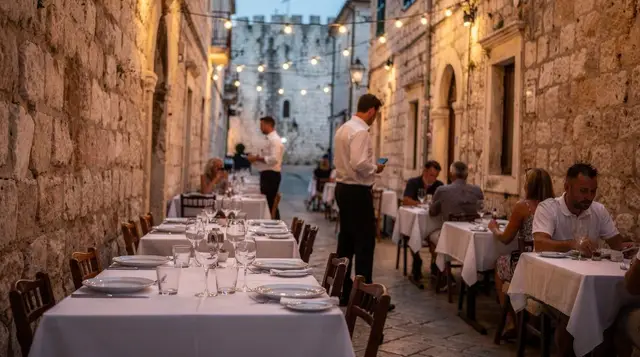
This is the part that actually matters for a visit: none of the well-known seafood restaurants inside Kotor’s old town are farming their own shellfish, and most aren’t sourcing directly from Ljuta on a daily basis either. The places closest to the source are strung along the coast road heading north-west out of Kotor, through Dobrota, past Prčanj and Stoliv, on to Ljuta itself and Orahovac, and into Risan. These are small, often family-run places, sometimes no more than a terrace built out over the water with a dozen tables, and they tend to buy shellfish the same day it’s pulled from the ropes rather than holding stock.
They don’t compete with old town restaurants on atmosphere or setting in the way a table on Kotor’s main square does, and several have no view of anything more dramatic than the water and the opposite shore. What they offer instead is proximity: shorter transport time between the rope and the plate, lower rent than a old town address, and a clientele that’s disproportionately local, which keeps quality honest in a way that heavy cruise-day footfall doesn’t always allow inside the walls. If you’ve read Where to eat in Kotor Old Town and want the contrast, this is it: quieter rooms, plainer decor, and shellfish that travelled less distance to reach you.
| Where | Distance from Kotor | What it’s known for |
|---|---|---|
| Dobrota waterfront | 5-10 minutes | Mixed seafood, some rope-grown mussels |
| Prčanj / Stoliv | 15-20 minutes | Small terraces, quieter, family-run |
| Ljuta | 20-25 minutes | Closest to the freshwater spring, oyster and mussel focus |
| Orahovac / Risan | 25-35 minutes | Inner-bay farms, some of the largest local operators |
None of these villages have a dense restaurant strip; you’re often looking for one or two specific addresses rather than choosing between rows of competing terraces the way you can in Budva or Kotor’s old town. Asking your accommodation for the current recommendation is more reliable than trusting a single name printed in an older guidebook, since small operators open, close, and change hands more often than the well-known old town restaurants do.
What to order and roughly what it costs
Mussels here are usually served buzara-style, cooked quickly in white wine, garlic, olive oil, breadcrumbs, and parsley, a preparation shared across much of the Adriatic coast rather than unique to the bay. Oysters, when available, are typically served raw on ice, sometimes with nothing more than a squeeze of lemon, since the point of ordering them here is the shellfish itself rather than a heavy sauce.
Prices at these smaller, non-touristic bayside places generally sit at the lower end of what you’d pay for a seafood main in Montenegro overall, in the range of roughly 8 to 15 EUR for a mussel dish, broadly in line with a standard non-touristic restaurant meal. Oysters are usually priced by the piece rather than by the plate, and a half dozen typically costs less at these bayside spots than the same order would at a seafront terrace inside Kotor’s old town, where rent and cruise-day demand push prices up. Exact figures vary by season and by operator, so treat any number here as a starting point for comparison rather than a fixed menu price.
| Item | Typical setting | Price level vs. old town |
|---|---|---|
| Mussels buzara | Bayside village restaurant | Lower |
| Oysters, half dozen, raw | Bayside village restaurant | Lower |
| Mixed seafood platter | Old town waterfront terrace | Higher |
| Grilled fish, whole | Either | Similar |
Pair either dish with a glass of local white; growers and restaurant staff along this stretch of coast tend to recommend Krstač over anything imported, and it’s worth reading Montenegrin wine guide: Vranac and Krstač before you order if you want to know what you’re drinking rather than just pointing at the house white.
Farm visits and tastings
A small number of the farms around Risan and Ljuta let visitors come out on a boat to see the ropes and rafts directly, sometimes finishing with a tasting of oysters or mussels pulled from the water minutes earlier. These aren’t run as fixed-departure tours with a ticket desk; they’re closer to informal arrangements you set up through a local restaurant, your accommodation, or by asking around in Risan or Perast itself. Expect a modest cash fee for the tasting rather than a formal booking system, and don’t expect English-language signage or a visitor centre.
If that kind of arrangement feels too uncertain to plan around in advance, a guided option covers similar ground with none of the guesswork: a guided mussel-farming tour out of Kotor takes you to see how the ropes and rafts work and includes a tasting, without you needing to negotiate anything locally yourself. For a broader taste of the region’s food beyond shellfish, a three-hour food tour around Kotor covers cheese, prosciutto, and wine alongside seafood, which is useful if you’re travelling with people who don’t want an entire meal built around mussels and oysters.
Combining it with a day on the water
Because the shellfish-growing stretch of coast runs along the same route as the boat trips out to Our Lady of the Rocks, it’s easy to fold a seafood lunch into a day already built around the water rather than treating it as a separate errand.
A private day trip such as a guided Kotor and Perast day trip typically passes directly along this coast and can be a natural point to stop for lunch at one of the smaller restaurants rather than eating back in the old town. If boats interest you more broadly, Kotor Bay boat tours: Perast, Our Lady of the Rocks and beyond and the Kotor Bay by boat: a 3-day itinerary itinerary both cover routes that pass this stretch of coastline.
Getting there without a car
If you’re not driving, reaching these villages takes more planning than a stroll through the old town. The coastal bus route linking Kotor with Herceg Novi runs along this road and stops in or near Dobrota, Perast, and Risan, though schedules aren’t dense and there’s no centralised online booking, so check current times locally rather than relying on an app. A taxi from Kotor to Ljuta or Risan is a short, fixed trip, but agree the fare before getting in, since meters here are rarely used with tourists despite the legal requirement to run them.
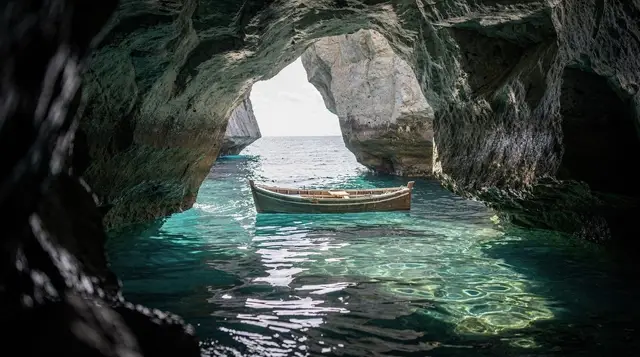
Renting a car for a day is the simplest way to string together several villages and a seafood lunch without waiting on bus timing, and it also opens up the wider loop through Dobrota, Perast, and Risan at your own pace. If you’d rather not manage logistics at all, a boat-based day out such as a three-hour Boka Bay boat trip covering the Blue Cave and Our Lady of the Rocks covers much of the same water without requiring you to arrange transport, parking, or restaurant bookings yourself; you’d still want to plan a separate stop for the meal, since these boat trips don’t typically include a full seafood lunch on land.
The bottom line
The oysters and mussels of Boka Bay aren’t trying to compete with famous French names, and they don’t need to. They’re a small, local, rope-grown product tied to one specific geographic quirk, a freshwater spring meeting the sea near Ljuta, and best eaten within sight of the water they came from, at one of the modest family-run restaurants strung along the coast between Kotor and Perast rather than at a old town terrace with a bay view and a markup to match. Build in an extra 20 to 30 minutes of driving or a taxi fare, and you’ll eat better and pay less than you would inside the walls.
Kotor food & drink tours on GetYourGuide
Verified deep-linked GetYourGuide tours. Book through these links and we earn a small commission at no cost to you.
GetYourGuide does not provide a product photo for this activity — the image shows the meeting point, photographed by us.