Budva versus Kotor: which one to sleep in
Budva sits on the open Adriatic coast, about 35–40 minutes south of Kotor by road, and it runs on a different rhythm entirely. Where Kotor closes down after the cruise crowds leave and the bay goes quiet by 9pm, Budva’s promenade and beach clubs are only getting started. If you are choosing where to base yourself for a Montenegro trip, this is the real question, and the honest answer depends on what you actually want from your evenings.
Kotor gives you the Bay of Kotor’s mountains-into-water scenery, a walkable UNESCO old town, and easy access to Perast, Our Lady of the Rocks and the fjord-like drive up to Lovćen. It is quieter, cheaper outside the cruise-ship hours, and a better base if you plan to explore inland. Budva gives you sand beaches instead of shingle, a livelier promenade, and the coast’s concentration of clubs and late bars. Neither is wrong; they serve different trips. Plenty of visitors do both — a night or two in Budva bookending a longer stay in Kotor — rather than treating it as an either/or choice.
If you’re still undecided, the fuller comparison is in our guide to Kotor versus Budva as a base. The short version: pick Kotor if mornings matter to you, pick Budva if your evenings do.
Getting there from Kotor
The coast road from Kotor to Budva takes 35–40 minutes in normal traffic, longer in the peak of August when the corniche backs up near Budva’s entrance. It’s a straightforward drive with no border crossing and none of the switchback intensity of the old road to Njeguši — this route hugs the shoreline rather than climbing a mountain.
Coastal buses connect Kotor and Budva regularly through the day, continuing on to Bar and Ulcinj in one direction and Herceg Novi in the other. There’s no centralised online booking system for Montenegrin buses, so you buy tickets at the station or on board; frequency is generous enough on this stretch that you rarely wait long. Taxis are the fastest option but insist on the meter or agree a price before you get in — a habit worth keeping anywhere on this coast, not just in Budva.
Parking in Budva’s centre is tight and paid in summer, much like parking in Kotor. If you’re driving, aim for one of the pay car parks near the marina rather than circling the old town looking for a space.
For an easier first look at the coastline, several boat tours run from Kotor down to Budva and back, which avoids parking altogether and adds the Bay of Kotor and Budva Riviera coastline to the same day. The boat trip along the coast to Budva covers that route by water instead of road.
Budva old town in an hour or two
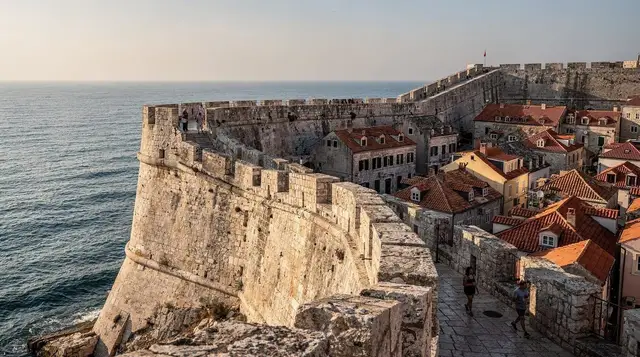
Budva old town is genuinely old — settlement here goes back over two millennia — but what you walk through today is mostly reconstruction. The 1979 earthquake that reshaped Kotor’s cathedral towers hit Budva hard too, and a large share of the old town’s walls and buildings were rebuilt afterwards rather than simply repaired. It’s smaller and less architecturally cohesive than Kotor’s old town as a result.
That doesn’t make it not worth an hour’s walk. The citadel at the seaward end has good views over the old town roofs and out to Sveti Nikola island, and the narrow lanes hold enough small squares, churches and seafront cafés to justify the detour if you’re already in town for the beach or the evening. It is not worth a dedicated day trip on its own if Kotor’s old town is the comparison point — go for the beach and nightlife, and treat the old town as the daytime add-on. Our walking guide to Budva old town covers a sensible one-hour loop.
The beaches: sand, not shingle
This is the practical difference that matters most for a lot of visitors. Inside the Bay of Kotor, beaches are mostly shingle, concrete platforms or rock, with the occasional imported-sand patch. Around Budva, the coastline turns to genuine sand and fine gravel, which is a large part of why families and beach-focused travellers gravitate here instead.
| Beach | Type | Character |
|---|---|---|
| Mogren | Sand, two coves | Closest to the old town, gets crowded by mid-morning in summer |
| Jaz | Sand, long stretch | Bigger and less packed than Mogren; occasional festival use |
| Bečići | Fine gravel and sand | Long promenade, resort hotels, family-oriented |
| Rafailovići | Sand | Quieter than Bečići, short walk from Bečići’s strip |
| Sveti Nikola island | Sand | Reached by small boat taxi from the mainland, less crowded |
Sun umbrellas and loungers are paid and can fill up by mid-morning in July and August. If you want space rather than a scene, arrive before 9.30am or head slightly further along the coast to Petrovac, which stays calmer than the beaches directly in front of Budva.
Nightlife: where the coast gets loud
Budva is where Montenegro’s coastal nightlife concentrates. The promenade fills with bars from early evening, and a cluster of beach clubs along Bečići and the Budva waterfront run music and dancing into the early hours through July and August. This is the single clearest reason to choose Budva over Kotor as a base: Kotor’s old town has restaurants and a handful of bars, but nothing on this scale, and locals there would rather it stayed that way.
If nightlife is the point of your trip, staying in or near Budva means you’re not driving back late on the coast road, and you’re not disturbing (or being disturbed by) a residential old town that isn’t built for it. Outside July–August the scene thins out considerably — plenty of clubs operate on reduced schedules or close for the season, so if the nightlife is your reason for coming, high summer is when it delivers. Full details are in our Budva nightlife guide; for a slower, café-and-terrace evening rather than clubs, Kotor’s own nightlife is the calmer alternative a short drive away.
Sveti Stefan: photograph it, don’t expect to enter
The postcard view most people associate with this stretch of coast — the fortified islet joined to the mainland by a narrow sand causeway — is Sveti Stefan, a few kilometres south of Budva. It has operated as an ultra-exclusive resort since the 1960s, and since 2021 it has been closed to the public entirely. There is no ticket, no tour and no way to walk onto the islet as a visitor, whatever older guidebooks or blog posts suggest.
What you can do is view it from the road above (there’s a marked viewpoint) or from Milocer beach next door, which gives a closer, sea-level look and a place to swim while you’re there. Our Sveti Stefan viewpoint guide covers both spots, and the longer story of why the resort closed to outsiders is in Sveti Stefan: you can’t visit.
Day trips and boat tours from Budva
Budva’s position on the open coast makes it a workable base for boat trips along the Budva Riviera and back towards the Bay of Kotor, as an alternative to basing those same trips out of Kotor itself. The Budva Riviera boat tour covers the coastline south of town, including views of Sveti Stefan from the water, while a combined day covering Kotor, Perast and Budva works well if you’re staying in Budva but still want the Bay of Kotor’s islands and old town in the same trip.
For something more active than a coastal cruise, canyoning trips run inland from the Budva area into the Krapina canyon, and paragliding operators launch tandem flights over the old town and coastline on clear days — both are activities you won’t find based out of Kotor itself. Inland, private day tours combining Lovćen, Cetinje and Budva let you cover the old royal capital and the national park’s viewpoints on the same day you return to the coast for the evening; that combination is covered by the private tour to Lovćen, Cetinje and Budva.
Prices in high season
Expect Budva to run noticeably above equivalent Kotor prices in July and August, particularly for beachfront rooms and anything sold directly on the promenade. Outside those two months the gap narrows substantially, and shoulder-season Budva can be close to Kotor pricing for accommodation.
| Item | Budva, July–August | Budva, shoulder season |
|---|---|---|
| Coffee | €1.50–2.50 | €1.20–2 |
| Beer (Nikšićko) | €3–5 | €2.50–4 |
| Restaurant main, non-touristy | €9–17 | €8–14 |
| Sunbed and umbrella (beach) | €10–25 for the pair | €8–15 for the pair |
| Apartment, night | €60–120 | €35–60 |
| Beach club entry / minimum spend | €20–50+ | Often closed or reduced hours |
Restaurants directly on the promenade or overlooking the beach charge a premium over anything a couple of streets back, the same pattern you’ll find on Kotor’s old town waterfront.
When to visit and when to avoid it
June and September give you sea warm enough to swim (roughly 23–26°C through the summer months) without the peak-season crowding or prices. Mid-July to mid-August is when Budva is at its most crowded, loudest and most expensive — which is exactly what some visitors are travelling for, and exactly what others are trying to avoid by staying in Kotor instead.
Outside the summer season, a large share of Budva’s clubs, beach bars and seasonal restaurants close entirely, and the town reverts to a much quieter Montenegrin coastal town. If you’re visiting between November and March expecting any of the nightlife described above, you’ll be disappointed — that side of Budva is a June-to-September phenomenon.
Budva FAQ: nightlife, beaches and staying versus visiting
How far is Budva from Kotor and how do I get there?
It is about 35–40 minutes by car or bus along the coast road. There is no railway. Buses run regularly between Kotor and Budva through the day, though there is no centralised online booking, so turning up at the station works as well as pre-booking.
Should I stay in Kotor or Budva?
Stay in Kotor if you want the Bay of Kotor scenery, a quieter old town and easier day trips inland. Stay in Budva if nightlife, sand beaches and a livelier promenade matter more than sleep and lower prices, especially outside July and August.
Is Budva more expensive than Kotor?
In July and August, yes, noticeably. Beachfront accommodation, club entry and drinks on the promenade all run higher than equivalent options around the Bay of Kotor. Outside high season the gap narrows a lot.
Can I visit Sveti Stefan from Budva?
You can view it from the road above or from Milocer beach next door, but the resort itself has been closed to the public since 2021. There is no way to walk onto the islet or through the village as a day visitor.
Are Budva’s beaches sand or pebble?
Mostly sand and fine shingle, which is the main practical difference from the rockier shoreline around Kotor inside the bay. Mogren and Jaz are the better-known sand beaches near the old town.
Is Budva old town worth seeing if I’ve already seen Kotor’s?
It is smaller and less complete than Kotor’s old town, with more of its walls rebuilt after the 1979 earthquake. Worth an hour if you are already there for the beach or nightlife; not worth a special trip on its own merits.
When is Budva at its loudest?
Mid-July through August, when the promenade and beach clubs run at full volume into the early hours. June and September are calmer while the sea is still warm enough to swim.