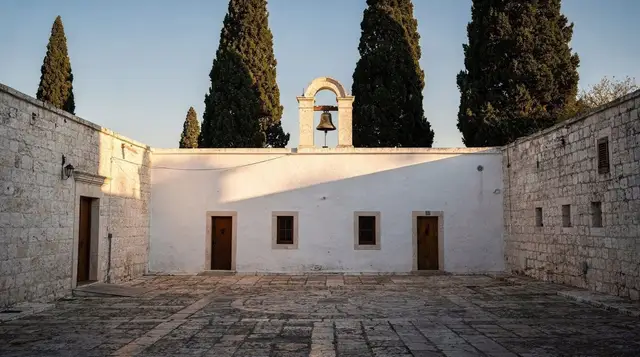
Perast without the crowds
How do you visit Perast without the crowds?
Arrive before 9am or after 6pm, when the day-trip buses from Kotor and Budva have not yet arrived or have already left. The village is a single waterfront street with no side roads, so midday between 11am and 4pm means shoulder-to-shoulder pavement outside the two main churches. Climbing St Nicholas's bell tower gives an uncrowded view over Our Lady of the Rocks and St George regardless of the hour.
Why Perast turns into a bottleneck between 11am and 4pm
Perast is 12km and about 20 minutes up the coast from Kotor, and that proximity is exactly the problem. It’s the single most photographed stretch of the Bay of Kotor, thanks to two small islets sitting just offshore, and every operator running a boat, coach or shore excursion out of Kotor or Budva knows it. Cruise passengers land at Kotor’s port, and a large share of the shore programmes sold that morning include a stop in Perast on the way to or from somewhere else. Independent day trippers from Budva add to the same window, because nobody leaves their hotel before breakfast finishes around 9am, and the drive along the coastal road takes 30-35 minutes from there.
The result is a fairly predictable rush that builds from about 10.30am, peaks between 11am and 4pm, and tails off by 5.30-6pm as coaches head back for dinner reservations in Kotor or Budva. Outside that window, Perast is a different place: quiet enough to hear the water against the sea wall, with room to actually look at the baroque façades rather than the back of someone’s head.
None of this is a secret to residents. Cafés along the front adjust their staffing around the same hours, and boat operators at the jetty know their busiest sales window matches the coach arrivals almost to the minute.
The one street that decides everything
What makes crowding in Perast worse than in a larger town is its layout. There is no grid, no back lanes, no alternative route: the whole settlement is a single waterfront street running along the base of the hill, with the church towers and a scatter of stone stairways as the only vertical relief. Once a coach group of thirty or forty people fills that street, there is no side passage to duck into and no parallel lane to overtake on. You either walk behind the group at their pace or you wait.
This is different from Kotor’s old town, which has enough interlocking lanes that a crowd at the Sea Gate doesn’t necessarily mean a crowd at the cathedral three minutes later. In Perast, one bottleneck is the whole bottleneck. It’s also why the crowding problem has a genuinely simple fix: since there’s only one street, and it fills and empties on a fairly fixed schedule tied to coach timetables, timing your visit outside that schedule solves nearly the entire problem in one move.
Two windows that actually work
Before 9am. The first coaches from Kotor and Budva rarely arrive before 10am, and cruise-linked excursions typically depart the ship terminal around 9-9.30am at the earliest, so anything before 9am is close to guaranteed quiet. The light is also better for photography at this hour, coming across the bay rather than glaring off the water, and the two or three cafés that open early will have tables free on the front rather than a queue.
After 6pm. By 5.30-6pm most organised groups have left for dinner reservations elsewhere, and the street empties out again. This is also when the stone façades pick up warm evening colour, and if you’re staying anywhere in the Bay of Kotor area, an evening drive or the coastal bus back is a reasonable way to end the day. The one trade-off: the small museums and the church interiors close by early evening, generally by 6-7pm depending on the season, so this window suits the street and the view but not the indoor sights.
Midday isn’t dead time if you have no other choice — it’s simply the version of Perast with a crowd in every photo and a short queue for the boat to Our Lady of the Rocks.
When Perast is busy versus quiet
| Time window | What to expect |
|---|---|
| Before 9am | Empty street, early cafés only, best light for photos |
| 9am - 10.30am | Filling gradually, still comfortable |
| 11am - 4pm | Peak coach and boat traffic, narrow street feels packed |
| 4pm - 6pm | Thinning out, groups departing |
| After 6pm | Quiet again, but museums and church interiors closed |
Climb St Nicholas’s bell tower for a crowd-free view
St Nicholas’s Church anchors the middle of the waterfront, and its bell tower is the one part of Perast that stays relatively empty even in the thick of the afternoon rush, simply because most people on a tight coach schedule don’t climb it. The staircase is narrow and turns tightly, so it isn’t for anyone uneasy on steps, but it’s a fraction of the effort of the climb up to the San Giovanni fortress above Kotor. From the top platform you get a direct, uncluttered view down onto both islets — Our Lady of the Rocks and St George — laid out side by side in the water, which is the view most people come to Perast for in the first place, minus the crowd standing at street level trying to get the same shot.
Entry to the tower is a small paid ticket, usually bought at the church or an adjoining counter, and it’s worth pairing with a look inside the church itself, which holds a modest collection of maritime paintings and silver reflecting Perast’s history as a captains’ town. For more on that history, the story of the Boka’s 18th-century sea captains explains why a village this small produced enough wealth to build baroque palaces three and four storeys high.
If the tower is included in a combined ticket with the maritime museum on your visit, buying it there rather than separately can save both money and a second queue.
Our Lady of the Rocks: seeing the islets without the boat queue
The more famous of the two islets, Our Lady of the Rocks, is artificial — built up over centuries as sailors and later residents deliberately sank rocks and old ships around a submerged reef until an islet with a church on it emerged. The neighbouring islet, St George, is natural and belongs to a monastery; it isn’t generally open to visitors, so most boat trips circle it rather than landing.
Small taxi boats run from the Perast jetty out to Our Lady of the Rocks for a few euros each way, and this is where the midday crowding shows up most directly: queues at the jetty can run 15-20 minutes deep between 11am and 3pm as coach groups arrive in batches. Outside that window the boats run on demand with little or no wait.
If you’d rather not manage the crossing yourself, a guided boat tour bundles the crossing with commentary on the islet’s construction and the small museum inside the church, which holds an unusual collection of votive silver plaques left by sailors and their families over the centuries. Our full sunset boat tour to Our Lady of the Rocks guide covers timing this for the golden-hour light rather than the midday crush.
For the fullest walkthrough of what’s inside and how the islet was actually built, the dedicated Our Lady of the Rocks visit guide goes further than this page can.
Getting to Perast from Kotor, Budva and beyond
Perast sits on the coastal road that rings the entire bay, so getting there is straightforward from most bases; the complication is timing your arrival to dodge the coach convoys rather than the drive itself.
| From | Distance / time | Notes |
|---|---|---|
| Kotor | 12km / ~20 min | Coastal road, some coach traffic mid-morning |
| Budva | ~30-35 min | Via the coastal road around the bay |
| Tivat | ~25-30 min | Via Dobrota and the northern shore |
| Herceg Novi | ~30-35 min | Fastest without using the Kamenari-Lepetane ferry |
| Risan | ~10 min | Just around the head of the bay |
Self-driving gives the most control over timing, since you set your own departure and can leave before 8am to catch the empty window. Public buses run along the coast between Kotor, Perast, Risan and beyond, though schedules are not centrally bookable and services thin out outside peak season — check current times locally rather than relying on an old timetable. Our car rental guide and the buses in Montenegro guide both cover the practical side of getting around the bay without joining an organised coach.
If you’re coming specifically to avoid the day-trip crowd, note that most organised tours combining several bay stops — the Kotor, Perast and Budva highlights circuit among them — are built around exactly the 11am-4pm slot you’re trying to avoid, since that’s when transport and guides are available. Booking one still gets you a comfortable, guided visit; just don’t expect it to be a quiet one.
Where to eat and stay without old-town prices
Perast has a handful of waterfront restaurants and cafés, and prices track the view rather than the food: a coffee or a plate of grilled fish directly on the front, with the islets in frame, costs more than the same order a street back or in nearby Risan or Dobrota, both a short drive away and considerably less visited. If you’re staying in the bay rather than just passing through, Kotor and Tivat have the widest range of accommodation and let you treat Perast as a short, well-timed stop rather than a base in itself — there simply isn’t much lodging capacity in Perast to support a multi-night stay comfortably in high season.
For the archaeology-minded, a stop at Risan on the way back to Kotor adds Roman-era mosaics with a fraction of Perast’s visitor numbers; the Roman mosaics guide and the museum-entry ticket covering both sites, the combined Perast and Risan mosaics ticket, make it easy to see both without buying separate tickets.
A half-day plan that skips the crush
Leave Kotor by 8am, park near the church end of the waterfront (spaces are limited but manageable at that hour), and walk the street end to end while it’s still empty — 20 minutes at a relaxed pace. Climb St Nicholas’s bell tower for the islet view, then take a taxi boat out to Our Lady of the Rocks before the queue forms, aiming to be back on dry land by 10.30-10.45am as the first coaches start arriving. Have coffee on the front once you’re done rather than before: by the time you sit down, you’ll have the good light and the empty street behind you, and you can watch the crowd arrive from a table instead of standing in it.
If you’d rather have someone else handle the logistics, a guided option that includes the boat crossing and museum entries in one booking, such as the relaxed 1.5-hour Kotor old town, Perast and Our Lady of the Rocks tour, removes the need to time the jetty queue yourself, though it still typically departs within the midday window rather than at dawn.
For a longer look at the whole bay rather than just Perast, the Kotor Bay by boat itinerary and the Kotor Bay boat tour guide both set Perast in the context of a fuller day on the water, and our broader notes on cruise-ship days in Kotor explain how to read the cruise calendar before you plan any stop in the bay, Perast included. For more on what else counts as city sightseeing around the bay, see the city sightseeing category.
Frequently asked questions about visiting Perast without the crowds
What time should I visit Perast to avoid crowds?
Before 9am or after 6pm. Coaches from Kotor and Budva, plus taxi boats from the cruise port, cluster between 11am and 4pm, which is exactly when the single waterfront street fills up.
How long does it take to see Perast?
The street itself takes 20-30 minutes end to end. Add 30-45 minutes if you climb St Nicholas’s bell tower and browse the maritime museum, and another 20-30 minutes for the boat out to Our Lady of the Rocks.
Is the bell tower of St Nicholas’s Church worth climbing?
Yes, it’s the one thing in Perast that stays uncrowded even at midday, since most visitors don’t go up. The narrow stairs open onto a platform with a direct view of both islets and the full curve of the bay.
Can I walk to Our Lady of the Rocks from Perast?
No, it’s an artificial islet a few hundred metres offshore, reachable only by boat. Small taxi boats run from the jetty in season for a few euros each way, or you can join a guided boat tour that includes the crossing.
Is Perast a day trip from Kotor or Budva?
It’s a short stop rather than a full day trip: 12km and about 20 minutes from Kotor, roughly 30-35 minutes from Budva. Most visitors combine it with Kotor old town or a wider Boka Bay itinerary rather than dedicating a whole day to it alone.
Where do the Perast crowds actually come from?
Mostly organised excursions: cruise-ship shore programmes out of Kotor, group tours pairing Perast with Kotor and Budva, and self-driven day trippers who all converge around late morning once breakfast is done and the coastal road has warmed up.
Is there anywhere to escape the crowds within Perast itself?
The bell tower, as above, and the far southern end of the waterfront past St Nicholas’s Church, where the street narrows and most coach groups don’t bother walking. The museum interiors also thin out the crowd since not everyone pays to go in.
Does Perast get cruise ship crowds too?
Indirectly. Cruise passengers disembark in Kotor, not Perast, but many shore excursions bus them the 12km up the coast, so Perast’s midday crush tracks the cruise calendar almost as closely as Kotor’s old town does.
City sightseeing tours on GetYourGuide
Verified deep-linked GetYourGuide tours. Book through these links and we earn a small commission at no cost to you.
GetYourGuide does not provide a product photo for this activity — the image shows the meeting point, photographed by us.