Budva vs Sveti Stefan: which base fits your trip
Should I stay in Budva or near Sveti Stefan?
Budva is a busy resort town with bars, a walkable old town and a wide public beach, at ordinary Montenegrin coastal prices. Sveti Stefan itself is a closed luxury hotel islet you cannot enter without a room key or a beach club booking; staying in that pocket of coastline costs several times more than Budva for a much quieter, more private stretch of sand at Milocer.
Budva and Sveti Stefan sit 8 kilometres apart on the same stretch of Montenegrin coast, and from a car window they can look like variations on the same theme: red-roofed stone, turquoise water, cypress trees leaning over the road. Up close they are not comparable at all. One is a working resort town of roughly 20,000 people with a walled old town, a marina, and a nightlife strip that runs loud from June to September.
The other is a single hotel occupying a fortified islet that ordinary visitors have not been able to enter since 2021, ringed by a stretch of private beach that charges accordingly. Choosing between them as a base is really a choice between a lively, affordable coastal town and a very expensive pocket of exclusivity next door to it.
This guide sets out what each place actually offers, what a night costs in each, and who ends up happier basing themselves in one over the other. If you are coming from Kotor and only have a day to spare, the honest answer for most people is: base in Budva, and see Sveti Stefan on a half-day trip down the coast.
What Budva actually is
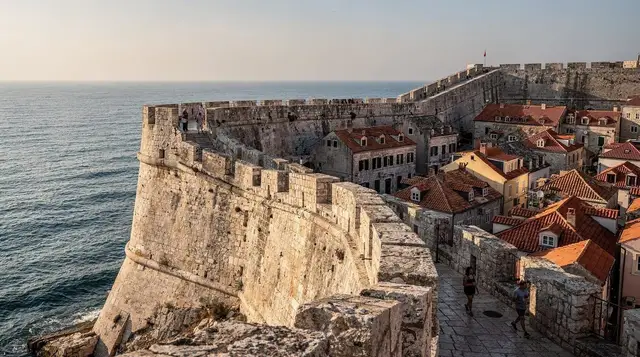
Budva’s old town sits on a small walled peninsula, considerably smaller than Kotor old town and less atmospheric by day, since a 1979 earthquake flattened much of it and the rebuild is closer to a careful reconstruction than an original medina. Where Budva wins is at night: the citadel and the stone lanes fill with restaurant tables, the harbour promenade fills with strolling crowds, and the bars around the marina and Slovenska Plaza run until 2 or 3am in July and August. If nightlife and a beach town atmosphere are what you want, this is the destination on this stretch of coast that delivers it; nowhere near Kotor does.
Budva’s beaches are its second draw. Mogren, split into two coves just past the old town walls, has clear water and a short scenic walk to reach; Slovenska Plaza is the long, wide, developed strip lined with sunbed concessions that most package visitors end up on. None of it is a hidden gem by any definition, and in August it is genuinely crowded, but it is also genuinely swimmable and well served by cafes, showers and lifeguards.
Accommodation in Budva spans the full range: hostel dorms, self-catering apartments in the surrounding blocks, three and four-star hotels along the seafront. This range is exactly what keeps prices reasonable. A family of four can find a functional apartment for the price of one night at Sveti Stefan.
| Budva | Sveti Stefan area | |
|---|---|---|
| What it is | Resort town, walled old town + marina + beach strip | Single luxury hotel islet + Milocer estate |
| Can you walk in freely | Yes, everywhere | No, islet is guests-only |
| Nightlife | Loud, bars to 2-3am in season | Quiet, resort-contained |
| Double room, August | roughly 90-180 EUR | often 500 EUR+ |
| Double room, shoulder season | roughly 30-100 EUR | still high, resort rarely discounts deeply |
| Beach access | Free public beaches (Mogren, Slovenska Plaza) | Public stretch of Milocer beach free; managed section paid |
| Best for | Nightlife, budget flexibility, walkable base | A splurge night, total quiet, privacy |
What Sveti Stefan actually is
Sveti Stefan is a fortified islet joined to the mainland by a narrow sand causeway, built up over centuries as a fishing village before Yugoslavia’s socialist government turned the whole islet into a state-run luxury hotel in the 1960s. It closed for renovation, reopened under an international hotel operator, and since 2021 it has functioned strictly as a guests-only resort. The causeway gate is staffed, and no amount of asking gets a non-guest across it. If your idea of Sveti Stefan is walking its lanes and photographing the rooftops from inside, that trip does not exist anymore for anyone who is not paying for a room.
What does exist is the view, and it is a genuinely good one: a small hill above the causeway on the main road gives a clean postcard angle over the islet and the bay, and it is free and always open. Milocer beach, directly beside the causeway, gives a closer, sea-level view while you swim, and this is where almost all non-guests end up spending time. Read the Sveti Stefan viewpoint guide for exact spots and how to get there without a car.
Staying at the Sveti Stefan hotel itself, or at the affiliated Villa Milocer next door, means high-season rates that routinely clear 500 euros a night and can run several times that for the better rooms and suites. What you are paying for is privacy and quiet rather than more square metres or better food than a good Budva hotel: the islet holds a small number of rooms, the beach clubs are not crowded, and there is effectively no nightlife noise, because there is no nightlife on site beyond the hotel’s own restaurants and bar.
The real cost gap
This is the part worth being blunt about, because online write-ups tend to blur it. Sveti Stefan is not a moderately pricier version of Budva. It is a different tier of spending entirely.
A mid-range apartment in central Budva in August runs 50 to 100 euros a night; a three or four-star hotel room runs 90 to 180 euros. Outside July and August, both drop by roughly a third to a half. Food follows the same pattern: a plate at a non-touristy restaurant in Budva runs 8 to 15 euros, a coffee 1.20 to 2 euros, a Niksicko beer 2.50 to 4 euros, all fairly ordinary Montenegrin coastal prices.
A room at the Sveti Stefan hotel starts well above 500 euros a night in high season and the top suites go considerably higher, with a similar story at the Villa Milocer. Dinner at the resort’s restaurants is priced to match. Even non-guests who only want a sunbed on the managed section of Milocer beach pay a rate that would cover a full day’s food budget in Budva. None of this is unusual for a five-star resort anywhere in the Mediterranean; it is simply worth stating plainly rather than letting “luxury” stand in for a number, since the gap between the two towns is closer to five or ten times than “a bit more.”
Who should base where
Base in Budva if nightlife matters, if you are travelling on an ordinary holiday budget, if you want to walk to restaurants and a beach without driving, or if you are exploring the coast and the Bay of Kotor together and need something central and well connected by bus. Most travellers doing a one-day Kotor visit combined with a coastal loop end up in or near Budva by default, because it has the accommodation stock and transport links the smaller villages do not.
Consider paying for a night near Sveti Stefan only if the point of the trip is specifically that kind of quiet, expensive privacy, or if it is a one-night splurge bookended by cheaper stays elsewhere. Doing one night at the Sveti Stefan hotel or Villa Milocer as the highlight of an otherwise budget trip is a reasonable way to use the price gap rather than fighting it: most people who try to stay there for a full week end up spending as much as the rest of the trip combined.
There is also a genuine middle ground. Becici and Rafailovici, the developed beach strip between Budva and Sveti Stefan, offer calmer nights than the old town at similar prices to Budva, with an easy walk to both the beach and, further along, the Sveti Stefan viewpoint. For travellers who want quiet without the five-star bill, this stretch is worth checking before assuming the choice is only Budva or the islet itself.
If you are still weighing Budva against staying put on the bay, the Kotor vs Budva base comparison looks at the same question from the other side. Budva’s own highlights are covered in the Budva old town guide, and the Budva destination page and Sveti Stefan destination page give the short version of each place. Evenings out are covered in the Budva nightlife guide, and for the sea itself, Mogren beach is the one most visitors walk to first. If the story of the islet interests you more than a night in it, Sveti Stefan, the islet you can’t visit tells it.
Getting between the two
The drive from Budva to Sveti Stefan takes 25 to 30 minutes along the coast road, and it is one of the easier short drives on this part of the coast, nothing like the hairpins of the old road to Njegusi above Kotor. Coastal buses running the Budva-Petrovac-Bar route stop near the causeway; taxis from Budva’s centre are a straightforward flat run. Most visitors staying in Budva treat Sveti Stefan as a half-day trip: the viewpoint, a swim or lunch at Milocer, then back to Budva for the evening.
For a first coastal trip out of Kotor that puts both towns on one route, a Kotor to Perast, Budva and Sveti Stefan style day, booked through a tour or done independently by car, is the practical way to see both without committing a whole stay to either. If you have more time, the itinerary planner for 5 to 7 days around the bay leaves room for a Budva night and a Sveti Stefan afternoon without forcing a choice between them.
Booking a look at both
a half-day trip pairing Budva’s old town with the Sveti Stefan viewpoint is the simplest way to see both places without renting a car, and it drops you back in either Kotor or Budva by evening. For a slower look from the water, a boat trip past Sveti Stefan and the smaller Stefan and Katic islands gives a sea-level view of the islet that the road viewpoint cannot match. Travellers based further north can join a combined Kotor, Perast and Budva day tour that adds Sveti Stefan as a photo stop along the way, or take a more basic boat transfer to Budva and treat the Sveti Stefan viewpoint as a short add-on once there.
Budva vs Sveti Stefan: common questions
Can I still visit Sveti Stefan islet as a day tripper?
No. The islet has operated as a private hotel since 2021 and the causeway gate is guarded. You can walk down to the public viewpoint above it or photograph it from Milocer beach, but you cannot cross onto the islet without being a hotel guest.
Is Budva too noisy for a relaxed holiday?
The old town and the strip behind Mogren and Slovenska Plaza get loud from June to September, with bars running past midnight. Quieter apartments exist a 10 to 15 minute walk inland or toward Becici, so noise depends on exactly where you book, not just the town.
How much more expensive is Sveti Stefan than Budva?
A double room in central Budva in August typically runs 90 to 180 euros in a mid-range hotel, versus 30 to 100 euros outside peak season. Rooms at the Sveti Stefan hotel and the Villa Milocer routinely start well above 500 euros a night in high season, and beach club sunbeds at Milocer add a separate charge on top.
Can I stay in Budva and still see Sveti Stefan?
Yes, easily. The islet is a 25 to 30 minute drive or coastal bus ride south of Budva, and most visitors do exactly this: base in Budva for the nightlife and beaches, then take a half-day trip down the coast to view Sveti Stefan and swim at Milocer or Kamenovo beach nearby.
Is Milocer beach open to non-guests?
Milocer beach, between Budva and Sveti Stefan, has both a public stretch and a paid beach club section tied to the resort. Non-guests can use the public part for free but pay for sunbeds and shade in the managed section, which is considerably pricier than an ordinary public beach further up the coast.
Which is better for families, Budva or Sveti Stefan?
Budva suits families on an ordinary budget: shallow water at parts of the main beach, shops and pharmacies within walking distance, and a wide choice of self-catering apartments. Sveti Stefan suits families only if the hotel budget is not a constraint, in exchange for calm private beaches and none of the old town crowds or nightlife noise.
Is there a middle option between the two?
Becici and Rafailovici, the beach strip between Budva and Sveti Stefan, offer calmer nights than central Budva at similar prices, with an easy walk or short drive to both the old town and the Sveti Stefan viewpoint.
Popular Kotor experiences on GetYourGuide
Verified deep-linked GetYourGuide tours. Book through these links and we earn a small commission at no cost to you.
GetYourGuide does not provide a product photo for this activity — the image shows the meeting point, photographed by us.