Buses in Montenegro: routes, prices and timetables from Kotor
Is the bus a practical way to get around Montenegro from Kotor?
Yes on the coast, where Kotor, Budva, Tivat and Herceg Novi have frequent buses in summer. Inland towns like Žabljak or Kolašin have far fewer departures, and online timetables are unreliable, so confirm times at the Kotor bus station a day ahead rather than trusting a website.
How the bus network actually works
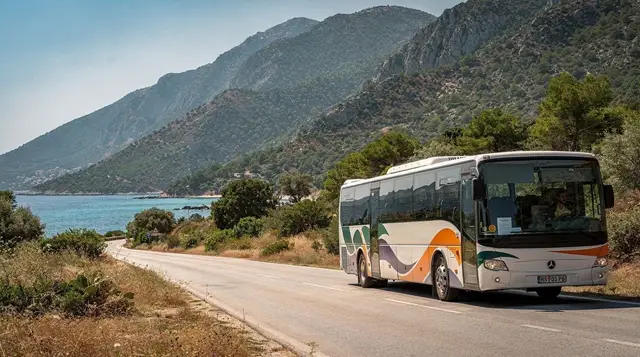
Montenegro’s inter-city buses are run by a handful of private companies rather than one national operator, which is the root of most of the confusion. There is no single app or website that reliably aggregates every route, price and departure time. What exists is a patchwork: some companies publish their own timetables online, some only post prices at the station, and third-party timetable sites often carry information that is a season or two out of date. None of this makes the network unusable — it just means the bus station itself, not a screen, is the source of truth.
The Kotor bus station sits just outside the old town walls, close to the market, a five-minute walk from the main gate. It is small: a ticket hall, a handful of stands, and boards that show same-day departures rather than a full weekly grid. For coastal routes this is enough, because buses run often and you rarely wait more than an hour even without a ticket in hand. For inland or cross-border routes, arriving with no plan and hoping for the best is a weaker strategy.
Confirm at the window, not online
This is the piece worth repeating: whatever a website says about a Kotor to Žabljak or Kotor to Dubrovnik departure time, treat it as approximate until you have checked at the station. Montenegrin operators adjust schedules by season, sometimes by month, and the update rarely reaches every timetable site that indexed the old numbers. The practical fix costs nothing — walk to the Kotor station the afternoon or evening before you travel, ask at the ticket window for the actual departure time and price for your route, and buy the ticket there if the route is not a frequent coastal one. Staff usually speak enough English for this exchange even if the printed board does not.
For same-day coastal travel — Kotor to Budva or Kotor to Tivat, for instance — this matters less, since a bus leaves roughly every half hour to hour through the summer and you can simply turn up.
Coastal routes: frequent and cheap
The coastal corridor is the strongest part of the network, and it is genuinely a good budget option here. In peak summer, buses connect Kotor with Budva, Tivat and Herceg Novi at intervals of roughly 30 to 60 minutes during the day, thinning out but not disappearing outside July and August.
| Route | Journey time | Typical price | Frequency (summer) |
|---|---|---|---|
| Kotor to Budva | 40–60 min | 3–5 EUR | Every 30–60 min |
| Kotor to Tivat | 20–30 min | 2–4 EUR | Every 30–60 min |
| Kotor to Herceg Novi | 45–70 min | 4–6 EUR | Every 45–60 min |
| Budva to Petrovac | 25–40 min | 3–5 EUR | Every 45–60 min |
| Kotor to Podgorica | 1 h 30–2 h | 7–10 EUR | Roughly hourly |
Prices are close to what you would pay for parking a rental car for the same time in Kotor, which is part of why the bus makes sense for a single day trip along the coast rather than a full self-drive loop. Note that the Kotor to Herceg Novi bus takes the road around the bay rather than the Kamenari-Lepetane ferry, so it is not necessarily faster than driving and using the crossing yourself.
Inland routes: thinner and slower to check
Once you leave the coast, the picture changes. Buses to Podgorica run close to hourly and are reliable, since Podgorica is the country’s transport hub and most routes pass through or near it. Beyond that, frequency drops fast.
Kotor to Žabljak, the base for Durmitor National Park, is not a route you can assume exists on a given day outside the main July-to-September season, and even in season it may mean one or two departures, sometimes with a change in Podgorica. The same caution applies to Kolašin and Pljevlja. If Durmitor is a fixed point on your itinerary, do not build the plan around a bus you have not personally confirmed at the Kotor window, or better, at the Podgorica station where connections originate.
Buses toward Cetinje exist and are frequent enough, but they typically run via Podgorica or Budva rather than over the old Njeguši road, so they will not drop you at the Njegoš mausoleum or the Lovćen National Park viewpoints. For that route, a car, a taxi, or an organised tour covers ground the bus network was not built to serve — see the Njeguši village guide for what the drive itself involves.
Cross-border buses: Dubrovnik, Podgorica airport, and beyond
At least one daily bus connects Kotor with Dubrovnik, scheduled at roughly two and a half to three hours. The scheduling is the easy part; the border is not. At Debeli Brijeg, the main crossing on this route, July and August queues regularly run 2 to 5 hours, worse on Saturdays, and a bus sits in that queue exactly like every other vehicle — it does not get priority lanes. If you are booking a Dubrovnik bus in high season, build in the possibility of arriving three hours later than the timetable says, and see the Dubrovnik day trip from Kotor guide for how that affects planning a single day across the border.
There is no direct bus between the coast and Tivat Airport or Podgorica Airport that is built specifically for air travellers with luggage in mind. Regular inter-city buses pass near both airports on some routings, but connections are not timed against flights, and dragging suitcases between a bus stop and a terminal is a poor trade against a fixed-price transfer. A private transfer such as the Podgorica airport to Budva one-way transfer removes that uncertainty entirely, which matters more for a flight than it does for a day out.
When the bus beats renting a car
The bus wins clearly for a single coastal errand: a day in Budva, a trip to Herceg Novi, or a one-way hop where you do not want to deal with parking in Kotor or a rental return. At 3 to 6 EUR a leg, it undercuts fuel plus parking plus the mental overhead of driving the narrow coast road in summer traffic.
It loses ground once your plan touches more than two or three fixed points inland, or requires an early start to beat cruise crowds somewhere specific. A Kotor to Montenegro highlights day trip with a guide or a private tour covers Lovćen, Cetinje and Njeguši in one outing that no public bus route replicates. For travellers weighing the two approaches across a whole trip, the Montenegro without a car itinerary and the broader car rental in Montenegro guide go through the trade-offs route by route.
For a guided alternative that removes both the driving and the timetable-checking, a day out with a Kotor and Budva guided tour covers the same coastal ground the bus does but on a fixed schedule with a driver, which suits anyone travelling with limited time or without patience for a station ticket window.
Practical notes for using the Kotor bus station
Tickets are usually bought at the counter rather than online, in cash, though card acceptance has improved at the main window in recent years — carry euros as a backup regardless, since Montenegro uses the euro despite being outside the EU. Left luggage is limited, so do not plan on storing bags for a full day.
Buses on the coastal route can fill in August, particularly the late-morning and early-evening departures when day-trippers and commuters overlap. Arriving 15 to 20 minutes before a coastal departure is usually enough; for a longer or less frequent inland route, arriving earlier, and having already confirmed the time the day before, avoids the situation of watching a half-empty bus leave because the version you saw online was for the wrong month.
If your itinerary includes a cross-border leg to Mostar or into Albania, dedicated coach services exist on some days but are far less frequent than the domestic coastal routes, and the same rule applies twice over: check at the window, and expect the timetable to be seasonal even when the website does not say so. For a single day trip that swaps schedule risk for a fixed itinerary, a private tour from Montenegro to Dubrovnik with transfer sidesteps the bus timetable question altogether, at a higher price than a station ticket but with a guaranteed return time.
Reading the station like a local
A few small habits make the Kotor station far less intimidating. Look first at the board for same-day departures, then compare it with what the ticket window tells you: the two do not always match, and the person behind the glass knows which company actually runs the route this week. If the destination you want is not on the board, ask anyway. Some services are posted only at the window, and a polite question often turns up a departure that no screen mentions.
Different companies sell their own tickets, so the stand a bus leaves from can change from one day to the next. Ask which stand your bus uses when you buy the ticket, and check again a few minutes before departure rather than assuming yesterday’s arrangement still holds. Drivers are generally happy to confirm the destination if you show them your ticket, which is a simple way to avoid boarding the wrong vehicle when two buses stand side by side.
Luggage usually goes in the hold underneath, sometimes with a small extra charge collected by the driver. Keep a few small coins or notes ready, because drivers do not always have change for a large banknote. Valuables and documents stay with you in the cabin, as on any bus in southern Europe.
Building a day around the bus
The most successful bus days from Kotor share one trait: they are short and anchored by a return you have already confirmed. Choose a single destination along the coast, check the last return departure when you buy your outbound ticket, and write it down. Evening services thin out sooner than most visitors expect, and missing the last bus turns a cheap day into an expensive taxi ride back.
Mornings are the best time to travel, both for temperature and for seats. Buses are calmer before the day-trippers set off, the coast road is quieter, and you arrive with the whole day ahead of you. If you want to see more than one place, pair neighbouring stops rather than jumping back and forth, since every extra leg is another timetable to verify and another queue to join.
In the shoulder seasons, expect fewer departures and plan with more margin. A route that felt effortless in August may run only a handful of times a day in spring or autumn, and some seasonal services stop entirely. This is exactly why the habit of confirming at the window matters most outside the summer peak, when websites are least likely to reflect reality.
Comfort, heat and the coast road
The coast road between the bay towns is scenic but slow when traffic builds, and a bus stuck in it feels every minute. Sit on the side facing the water if you want the view, and bring water, since a delay on a hot afternoon can stretch a short ride longer than planned. A light layer is worth carrying too, because air conditioning on a modern coach can be stronger than you expect after standing in the sun.
Motion sickness is worth a thought for anyone sensitive to winding roads, particularly on the bends around the bay and on mountain routes inland. Sitting near the front and keeping your eyes on the horizon helps. If you are travelling with children, a snack and something to do will make the ride easier, and the family guide to Kotor covers the wider picture of getting around with them.
When to give up on the bus
Part of using public transport well is knowing when it is no longer the right tool. If your plan depends on a precise arrival time, a flight, a booked tour start or a ferry, the bus adds a risk you can remove for a modest price. The same is true when you are carrying heavy luggage, travelling late at night, or heading somewhere the network barely reaches. In those cases a taxi or private transfer is not an indulgence but a sensible way to protect the rest of your trip.
Equally, a group of three or four people can find that sharing a ride erases the saving that made the bus attractive in the first place. Add up the real cost per person, including the time you spend waiting, before deciding. Often the answer is a mix: the bus for easy coastal hops, something private for the awkward legs, and a rental car only for the days that genuinely need one.
The bottom line
For getting up and down the coast between Kotor, Budva, Tivat and Herceg Novi, the bus is cheap, frequent enough not to plan around, and a reasonable default. For anything inland, cross-border, or timed against a flight, treat the online timetable as a starting point only, and confirm the real departure at the Kotor bus station ticket window a day ahead. That single habit avoids the majority of the frustration visitors report with Montenegrin buses, which is less about the buses themselves than about trusting a website that nobody has updated since last season.
Transport passes & transfers on GetYourGuide
Verified deep-linked GetYourGuide tours. Book through these links and we earn a small commission at no cost to you.
GetYourGuide does not provide a product photo for this activity — the image shows the meeting point, photographed by us.