A citadel built for a different kind of evening
Kotor and Budva share a Venetian building manual — thick stone walls, a sea gate, a warren of lanes too narrow for cars — and travel guides that lump them together as “the two old towns on the bay” are doing both a disservice.
Walk into Budva old town after dark and the contrast with Kotor’s old town is immediate: where Kotor is quiet stone and echoing footsteps by 9pm, Budva is restaurant terraces spilling into the alleys, music from three bars competing at once, and a queue forming outside a club that won’t close until the small hours. This page is about that contrast, not another pass through the architecture — for a room-by-room account of the walls and churches, see our Budva old town highlights guide.
The old town sits on a small rocky peninsula, with the modern town and its long beach fanning out behind it and a working marina tucked against the walls on the northern side. It is genuinely compact: a single loop of the lanes takes 15-20 minutes, against 30-45 minutes to cross Kotor’s much larger enclosure. What Budva lacks in scale it makes up for in density of things to eat, drink and buy per square metre, which is exactly why it functions as this coast’s evening destination rather than its daytime monument.
Layout: walls, marina, and the promenade
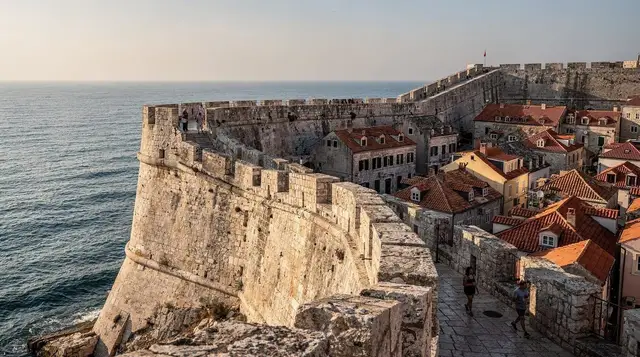
Budva’s fortifications were rebuilt and reinforced under Venetian rule between the 15th and 18th centuries, on top of a settlement that is considerably older — the town has been continuously inhabited since antiquity, one of the oldest urban sites on the Adriatic. Most of what stands today, though, reads as compact 18th-century Venetian citadel rather than layered medieval Balkan town, and that relative uniformity is part of why it photographs so cleanly and sells so many souvenirs.
Inside the walls, the streets are a tight grid rather than Kotor’s more organic tangle. The Citadela, a fortress within the fortress at the seaward tip, holds a small maritime museum, a library, and a terrace with sea views that’s worth the modest entry fee for the view alone, particularly close to sunset. Below it, the old town’s main square and its side lanes are where most of the restaurants and bars cluster.
Outside the walls, the seafront promenade runs the length of the modern town and links the old town to the marina, the main beach, and eventually to Mogren beach around the headland. This is where the Dancing Girl, better known simply as the Ballerina, stands — a bronze statue on the rocks by the water, placed in 2006, arms raised in a dance pose. It has become the single most photographed spot on this stretch of coast, especially in the last hour before sunset when the light is soft and the crowd thins slightly from its daytime peak. It’s a fairly small, unassuming statue in person; expect a queue for photos in July and August.
Inside the walls: Holy Trinity and the old streets
The Church of the Holy Trinity (Sveta Trojica), a red-and-cream striped Orthodox church built in 1804, sits in the old town’s main square and is the most visually distinctive religious building inside the walls — its banded stonework is a clear step away from the plainer Catholic churches that dominate Kotor’s skyline. It’s a working parish church, so dress modestly and expect it to be closed during services, but it’s usually open to visitors for short periods through the day.
Beyond Holy Trinity, the old town’s draw isn’t a checklist of monuments; it’s the density of small squares, gelato counters, jewellery shops, and restaurant terraces packed into a few hundred metres. Compare that to a walk through Kotor’s old town, which spends its space on the cathedral of Saint Tryphon, the maritime museum, and long stretches of quieter residential lane — Budva has traded some of that historical texture for a much higher concentration of places to sit down and order something.
Why Budva runs later than Kotor
This is the real distinction worth making. Kotor’s evening rhythm is shaped by its residents — a few hundred people still live inside the walls — and by a tourism model built around day-trippers and cruise passengers who are largely gone by 6pm. Restaurants inside Kotor’s walls mostly wind down by 10 or 11pm, and outside the height of summer the streets after dark can feel close to empty.
Budva’s economy runs on overnight stays rather than day trips: package holidaymakers based in Bečići and Rafailovići next door, along with a younger regional crowd drawn specifically by the nightlife. Bars inside and around the old town routinely serve past midnight in July and August, and a handful of clubs — some seasonal, opening only for summer — run well into the early hours.
It is, by a wide margin, the liveliest late-night scene on the Montenegrin coast south of Herceg Novi. If bars and clubs are the point of the evening, see our dedicated Budva nightlife guide; if it’s a good dinner you’re after without the club noise, the Budva restaurants guide is more useful.
| Kotor old town | Budva old town | |
|---|---|---|
| Walled area | Roughly 4.5 km of ramparts | About a third the size |
| Evening character | Quiet by 9pm outside cruise days | Busy well past midnight in summer |
| Backdrop | Mountains rising straight from the walls | Marina, beach and modern town |
| Built for | Daytime walking, views, history | Dinner, drinks, late nights |
| Typical visit | Half a day or more | 2-3 hours, or an evening |
Practical logistics from Kotor
By car or taxi, Budva is about 30 minutes along the coast road, a route that hugs the shoreline through Tivat and past the Bay of Kotor’s outer edge before opening onto the Budva riviera. Regular buses run the same route from Kotor’s bus station, though there’s no centralised online booking for Montenegrin coastal buses — you turn up and buy a ticket. Traffic on this road is genuinely bad on July and August evenings, when everyone staying in Kotor or Tivat heads to Budva for dinner at roughly the same time; allow closer to 45-60 minutes at peak times, and expect a slow crawl to find street parking, which is limited and often paid near the old town — arriving before 6pm gets you a much easier time than arriving at 8.
Several boat tours also work Budva into a longer day on the water. A Budva riviera boat trip typically runs along the coast past the beaches and the Sveti Stefan viewpoint before mooring near the old town, which suits visitors who’d rather not deal with the evening road traffic in either direction. For a version that adds a walk through the old town itself, a riviera tour that includes a guided old town walk covers the marina, the Ballerina statue, and Holy Trinity without you having to work out the route solo.
If you’re coming from further along the bay, a wider day out such as the combined Kotor, Perast and Budva sightseeing route strings the three towns together in a single itinerary, which is a reasonable way to get a sense of how different they actually feel from one another in a single day rather than across separate trips.
Beyond the walls: what’s nearby
Budva’s own beach, the long stretch running north from the old town, is functional but busy and lined with sunbeds rather than scenic; most visitors staying in the area actually prefer the beaches just along the coast. Jaz beach, a few kilometres northwest, is longer and less crowded, while Mogren beach, reached on foot from the old town through a short tunnel in the cliff, is smaller but closer and more scenic. Sveti Nikola island, visible offshore, is a popular water-taxi trip in summer for a quieter stretch of sand away from the mainland.
South along the coast, Sveti Stefan and its famous islet-hotel are worth the short drive for the view alone — the property has been closed to non-guests since 2021, and there’s no way in for a casual visitor, so treat it strictly as a photo stop from the road or the neighbouring Miločer beach rather than a destination in its own right. Full detail on where to actually see it from is in our Sveti Stefan viewpoint guide.
For travellers weighing where to actually spend the night, the honest answer is that Kotor and Budva serve different trips — our Kotor versus Budva base guide and the more pointed Budva versus Sveti Stefan comparison both go into that trade-off directly rather than pretending one town suits everyone.
Costs and what to expect on the ground
Budva’s old town restaurant prices sit close to Kotor’s most touristy waterfront terraces — expect to pay towards the top of the range for a coastal meal here, roughly in line with the figures in our cost of a day in Kotor breakdown, just with a livelier room around you and later opening hours. Taxis around the marina and outside clubs are the spot on this coast most likely to try running without a working meter; agree a price before getting in, or book through your accommodation rather than hailing on the street late at night.
If you’re building Budva into a wider first visit to the coast, our one day in Kotor itinerary and the practical notes on avoiding the worst of the July-August crowds are both useful companions, since the same seasonal crush that fills Kotor’s cruise hours also fills Budva’s evening streets, just a few hours later in the day.
Cable car access between Budva and the hills above Tivat has also opened up a different kind of evening plan: a cable car ride paired with a Tivat sunset viewpoint gets you elevation and a wide bay view before heading back down into Budva’s old town for dinner, which is a genuinely different pace from a straight night out in the lanes.
How to pace an evening in the lanes
The easiest mistake is to treat Budva like Kotor and arrive with a plan to see things. The old town rewards the opposite approach: arrive with no fixed route, walk the loop once while the light is still good, and then pick a terrace and let the evening happen. If you have already spent a day in Kotor, this slower, looser rhythm is part of the appeal, a change of gear rather than another round of sightseeing.
A sensible shape for the night is a late-afternoon walk, a drink with a view of the water, dinner once the lanes have filled up, and only then, if you are in the mood, a bar or two. Because the old town is so small, nothing is ever far away, and you can change your mind about where to eat without losing the evening to a long walk. Reservations are worth thinking about on summer weekends, when the best terraces fill early, but on a quieter weekday you can usually just wander until something looks right.
Getting back to Kotor after dark
The part of a Budva evening that catches people out is the return journey. The buses that suit a daytime visit are not the plan for a late night, and the roads fill at the same hours as the restaurants. Decide before dinner how you are getting back: a pre-arranged driver, a taxi booked through your accommodation, or a boat tour that handles the transport for you. Our taxis in Kotor guide explains how to avoid the common pitfalls around fares, and the same advice applies at the Budva end of the road.
If you would rather not think about the drive at all, the better answer is often to do Budva by water in the afternoon and head home before the evening rush. A boat tour that brings you into Budva from the bay lets you see the old town from the sea, spend a few hours ashore and be back on the Kotor side without sitting in traffic. For a fuller idea of how a day on the water fits together, the Kotor Bay by boat itinerary is a useful reference.
When the weather turns
Budva’s strength is its evenings, but a grey or wet day does not have to be written off. The old town’s covered corners, small museums and café terraces under awnings make it one of the easier places on the coast to wait out a shower, and our guide to what to do in Budva when it rains collects the alternatives. In the other direction, a clear, still day opens up the active side of the riviera: paragliding above Budva and jet skis along the coast both start from the same stretch of shoreline that the old town overlooks, so a morning on the water or in the air can sit comfortably before an evening in the lanes.
Small habits that make the night easier
A few simple habits go a long way here. Carry a little cash for the smaller bars and kiosks, keep your phone and wallet in a closed pocket in the densest crowds, and wear shoes that cope with worn stone, because the old paving is polished and can be slippery after the evening hose-down or a shower. If the service has been good, a modest tip is welcome, and our tipping etiquette guide explains what locals actually do rather than what the menus imply.
Noise is the other thing to plan around. If you are staying inside or right beside the walls, expect music to carry late in summer, and ask for a room on a quieter side before you book. Visitors who want to enjoy Budva’s evening and still sleep well often choose to stay elsewhere and come in for the night, which is exactly the trade-off the base guides above describe.
A quieter alternative along the coast
If Budva’s volume is more than you want, there is a calmer walled settlement a little further down the coast. Petrovac’s old town and fortress offers a gentler seafront evening with the same Adriatic light and far less noise, and it pairs naturally with a visit to Budva earlier in the day. Seeing both on one trip is a good way to understand how varied this short stretch of coast really is.
The bottom line
Budva old town isn’t a smaller, lesser Kotor — it’s built for a different part of the day. Go in the morning expecting Kotor’s atmosphere of quiet stone and mountain views and you’ll find a compact, fairly commercial citadel that’s pleasant but doesn’t hold your attention for long. Go in the evening, with dinner and a couple of bars on the plan, and it makes considerably more sense: this is where the coast’s nightlife actually happens, well after Kotor’s own old town has gone dark.