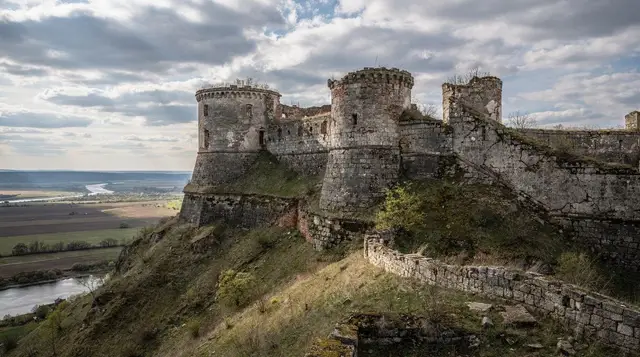
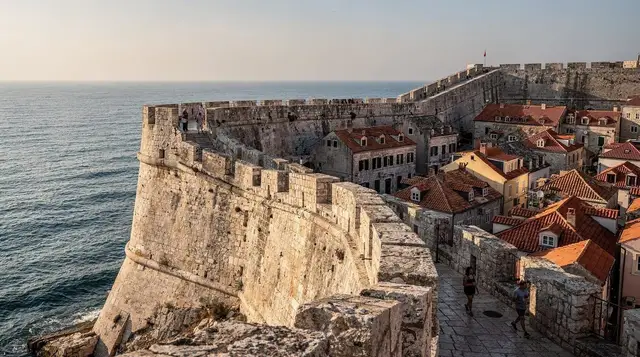
Petrovac na Moru sits about 20 minutes south of Budva on the same stretch of coast, and it feels like a deliberately smaller version of it: one seafront promenade, one 16th-century fortress on the point, one main beach curving away from it under a line of Aleppo pines. There is no old town of narrow stone lanes here, no cruise-ship crowds, and by 9pm the loudest thing on the promenade is usually a live band playing covers on a restaurant terrace rather than a nightclub. That makes Petrovac a reasonable base for anyone who wants beach time without Budva’s noise, or a half-day stop for anyone driving the coast road between Budva and Bar.
A resort that stayed small
Petrovac was a Roman-era harbour long before the fortress went up, and Roman coins and pottery have turned up on the seabed near the point over the years, which is part of why the local diving schools include a wreck-and-ruins route among their trips. The modern town, though, is mostly a 20th-century holiday resort: a scatter of hotels and guesthouses built from the 1960s onward around a much older fishing village, with the promenade and the fortress as the only real historic anchor.
That history shows in the layout. There is a single pedestrian seafront street lined with restaurants, gelato counters and small shops, backed by a short grid of residential streets climbing the hill behind it. It takes about ten minutes to walk the whole promenade end to end. Compared with a guided walk through Budva’s walled old town, Petrovac has nothing close to the same density of monuments — which is exactly why some travellers prefer it as a place to actually switch off.
The Venetian fortress and the islet of Katič
The fortress (Tvrđava Kaštel) sits on the northern point of the bay, built by the Venetians in the 16th century to watch the approach from the sea and to shelter local boats behind its walls. It is small — you can walk the perimeter in 20 to 30 minutes — and today parts of it are given over to a seasonal bar and occasional small exhibitions rather than a formal museum, so treat the entrance fee as paying for the view rather than for exhibits. From the walls you look straight out at Katič, a low rocky islet with a whitewashed chapel to Our Lady, close enough offshore that strong swimmers and paddleboarders reach it in calm weather.
Katič turns up on several boat itineraries that run along this stretch of the Budva Riviera. A half-day boat trip from Budva past Sveti Stefan and around Katič island is the easiest way to see the islet properly if you are not swimming out to it, and it also gives a sea-level view of the Petrovac fortress that you do not get from the beach.
On land, the wooded point just south of the fortress is a protected pine park with sea-facing benches and a mild, resin-scented microclimate that locals treat as a low-key wellness stop; a guided visit to the Katič nature park, with its sea-air spa area and small caves is a slower way to spend an hour than the beach.
Two beaches, then two more coves down the coast
Petrovac’s own beach is a curved stretch of fine pebble and coarse sand, backed by the pine trees that give the whole town its shade in the middle of the day — useful, since there is little else to hide under between roughly noon and 4pm at the height of summer. It shelves gently, which is part of why the town works well for families; see our broader guide to pebble versus sand beaches if you are trying to work out what to expect underfoot along this coast, and the free versus paid beach guide if you want to know where sunbeds are included and where they are not.
Two more coves lie within easy reach and are usually treated as extensions of a Petrovac stay rather than separate destinations. Lučice, immediately south past the fortress, is a small crescent of a beach reached by a coastal footpath in 15 to 20 minutes, or by the small boat-taxis that run in season. Buljarica, further south again, is a much longer and less developed beach, reachable on foot in under an hour or by a short taxi or bus hop; it has less shade and fewer facilities than Petrovac itself, which is exactly why some people prefer it.
Neither has enough going on to justify its own guide, but both are worth the short walk or the few euros for a boat-taxi if you are staying more than a day. For the wider picture of where these two rank against other stretches of coast, see our roundup of the best beaches near Kotor.
Getting to Petrovac from Kotor
There is no direct route that avoids Budva. By car, the drive follows the coast road south through Budva and Bečići before continuing to Petrovac, and takes roughly 50 minutes to an hour outside peak traffic — allow longer in July and August, when the same road backs up around Budva’s beach access points in the middle of the day. Parking in Petrovac itself is limited along the seafront in season; the small car parks on the hill above the promenade fill early on summer weekends.
| From | Distance / time | Notes |
|---|---|---|
| Kotor | ~45 km, 50–60 min | Coast road via Budva |
| Budva | ~15 km, 20–25 min | Same road, most direct leg |
| Bar | ~20 km, 25–30 min | Continuing south |
| Tivat Airport | ~55 km, 1h–1h10 | Via Budva |
| Podgorica Airport | ~65 km, 1h10–1h20 | Via the Sozina tunnel and Budva |
Public transport means going through Budva. There is no direct bus from Kotor to Petrovac; the practical option is a coastal bus or shared taxi from Kotor to Budva, then a second, shorter bus or taxi on to Petrovac. Coverage on this stretch is reasonable but there is no centralised online booking, so it is worth checking times at the bus station on the day rather than assuming a fixed schedule — the same caveat that applies to buses across Montenegro generally. Travellers without a car may find it simpler to treat Petrovac as a stop on a rental-car day out; see the car rental guide for what that costs on this coast.
Where to stay: Petrovac versus Budva
Basing yourself in Petrovac rather than Budva is a genuine trade-off, not an upgrade in either direction. Budva has the old town, the widest choice of restaurants and bars on this coast, and better transport connections; Petrovac has quiet nights, a family-friendly beach, and lower accommodation prices for a comparable standard of hotel. Our detailed comparison of Kotor versus Budva as a base and the separate look at Budva versus Sveti Stefan both cover the wider trade-offs; the short version for Petrovac is that it suits a beach-focused stay better than a sightseeing-focused one.
Anyone cross-shopping the whole Budva Riviera should also weigh Bečići, which has a longer sand-and-shingle beach and a more built-up hotel strip, and Rafailovići, which sits between Bečići and Budva old town and trades quiet for convenience. Sveti Stefan is visible from the coast road on the way south but is not open to visitors — the former hotel-village closed to the public in 2021, and the closest most travellers get is the photograph from the viewpoint above it or from the neighbouring beach.
Boat trips from Petrovac’s own harbour
Petrovac’s small harbour is a departure point for its own boats rather than only a stop on trips from elsewhere, which is one of the genuine advantages of basing here. A day cruise to Lake Skadar with lunch, departing from Petrovac or Budva, saves the drive out to Virpazar and covers the national park’s carp-and-eel restaurants and water-lily channels in a single day without renting a car. For a shorter outing that stays on the coast, a boat tour along the coast to Budva is a scenic alternative to the coast road and lands you within walking distance of the old town.
Neither trip needs advance planning beyond booking a place, and both are a reasonable way to fill a day if the beach alone is not enough. For context on the wider boat-trip market along this coast, our Lake Skadar boat tour guide covers what a Skadar cruise from any departure point typically includes.
Eating on the promenade
The seafront strip is almost entirely restaurants, and the standard is generally reasonable rather than exceptional — this is a resort menu of grilled fish, calamari, ćevapi and pizza repeated at a dozen addresses, priced a little below equivalent spots in central Budva. Expect roughly €8–15 for a main course away from the very front row of terraces, and closer to €18–25 for a whole grilled fish sold by weight. A handful of places serve the inland staples of this coast — pršut and cheese from Njeguši, kajmak, rakija — alongside the seafood, but Petrovac is not a food destination in the way some inland villages are; it is a place to eat well enough while looking at the water.
How a day in Petrovac tends to unfold
The rhythm here is simple, and that is the point. Mornings belong to the beach and the pine shade, when the pebbles are quiet and the water is calmest for a swim out toward Katič. Midday is for lunch on the promenade or a long break under the trees, because the sun on the open shore is at its strongest then. Late afternoon is the natural moment for the fortress walls, when the light softens over the bay and the islet. Evenings are slow: a stroll along the seafront, a gelato, a table with a view of the water. Anyone who needs a schedule of activities will run out of things to tick off quickly; anyone who wants a place to do very little well will not.
For more detail on the fortress itself and what you can and cannot expect inside, our guide to Petrovac’s old town and fortress goes further than this overview.
Pairing Petrovac with the rest of the coast
Petrovac rarely works as a destination on its own for more than a few days, and it pairs well with its neighbours. Budva is close enough for an evening out or a morning of sightseeing, and our pages on Budva and the Budva old town cover what you would be going for. Heading the other way, Bar and the hilltop ruins of Stari Bar make a good change of pace from the beach, and the same coast road carries on toward Sutomore and, further on, Ulcinj for anyone who wants to keep moving south.
If your main base is Kotor and Petrovac is only one stop on a longer trip, the day-by-day plans in the five-day Kotor itinerary and the beach and mountains week show how a coastal afternoon can fit between the bay and the interior. For the practical side of getting around without a car, the Montenegro without a car guide is worth reading before you commit to this stretch of coast.
Who Petrovac suits, and who it does not
Petrovac suits families who want a gentle beach and a traffic-free promenade, couples who would rather hear the sea than a sound system, and travellers who like a short walk to everything. It is also a sensible choice for people who plan to spend the day on a boat or at a nearby beach and want somewhere calm to come back to at night.
It suits less well anyone who wants nightlife, a wide choice of restaurants, or a dense historic centre to explore on foot. If that sounds like you, Budva’s nightlife guide and the Budva restaurants guide will point you in a better direction. And if rain interrupts the beach plan, what to do in Budva when it rains offers ideas a short drive away, since Petrovac itself has few indoor options.
Small things that make a stay easier
A few habits make the town more comfortable. Bring footwear for the pebbles, because the entry into the water is easier with a pair of beach shoes than barefoot. Carry a hat and water for the walk to the neighbouring coves, where shade is thin. Keep some cash for boat-taxis and smaller cafés, as covered in the money and ATMs guide. And if you are packing for a coastal trip that also takes in the mountains, the packing guide for Montenegro will help you avoid carrying more than you need.
Practical information
Petrovac uses the same infrastructure as the rest of the Montenegrin coast: the euro despite Montenegro sitting outside the EU and the eurozone, plugs of the two-round-pin European type at 230V/50Hz, and tap water that is safe to drink. Mobile coverage is solid along the whole promenade. The town has a pharmacy and a small medical point but nothing beyond that; anything more serious means a drive to Budva or Bar. There is no dedicated tourist police desk in Petrovac itself, and the general emergency number 112 applies here as everywhere else in the country.
Outside July and August, Petrovac largely shuts down — a meaningful share of restaurants and guesthouses close for the winter, and the promenade that is lively at 9pm in July can be nearly empty by October. That trade-off — warmer water and open businesses in high summer against real crowding, or a quiet but half-closed town in the shoulder months — is common to this whole coast; see the best time to visit guide for how it plays out season by season.