Herceg Novi old town: stairs, forts and a calmer base than Kotor
What makes Herceg Novi old town worth a visit from Kotor?
Herceg Novi is a stepped town at the mouth of the Bay of Kotor, built up a steep hillside and linked by well over a hundred separate flights of stairs between the seafront and the old town above. Its core sights - Kanli Kula fortress and the Ottoman clock tower - take an hour or two on foot, and it works well as a quieter, cheaper base for exploring the whole bay by car.
A town built on stairs, not streets
Most visitors staying in Kotor see Herceg Novi as a name on a road sign at the edge of the bay, if they see it at all. That is a mistake, and not only because it sits right where the Bay of Kotor meets the open Adriatic. Herceg Novi was built up a hillside so steep that a normal street grid never made sense: instead, the town is threaded together by an estimated hundred-plus separate flights of stone stairs, some barely wide enough for two people, connecting the seafront promenade to the old town several storeys above and the residential terraces higher still. Locals give directions by staircase name as often as by street name.
The result is a town you experience vertically rather than horizontally. You climb from the harbour, pass through a gate, cross a square shaded by plane trees, climb again, and the bay keeps reappearing between rooftops at a slightly different angle each time. It is more physically demanding than a stroll through Kotor old town, but nothing like the 1,350-step haul up to San Giovanni fortress - most of the stairs here come in short runs of twenty or thirty steps, with a bench or a café terrace to break the climb.
Herceg Novi’s founding is later than Kotor’s long Venetian and Byzantine history: it was established in 1382 by the Bosnian king Tvrtko I as a fortified port, then passed through Ottoman, Venetian, Austro-Hungarian and, briefly, Russian hands before becoming part of Yugoslavia and then Montenegro. That succession of rulers left a town with an Ottoman fortress, a Venetian clock tower gate, Austro-Hungarian villas along the seafront and a scattering of Orthodox and Catholic churches within a few hundred metres of each other - more layered, in a small area, than most stops on this coast.
Kanli Kula fortress and what is left of the walls
a guided walk through the old town’s staircases and fortifications is the easiest way to get the layout straight on a first visit, but Kanli Kula can also be seen on your own without much difficulty.
Kanli Kula (“Bloody Tower” in Turkish) is the largest surviving fortification, built by the Ottomans in the 16th century on high ground above the old town. It functioned as a garrison and, later, a prison - the name is not decorative. Today the fortress is open to the public for a small entrance fee: inside are old cannon emplacements facing the sea, thick stone ramparts you can walk along, and a summer amphitheatre that hosts concerts and theatre during the warmer months. There is no shade to speak of once you are on the upper walls, so a midday visit in July or August is uncomfortable; late afternoon light also photographs better across the bay.
Below and around Kanli Kula, other bastions survive in fragments - Forte Mare down by the water, parts of the Spanjola fortress higher on the hill, and sections of town wall now built into private houses. None of it is as complete or as walkable as Kotor’s 4.5 km circuit of ramparts, and that is part of the appeal: Herceg Novi’s defences feel like something you stumble across between staircases rather than a single monument to tick off.
The old town: the clock tower, the squares and the churches
The main entrance into the historic core is marked by the Sahat Kula, an Ottoman clock tower gate dating from the 17th century, still keeping time over the arch beneath it. Passing through it brings you into Trg Herceg Stjepana, the old town’s principal square, named after the 15th-century Bosnian nobleman Herceg (Duke) Stjepan Vukčić Kosača, from whose title the town takes its name.
Within a few minutes’ walk of the square are the Orthodox Archangel Michael’s Church, unusual for combining Byzantine and Gothic elements with an Islamic-influenced dome, and a scattering of smaller chapels reflecting the town’s mixed religious history. None of these charge admission, and none require more than ten or fifteen minutes unless you have a particular interest in the architecture.
The old town’s café terraces, mostly built into the staircases and small squares rather than lined up along a single strip, tend to be less geared toward one-off tourist footfall than the seafront cafés of Kotor’s old town, since a larger share of the trade is local and repeat.
Getting there and around from Kotor
The most direct route from Kotor to Herceg Novi uses the Kamenari-Lepetane ferry, which cuts across the narrowest point of the bay rather than following the road around its full perimeter. The crossing itself takes only a few minutes, costs 5 EUR per car (2.50 EUR for a motorbike, free for foot passengers), and runs every 15-20 minutes through summer. Total driving time from Kotor to Herceg Novi, ferry included, is around 45 minutes. The queue for the ferry can run up to an hour at peak times in July and August, which is worth building into a day plan; the alternative is the longer road around the head of the bay, adding real time rather than saving it.
Coastal buses connect Kotor, Tivat, Herceg Novi and points between reasonably well, though there is no centralised online booking system - tickets are bought from the driver or a kiosk. If you are staying car-free, a private transfer to Kotor and Perast or a half-day car tour that covers both towns in one loop removes the ferry-queue guesswork.
Herceg Novi is also close to the Croatian border - closer than Kotor by a meaningful margin - which matters if a Dubrovnik day trip is part of the plan. The Debeli Brijeg / Karasovici crossing on that road can back up to 2-5 hours in mid-July and August, especially on Saturdays, partly because of the EU’s newer entry-exit checks on the Croatian side. The quieter Vitaljina crossing further inland usually clears in 10-20 minutes and is worth the small detour in peak season.
Why Herceg Novi works as a base for the Bay of Kotor
Basing yourself in Kotor old town means walking distance to the cathedral and the ramparts, but also cruise-day crowds, limited and expensive parking, and accommodation prices pushed up by that same demand. Herceg Novi trades the walk-everywhere convenience for easier logistics if you are driving:
| Kotor old town | Herceg Novi | |
|---|---|---|
| Parking near the centre | Very limited, paid in season | Easier, cheaper - use the marina or edge-of-town parking |
| Cruise ship crowds | Heavy, 10:00-16:00 in season | Ships dock at Kotor, not here - stays calmer |
| Typical accommodation cost | Higher, especially July-August | Generally lower for a comparable standard |
| Distance to explore the bay by car | Central, but parking limits driving in and out | At the bay’s mouth - no backtracking needed |
| Walkability of sights | Everything within the walls | Old town is compact; sights outside it need transport |
Neither is objectively “better” - it depends on whether you want to park the car for your stay or use it daily. Anyone planning to see Perast, the Lustica peninsula, Herceg Novi itself and Kotor all in a few days without moving hotels will find Herceg Novi’s position and easier parking work in their favour; see the Bay of Kotor by boat itinerary or the Montenegro without a car itinerary for how the logistics differ either way.
Where to eat and what it costs
Restaurant and café prices in Herceg Novi generally sit at the lower end of the coastal range: a coffee still runs 1.20-2 EUR, a Nikšićko beer 2.50-4 EUR, and a main course at a non-touristy restaurant 8-15 EUR - much the same nominal prices as elsewhere on the coast, but without the seafront old-town markup that Kotor’s most visible terraces charge. Menus lean on grilled fish, calamari, and the same prsut and Njeguši cheese found around the bay, alongside more inland Herzegovinian influences given the town’s proximity to Bosnia.
For something more structured than a meal out, a wine tasting paired with a hands-on gnocchi cooking class runs in the town and gives a reason to stay through the evening rather than driving back to Kotor after the fortress and the old town.
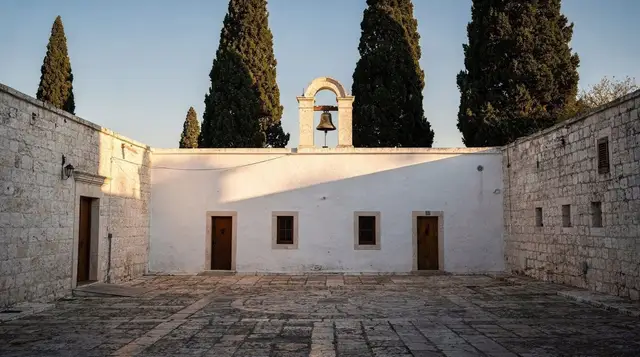
Nearby Savina Monastery, a working Orthodox monastery set among cypress trees a short drive or a longer walk above the town, is worth combining with a meal - it is quiet even in August and free to enter, with modest dress expected inside the churches. See the Savina Monastery guide for opening patterns and etiquette.
Beaches and boat trips from Herceg Novi
Herceg Novi’s own town beaches are small and pebbly rather than a headline attraction, but the town works well as a launch point for boats heading further out. From here, a full-day boat tour taking in the bay’s caves and Our Lady of the Rocks covers more ground than is practical by car in a single day, since it skips the road entirely.
The Blue Cave, a sea cave on the Lustica peninsula where sunlight refracts through the water to give it an intense blue glow, is best visited by boat in mid-morning when the light angle is strongest; nearby Bijela is a common departure point, and speedboat trips from there reach it faster than the larger tour boats. Mamula Island, a circular Austro-Hungarian fortress built on an islet at the bay’s mouth, is visible from Herceg Novi’s seafront and reachable by short boat transfer - see the Mamula Island fortress guide for what is inside.
For beach time closer to town, Igalo, immediately west of Herceg Novi and known as a spa town, has a longer stretch of shoreline than the old town itself.
Practical details: opening hours, parking and tickets
Kanli Kula has no single fixed year-round schedule publicised in advance; expect it open through the day in the main season (roughly April to October), with shorter hours or partial closure outside that window - checking locally on arrival, or via your accommodation, is more reliable than any timetable printed months ahead. The small entrance fee is paid on site; card acceptance is not guaranteed, so carry some cash in euros.
Parking in the old town itself is tight and mostly on-street; the harbour-front area and marked lots further from the water are the practical option for a half-day visit, at a noticeably lower cost than parking near Kotor’s old town. If you are renting a car for the wider trip, the Montenegro car rental guide covers what to expect at pickup and on the coastal roads generally.
Taxis operate on a metered basis by law, but the meter is inconsistently used with visitors, particularly around transport hubs - agree a price before getting in, or book through your accommodation.
Frequently asked questions about Herceg Novi old town
How long do you need in Herceg Novi old town?
An hour and a half to two hours covers Kanli Kula, the clock tower and the old squares at an unhurried pace. Add another hour if you walk down to Savina Monastery or along the seafront promenade.
Is Herceg Novi cheaper than Kotor?
Generally yes, for accommodation and restaurant meals in particular. It sees far fewer cruise passengers than Kotor, so prices in the old town and along the seafront have not been pushed up in the same way.
Can you still visit Kanli Kula fortress?
Yes. Kanli Kula is open to the public with a small entrance fee. Inside are the old cannon positions, a summer amphitheatre used for concerts, and views back over the terracotta roofs to the bay.
How do you get from Kotor to Herceg Novi?
By car it is about 45 minutes, mostly via the Kamenari-Lepetane ferry, which costs 5 EUR per car and saves roughly 25 km and 30-40 minutes compared with driving around the head of the bay. Buses run the coastal route but are not reservable online.
Is Herceg Novi a good base for exploring the Bay of Kotor by car?
It suits anyone who wants to drive rather than stay car-free. Parking is easier and cheaper than in central Kotor, and Herceg Novi sits at the entrance to the bay, so Kotor, Perast, Tivat and the Lustica peninsula are all reachable without backtracking.
What is the clock tower in Herceg Novi’s old town?
The Sahat Kula is an Ottoman-era clock tower standing over one of the old gates into the historic core, a reminder that Herceg Novi passed between Ottoman, Venetian, Austro-Hungarian and Yugoslav rule over the centuries - unusually layered even by the standards of this coast.
Does Herceg Novi get the same cruise ship crowds as Kotor?
No. Large cruise ships dock at Kotor, not Herceg Novi, so its old town does not see the same mid-morning to late-afternoon surges. It stays walkable through most of the day, even in July and August.
City sightseeing tours on GetYourGuide
Verified deep-linked GetYourGuide tours. Book through these links and we earn a small commission at no cost to you.
GetYourGuide does not provide a product photo for this activity — the image shows the meeting point, photographed by us.