Savina Monastery: Herceg Novi's wooded treasury of icons
What is Savina Monastery and is it worth visiting from Kotor?
Savina is an Orthodox monastery on a wooded hillside above Herceg Novi, roughly 45 minutes from Kotor by the coast road or the Kamenari-Lepetane ferry. It holds three churches, one with an 11th-century core, and a treasury with a manuscript bible and old icons. Entry to the grounds and the main church is normally free; the treasury sometimes needs a monk to unlock it.
A monastery you have to climb a little to reach
Savina Monastery sits on a wooded hillside above Herceg Novi, a few hundred metres up from the old town and just far enough from the coast road that the traffic noise fades into birdsong and cicadas. It is one of the wealthiest Orthodox monasteries in Montenegro, though nothing about the approach announces that: a narrow road climbs through cypress and pine, past a handful of guesthouses, to a walled compound where the trees do most of the work of shutting out the town below.
What makes Savina worth the climb is not one dramatic building but the accumulation of three churches on one small terrace, a treasury that most visitors never see, and a working monastic community that has kept the place going through Venetian rule, Austro-Hungarian administration, two world wars and the earthquake of 1979 that damaged so much of the coast. It is a smaller, quieter counterpart to Ostrog Monastery and Moraca Monastery further inland, and it rarely gets the queues either of those sites can produce in July and August.
Three churches, three centuries
The compound holds three churches built centuries apart, which is unusual for a site this compact.
The oldest is the small Church of the Dormition, with a core dating to the 11th century, making it one of the older standing religious structures on this part of the Montenegrin littoral. It is modest in scale, built from roughly cut stone, and sits slightly apart from its larger namesake.
Next to it is the larger Church of the Dormition of the Most Holy Mother of God, built in the 18th century and the one most visitors mean when they say they have “seen the church” at Savina. It holds most of the icon screen and frescoes that give the interior its colour, and it is the church still used for regular services.
The third, the Church of Saint Sava, is a 19th-century addition dedicated to the founder of the Serbian Orthodox Church. It is the plainest of the three architecturally but rounds out the set and gives a sense of how the monastery kept building and rebuilding over roughly 800 years rather than freezing at one point in time.
Seeing all three does not take long. Walking between them, reading the information panels where they exist, and sitting for a few minutes in the shade of the churchyard fills 30 to 45 minutes comfortably.
| Church | Built | Notes |
|---|---|---|
| Church of the Dormition (small) | 11th century core | Oldest structure on site, modest scale |
| Church of the Dormition (large) | 18th century | Main church, icon screen, active for services |
| Church of Saint Sava | 19th century | Plainest of the three, completes the group |
The treasury: a manuscript bible and old icons
Behind the churches, in a room that is not always open, Savina keeps its treasury: a manuscript bible, a collection of icons spanning several centuries, and liturgical silver and vestments accumulated by a wealthy monastery over a long history. This is the part of a visit that separates a good stop from a routine one, and it is also the part that is hardest to guarantee.
Access depends on a monk being available to unlock the room, and there is no fixed opening schedule posted for tourists the way there might be at a state-run museum. Mornings tend to be the better window, and visits during a service are not a good time to ask. If the treasury happens to be open, it adds real depth to the stop: manuscript bibles from this period are not common outside monastery collections, and the icons here are not the tourist-shop reproductions sold in Herceg Novi’s old town but the real, aged objects a working monastery has kept and used.
If it is closed, that is not a wasted trip. The churches and the setting are the main draw; the treasury is a bonus for visitors who happen to arrive at the right moment. Do not build an entire day around seeing it, and do not be surprised if a monk politely says no.
Getting in: usually free, always modest
Entry to the grounds and the main church is normally free. There is no ticket booth, no turnstile and no fixed admission fee, which puts Savina in a different category from paid sites like San Giovanni Fortress in Kotor. A donation box near the entrance supports the upkeep of the buildings, and leaving a few euros is a reasonable courtesy given how much of Savina’s income historically came from just this kind of visitor generosity, plus vineyards the monastery has owned for centuries.
The dress code is the one rule that is not optional. Shoulders and knees should be covered for both men and women, and a headscarf is appreciated, though not policed as strictly here as at some pilgrimage sites. Sleeveless tops, short shorts and anything resembling beachwear are not appropriate, and turning up in swim gear straight from a beach day nearby is the most common mistake visitors make. Scarves are sometimes left at the door for borrowing, but this is inconsistent, particularly outside the busiest months, so it is worth packing a light layer if Savina is on the plan for the same day as a beach.
Because the churches are in active use, not preserved purely for visitors, it is also worth keeping voices down and phones away during a service. This is a working monastery first and a sight second.
A quick word on the setting
Savina’s location matters as much as the buildings. The compound sits in a genuinely wooded pocket above the bay, with cypress, pine and old olive trees shading the churchyard, and partial views down toward Herceg Novi and the water beyond. It is a cooler, calmer stop than most of the coast in July and August, and the shade alone is worth something on a hot afternoon. Visitors coming from the noise and crowds of a cruise-ship morning in Kotor’s old town often mention the contrast: Savina rarely feels busy, even in season.
Getting there from Kotor
From Kotor, Savina is roughly 45 minutes by car. The direct route goes around the head of the Bay of Kotor through Risan and into Herceg Novi. The alternative is the Kamenari-Lepetane ferry, which cuts about 25 kilometres and 30 to 40 minutes off the drive by crossing the bay directly, though the trade-off is a ferry queue that can stretch toward an hour at peak times in summer. Either way, once you reach Herceg Novi, Savina is a 15 to 20 minute uphill walk from the old town, or a short taxi ride if the climb is not appealing after a day already spent walking.
Public transport does not run directly to the monastery gate; the coastal bus network connects Kotor and Herceg Novi reasonably well, but the last stretch uphill to Savina is on foot regardless of how you arrive. If travelling without a rental car is the plan for the whole trip, this is worth building into the day.
| From | Distance / time | Route |
|---|---|---|
| Kotor (direct) | ~45 min | Coast road via Risan |
| Kotor (via ferry) | ~35-50 min depending on queue | Kamenari-Lepetane crossing |
| Herceg Novi old town | 15-20 min walk | Uphill on foot, or short taxi |
Pairing Savina with the rest of Herceg Novi
Almost nobody visits Savina in isolation, and it works best as one stop in a half-day around Herceg Novi rather than a destination in its own right. The old town below has its own layered history worth an hour or two, and the walk up to Savina through residential streets and stepped lanes is part of the experience rather than a detour from it. Coffee or lunch in Herceg Novi’s old town afterwards is the natural way to close out the visit, and Igalo just along the coast is an option for anyone wanting a swim to round off the day.
For visitors building a longer coastal itinerary, Savina fits naturally into a two-day Kotor plan that allocates a half-day to Herceg Novi, or into a car-free Montenegro itinerary that relies on the coastal bus and ferry rather than a rental. Anyone renting a car for the trip should check the car rental guide for the usual excess and cross-border caveats before adding a Herceg Novi loop to the plan.
Savina in context: earthquakes, and why some churches feel newer than they are
The 1979 earthquake that struck this coast did serious damage to churches and historic buildings across Montenegro, and Savina’s structures, like many others, carry the marks of repair and reconstruction from that period and earlier ones. It is part of why comparing the “age” of a building here to its founding date can be misleading: what stands today is often a rebuilt or reinforced version of something older, patched together after seismic damage rather than a single unbroken structure since the 11th century.
The 1979 reconstruction touched religious sites across the bay, and Savina’s relatively good state of preservation reflects both careful restoration and the ongoing presence of a community that has kept using and maintaining the buildings rather than leaving them as ruins.
How Savina compares to Montenegro’s other monasteries
Montenegro has several monasteries that draw visitors for different reasons, and it is worth being clear about what each one actually offers before building a day around it. Ostrog, built into a cliff face and reachable by a narrow mountain road, is the country’s major pilgrimage site and gets genuinely large crowds, especially around religious holidays. Moraca, near the Tara canyon road toward the north, is known for its frescoes and river setting rather than its treasury. Savina is smaller than both, closer to the coast, wooded rather than dramatic, and its main appeal is depth and quiet rather than scale.
For visitors curious about seeing more than one, an organised trip such as an day tour to Ostrog Monastery covers the cliffside site properly with a driver who knows the mountain road, which is not a route to underestimate in a rental car. A longer version, the full-day trip combining Ostrog with other stops, suits anyone basing themselves in Kotor for a week and wanting to see the interior alongside the coast.
Lake Skadar has its own monastery interest too: a boat tour to Kom Monastery on Lake Skadar reaches a site that is only accessible by water, quite different from Savina’s easy uphill walk. And for visitors basing part of their trip in Dubrovnik rather than Kotor, a private guided visit to Dubrovnik’s Franciscan Monastery Museum makes a useful comparison point, since it holds one of Europe’s oldest working pharmacies inside a similarly long-lived religious complex.
None of these tours stop at Savina itself, since it is a free, self-guided site best reached independently or as part of a Herceg Novi walk rather than a booked excursion. They are useful for the monasteries further afield that involve a longer drive, a mountain road, or a boat crossing that is harder to arrange alone.
What to bring and what to skip
A light scarf or shawl covers the dress-code requirement without needing to plan an outfit around it, and it packs down small enough to carry on a beach day that also includes Savina. Comfortable shoes matter more for the walk up from Herceg Novi than for the compound itself, which is flat once you arrive. Bring a few euros in cash for the donation box; card payment is not an option here. Skip the idea of a strict visiting schedule: because the treasury’s opening depends on a monk’s availability, flexibility gets better results than a tightly timed itinerary.
Photography in the churchyard is generally fine; inside the churches during a service, it is not appropriate, and it is worth watching what other visitors and any monks present are doing rather than assuming photography is welcome everywhere on site.
The bottom line
Savina Monastery rewards visitors who treat it as a quiet stop rather than a headline sight: three churches spanning roughly 800 years, a treasury that may or may not be open on the day, free entry, and a genuinely peaceful wooded setting a short but real climb above Herceg Novi. It pairs naturally with an old-town walk below and asks little in return beyond covered shoulders, a few euros in the donation box, and enough time not to rush between the three churches. For a coastal itinerary already covering Kotor, Perast and the bay, Savina is one of the better reasons to give Herceg Novi a half-day rather than a drive-through.
Kotor food & drink tours on GetYourGuide
Verified deep-linked GetYourGuide tours. Book through these links and we earn a small commission at no cost to you.
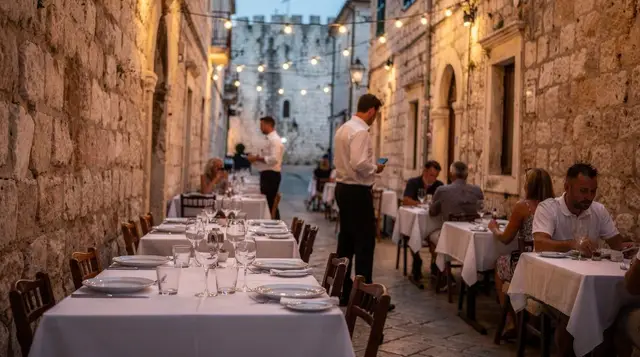
GetYourGuide does not provide a product photo for this activity — the image shows the meeting point, photographed by us.