The Njegoš Mausoleum: what the climb to 1,660m involves
How hard is the climb to the Njegoš Mausoleum?
From the car park in Lovćen National Park, a tunnel and roughly 461 steps lead up through the rock to the mausoleum near the summit of Jezerski vrh, at about 1,660m. Most people manage it in 20-30 minutes each way, but the top is often windy and noticeably colder than the coast, even in August.
Most tombs are in churches, at ground level, and take five minutes to see. The one built for Petar II Petrović-Njegoš — bishop, poet, and the closest thing Montenegro has to a founding figure — sits near the top of Jezerski vrh, 1,660m up, reached by a car park, a tunnel, and several hundred steps. That’s the whole point of the place: the climb is not an obstacle to the mausoleum, it more or less is the mausoleum. This is what the ascent, the building, and the weather at the top actually involve, so you can decide whether it belongs in your itinerary.
A tomb built on a mountain, not a church
Njegoš died in 1851 and was originally buried in a small chapel on this same peak, which he had asked for himself. That chapel was damaged in the First World War and later demolished by royal decree in the 1920s to make way for something grander — a monument as much to Montenegrin identity as to the man. The current mausoleum, designed by the Croatian sculptor Ivan Meštrović and completed in the 1970s, replaced it on the same site, at what is effectively the second-highest point of the Lovćen massif, just below the true summit of Štirovnik.
The choice of location was deliberate rather than convenient. From Jezerski vrh the sightlines run out over most of western Montenegro — the Bay of Kotor on one side, the interior toward Cetinje and beyond on the other, on a clear day as far as Lake Skadar and, some claim, into Albania and across to Italy. Whether or not the further claims hold up depends entirely on haze, they’re rarely usable in July heat and more plausible after a day of rain has cleared the air. What’s certain is that no lower site in the park offers anything close to the same reach.
Getting there from Kotor: the road through Njeguši
The standard route from Kotor climbs the old road toward Njeguši — the same switchback road, roughly two dozen hairpins carved into the hillside above the bay, that most visitors know from photographs taken looking straight down at Kotor’s old town and the water below. It’s a striking drive and also a slow one: budget close to an hour just to reach Njeguši village, then continue up into Lovćen National Park itself. All in, Kotor to the mausoleum car park runs to around 1 hour 15 minutes.
The road is narrow, has no barrier in places, and is genuinely uncomfortable for a driver who isn’t used to mountain switchbacks — slow down, use the pull-offs, and let faster local traffic pass rather than rushing the bends yourself. If you’d rather not drive it, the alternative is to approach via Cetinje on the interior side, which is a longer but gentler road, or to leave the driving to someone else entirely (see the transport options further down).
There is a national park entry fee for vehicles coming into Lovćen, separate from any charge at the mausoleum itself. Bring cash in euros for both — card readers at mountain ticket booths are not something to rely on.
The 461 steps: what the ascent actually feels like
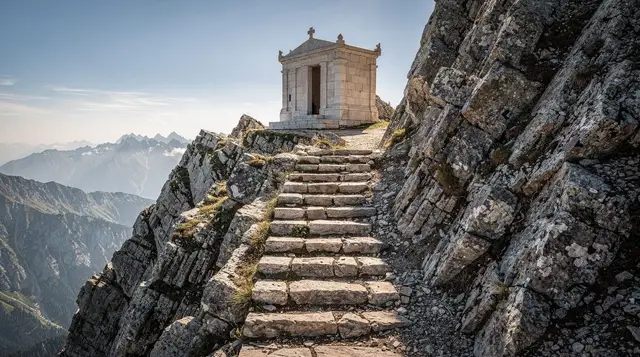
From the car park, the path leads to a stone portal and then into a tunnel bored directly through the rock of the mountain — this isn’t a metaphorical “carved into the mountainside,” it’s a literal passage cut through stone, lit but not brightly, with the steps continuing inside it. Depending on the count you use, the total from car park to the mausoleum entrance comes to roughly 461 steps. It is not a technical climb — no scrambling, no exposure — but it is a sustained, moderate stair climb at altitude, and it will register with anyone who doesn’t walk stairs regularly.
Most visitors cover it in 20 to 30 minutes going up, with a couple of pauses, and 15 to 20 minutes coming back down. There’s no way to shorten it: no lift, no partial-access route, no vehicle track. Anyone with significant mobility limitations should treat this site as inaccessible rather than plan around a workaround that doesn’t exist — see the note on accessibility further down.
Bring water. There’s little shade in the tunnel and none on the open sections, and the kiosk at the car park is the last reliable place to buy a bottle before you start.
Two caryatides and a golden dome: inside the mausoleum
The staircase ends at a small terrace guarded by two granite caryatides — female figures roughly nine metres tall, carved in the stylised, monumental manner typical of Meštrović’s later work — flanking the entrance to the burial chamber itself. Inside, a black granite statue of Njegoš, also by Meštrović, sits beneath a domed ceiling finished in gold mosaic, the one genuinely ornate surface in an otherwise austere building. The tomb itself is set into the rock behind the statue.
It’s a short visit — five to ten minutes covers the interior comfortably — and the building rewards more for what it represents than for anything to linger over inside. Photography is usually permitted; check current signage at the entrance, since site rules do shift.
The view — and the wind that comes with it
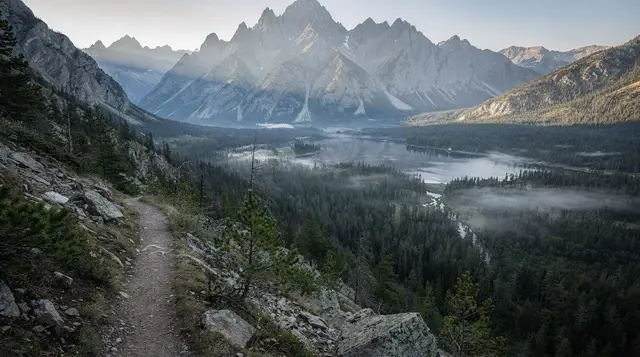
The outdoor terrace beside the mausoleum is the actual reason most people make the climb. On a clear day the sightline takes in a genuinely wide sweep of western Montenegro: the folds of the Njeguši plateau immediately below, the descent toward Cetinje and the valley beyond it, and — on the coastal side — glimpses down toward the Bay of Kotor, which from this height and distance reads clearly as what it geologically is: a drowned river valley, a ria, rather than the fjord it’s often loosely called.
What catches most visitors off guard isn’t the view, it’s the temperature and the wind. At 1,660m, the summit sits in a different climate to the coast for most of the year. A day that’s 26-28°C and still in Kotor can easily be 12-15°C and blustery on Jezerski vrh, with cloud rolling across the terrace inside a few minutes and cutting the view to nothing. This isn’t an occasional edge case — it’s routine enough in summer that a jacket belongs in the car regardless of the forecast down at sea level. In poor weather the terrace can be genuinely unpleasant to stand on for long, and in winter conditions the whole site may be closed outright.
Combining the mausoleum with Cetinje and Njeguši
Almost nobody drives up to Lovćen purely for the mausoleum and turns straight back. The standard loop from Kotor takes in Njeguši village — worth a stop for prosciutto and cheese from local smokehouses — then the mausoleum, then continues down the far side of the mountain into Cetinje, Montenegro’s old royal capital, before looping back to the coast via the lower road through Budva rather than re-climbing the Njeguši switchbacks. That full circuit is realistically a half-day to a full day from Kotor, depending on how long you spend in Cetinje.
If time is tighter, the mausoleum plus Njeguši alone is a manageable half-day out and back on the same road. For travellers building a longer stay, this whole area also pairs naturally with an interior loop that takes in Cetinje Monastery and Lipa Cave, both a short drive from Cetinje itself — a guided visit covers Lipa Cave’s underground chambers near Cetinje without needing to arrange your own transport or entry.
Practical details: hours, tickets, what to bring
| Detail | What to expect |
|---|---|
| Altitude | About 1,660m, near the summit of Jezerski vrh in Lovćen National Park |
| Steps | Roughly 461, split between open stairs and a tunnel through the rock |
| Climb time | 20-30 minutes up, 15-20 minutes down |
| Drive from Kotor | About 1h15 via the old Njeguši road |
| Park entry | A vehicle fee applies to enter Lovćen National Park, cash in euros |
| Mausoleum entrance | A separate, modest fee; opening hours and price shift by season — check at the park gate rather than an old blog post |
| Best months | Late May-June and September for a manageable climb and a decent chance at a clear view |
| What to bring | A jacket even in August, water, cash, sturdy trainers |
Tours and transfers if you don’t want to drive
The road up from Kotor is manageable in a rental car if you’re comfortable with switchbacks, but it isn’t for everyone, and parking at the summit car park fills up on busy weekends in July and August. Letting someone else drive removes both problems.
For visitors who want to combine the mountain scenery with something more active than a staircase, Lovćen also has a via ferrata route up neighbouring Štirovnik, its actual highest peak — a guided via ferrata climb on Štirovnik within the same national park is a way to see the massif from outside a car window, for anyone who wants more than a viewing terrace out of the day.
The park’s slopes and pastures also draw birdlife through spring and autumn migration, and a guided birdwatching outing in the region is a quieter, slower alternative to the mausoleum loop for anyone building a nature-focused day rather than a sightseeing one.
None of this replaces basic planning: whichever way you get up there, check the weather for the summit specifically, not just for Kotor — the two can differ by ten degrees and an entire cloud layer, and that gap is the single most common thing visitors get wrong about this trip.
Njegoš Mausoleum: your questions answered
How many steps are there to the Njegoš Mausoleum?
Roughly 461, split between an open staircase and a tunnel bored through the rock of Jezerski vrh. It is a steady, moderate climb rather than a technical one, but there is no way to shortcut it — the car park sits well below the summit.
How long does the climb take?
20 to 30 minutes up at an unhurried pace with a couple of stops, 15 to 20 minutes back down. Add another 20-30 minutes inside and at the viewing terrace if the weather is clear.
Is the mausoleum open in winter?
Access depends on snow and road conditions on Lovćen, which sits well above Kotor and Cetinje in altitude. The site can close for days at a time between November and March. If you are visiting outside May-September, check locally before driving up rather than planning around it.
What should I wear at the summit?
A proper layer, even in August. The coast can be in the mid-20s while Jezerski vrh sits in cloud, wind, or both. Trainers are fine for the steps; an umbrella is not much use above the tree line.
Can I drive all the way to the mausoleum?
You can drive to the car park inside Lovćen National Park, a short walk from the tunnel entrance. From there it is on foot only — steps and a tunnel, no vehicle or cable car.
Is Lovćen National Park the same as the mausoleum?
No. Lovćen National Park covers the whole massif, with hiking trails, viewpoints and the village of Njeguši on its slopes. The mausoleum is one site inside the park, at the end of the access road near Jezerski vrh, Lovćen’s second-highest peak.
How do I combine the mausoleum with Cetinje?
Easily — Cetinje sits on the far side of Lovćen from Kotor, roughly 20-25 minutes past the park entrance. Most day trips do Njeguši, the mausoleum and Cetinje in one loop, returning to Kotor by the coastal road via Budva rather than back over Njeguši.
Is the mausoleum worth it if I’m short on time in Kotor?
If you only have one day, no — the old town, the walls and a boat on the bay will fill it. It earns a half-day once you have two or three days, mainly for the drive and the view, not for the tomb itself. For a full sense of how it fits against everything else worth doing near Kotor, see the wider things to do in the mountains around the bay, or check the best months to visit before you commit a day to it.
Mountain excursions on GetYourGuide
Verified deep-linked GetYourGuide tours. Book through these links and we earn a small commission at no cost to you.
GetYourGuide does not provide a product photo for this activity — the image shows the meeting point, photographed by us.