The relics inside Cetinje Monastery
What relics does Cetinje Monastery hold, and can visitors see them?
The monastery's treasury holds what it presents as the right hand of John the Baptist, a fragment of the True Cross, and a fragment of the Crown of Thorns, alongside royal regalia. They are shown only at limited times, not continuously, and shoulders and knees must be covered to enter at all.
A working church, not a museum
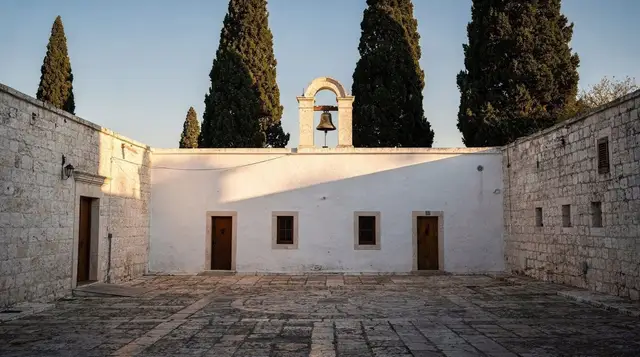
Cetinje Monastery sits at the edge of Cetinje’s old town, a low ochre building behind a modest gate that gives no hint of what’s inside. It is easy to walk past. It is also the single most important religious site in Montenegro, the seat of the Metropolitanate of Montenegro and the Littoral, and the place where the country keeps three objects it treats as sacred beyond almost anything else in its territory: a hand, a splinter of wood, and a length of thorn.
None of that is staged for tourists. There is no ticket booth with a laminated price list, no gift shop counter selling relic replicas, no queue-management system. It is a functioning monastic community with monks living and worshipping on site, and visitors are guests in that routine rather than customers in an attraction. That distinction shapes almost everything about how to visit well: what you wear, when you go, how you behave once you’re through the door, and what you can realistically expect to see.
The current building dates to the late 18th century, a reconstruction after the original 15th-century monastery was destroyed. It has been rebuilt and repaired more than once since, including after Montenegro’s turbulent 19th and 20th centuries, and the stonework shows it if you look closely at the patching around the courtyard walls.
The seat of Montenegro’s Orthodox Church
Cetinje was Montenegro’s royal and religious capital for centuries before Podgorica took over as the administrative seat, and the monastery is the reason the town still carries outsized weight in Montenegrin identity. It houses the residence of the metropolitan, the senior bishop of the Montenegrin diocese of the Serbian Orthodox Church, and its archive holds manuscripts, royal charters, and correspondence going back to the Petrović dynasty, the family that ruled Montenegro as prince-bishops for generations before it became a secular kingdom.
That royal connection matters for what’s on display. Alongside the religious relics, the treasury holds royal regalia, ecclesiastical vestments, and objects tied to Montenegro’s ruling family, so a single glass case can put a jewelled crown next to a fragment of bone reliquary from four centuries earlier. If you’re combining this stop with a look at Cetinje more broadly, the Cetinje day trip guide covers the wider town, including the former royal palace and the national museum complex nearby.
The treasury: three relics behind glass
The reason people make the detour from Kotor, rather than settling for the Njeguši viewpoint and the mausoleum on Lovćen, comes down to three objects.
The right hand of John the Baptist
The monastery presents its most prized possession as the right hand of John the Baptist, the hand traditionally understood in Orthodox and Catholic tradition to have baptised Christ. Relics attributed to John the Baptist exist in several churches across the world, and provenance for any of them rests on centuries of tradition rather than something a visitor can independently verify. What the monastery states, and what pilgrims come to see, is a reliquary said to contain this hand, encased in gold and gems, displayed only under supervision.
A fragment of the True Cross
The second object is a fragment the monastery identifies as part of the True Cross, the cross used at the crucifixion according to Christian tradition. Like the hand relic, its history involves transfers between religious and royal custodians over centuries, eventually reaching Montenegro. It is kept in its own reliquary and shown alongside, not instead of, the other two pieces.
The Crown of Thorns
The third is a fragment described as part of the Crown of Thorns. Together, the three objects form what the monastery treats as its core spiritual treasure, and it’s genuinely rare to find this specific combination — hand relic, True Cross fragment, and Crown of Thorns fragment — held under one roof anywhere in the Orthodox world.
None of this is something you take on faith to visit; you don’t need to be religious to find the objects and their history worth seeing. But it helps to arrive understanding that, for the community that keeps them, these are not exhibits. They are venerated.
When the relics are actually on display
This is the detail that catches out the most visitors, more than any other single fact about the monastery: the relics are not sitting in a permanently lit case that you can walk up to at any hour.
The treasury opens to visitors on a limited daily window, generally somewhere in the mid-morning to early afternoon stretch, and it closes around services. Sunday liturgy and major feast days change the schedule entirely, sometimes closing the treasury to casual visits for most of the day while the community is at worship. There isn’t a single published timetable that holds reliably year-round, and opening hours have been known to shift with the season and with who is available among the resident monks to supervise the room.
The practical upshot: don’t build a tight day around a guaranteed viewing. If seeing the relics specifically, not just the monastery building, is the point of your visit, going with a guide who can check ahead, or asking locally in Cetinje the same morning, is more reliable than planning around a website timetable. A private tour of the town, such as a private guided walk through Cetinje, typically builds in some flexibility around the treasury’s actual hours that day rather than assuming a fixed slot.
| What | Typical pattern |
|---|---|
| Church and courtyard | Open most of the day, closed during services |
| Treasury / relics room | Limited window, roughly mid-morning to early afternoon |
| Sundays and feast days | Reduced or closed to casual visits during liturgy |
| Photography inside | Generally not permitted, especially near the relics |
| Entrance fee | None; donations expected |
Dress code and behaviour: what gets you turned away
This is not a site where a cardigan thrown over a vest top will pass. The dress code at Cetinje Monastery is enforced, and it is enforced at the door, which means a wasted trip if you get it wrong and have nothing to change into.
The baseline: shoulders and knees covered, for everyone, not only women. Shorts, short skirts, sleeveless tops, and anything low-cut will get you stopped before you’re through the gate. Women are typically asked to cover their heads as well. A basket or box of shawls is often kept at the entrance for visitors who arrive unprepared, the same practice you’ll find at Ostrog Monastery and Moraca Monastery, but supply isn’t guaranteed at busy times, and relying on it is a gamble. Carrying a light scarf and a pair of trousers or a long skirt in your bag, even on a hot July day in Cetinje, is the safer habit.
Inside, the expectation is quiet. If a service is underway, that means real silence, not a lowered voice: no phone calls, no photography, no wandering close to the altar area or the relics room. Monks will ask you to stop or step outside if you break this, and it’s treated as more than an etiquette lapse — for the resident community, a disrupted liturgy is a genuine intrusion, not a photo opportunity gone slightly wrong. Photography inside the church and treasury is generally not allowed at all, service or no service; save the camera for the courtyard and exterior.
None of this differs much from Orthodox monastery etiquette across the region, but Cetinje sees more foreign visitors passing through on organised itineraries than most, which is exactly why the lapses happen here more than at quieter sites.
Getting to Cetinje Monastery from Kotor
The standard route from Kotor climbs the old road through Njeguši, the village famous for its air-dried prosciutto and cheese, and over the shoulder of Lovćen National Park, roughly an hour door to door in a private car. The road is the same one used to reach the Njegoš Mausoleum, so most visitors combine the two rather than making the drive twice — see the Lovćen hiking guide if you want to add a walk before descending into Cetinje.
That old road is narrow, with blind corners and no real shoulder in places, climbing through around 25 hairpin bends above the Bay of Kotor. It rewards a driver comfortable with mountain roads and unnerves one who isn’t; if that’s you, hiring a driver or joining a guided trip removes the stress entirely rather than white-knuckling it for a photo stop. The alternative route via the Sozina tunnel toward Podgorica avoids the switchbacks but adds distance and a toll, and it’s the one most self-drive visitors coming from Budva or the coast further south will end up on instead.
Public transport options are thin. Bus connections between Kotor and Cetinje exist but aren’t frequent or easy to plan around on a tight day, and there’s no direct service that drops you at the monastery gate — see the buses in Montenegro guide for what’s realistic. For a single focused day, renting a car or booking a guided trip removes the guesswork, and it’s the difference between reliably catching the treasury’s opening window and arriving to find it shut for the afternoon.
| From | Route | Approx. time |
|---|---|---|
| Kotor (old road via Njeguši) | Coastal switchbacks, ~25 hairpins | 1 hour |
| Budva | Via Cetinje road | 45–60 minutes |
| Podgorica | Via Sozina tunnel | 30–40 minutes |
| Tivat | Via Njeguši or coastal road | 1–1.25 hours |
What else to see in Cetinje while you’re there
The monastery rarely fills a whole day on its own, and pairing it with the rest of Cetinje’s compact old town makes better use of the drive up. The former royal capital still carries its low, 19th-century embassy buildings from when it hosted diplomatic missions from half of Europe, alongside the national museum complex and King Nikola’s former palace. The Cetinje day trip guide lays out a fuller loop through the town, and the Cetinje food and cafes guide is worth a look if you want lunch options that aren’t aimed purely at coach groups.
For visitors with a specific interest in relics and religious sites, Montenegro’s other major pilgrimage stop, Ostrog Monastery, built into a sheer cliff face further inland, follows the same core etiquette — modest dress, quiet during services — but sits roughly two hours from Kotor rather than one, and is usually a separate day rather than a combined trip.
Combining the monastery with Njeguši and Lovćen
Because the route up from Kotor already passes both, most travellers treat Cetinje Monastery as the third stop on a loop rather than a destination on its own: Njeguši for the smoked ham and cheese, Lovćen for the mausoleum and the panoramic views back over the Bay of Kotor, and Cetinje for the monastery and the old royal town. A guided day such as the Lovćen, Njeguši and Cetinje day trip or the Lovćen, Cetinje and Lipa Cave day trip covers this ground in one outing, which suits anyone without a rental car or without the appetite for the hairpin drive themselves.
If your priority is specifically the underground scenery rather than the monastery, the Lipa Cave entrance ticket with guided tour can be tacked onto the same day, since the cave sits just outside Cetinje on the way back toward the coast. Anyone arriving by cruise ship into Kotor with a single free day should check the timing carefully; a return trip covering Lovćen, Cetinje, and the monastery in a single shore excursion is workable but leaves little slack if the treasury’s opening window doesn’t line up.
For itinerary planning across more than one day, the Kotor three-day itinerary slots Cetinje in as a half-day excursion rather than a full one, which matches how most visitors actually use the time. The old road itself has its own following among drivers and photographers; the Njeguši old road blog post is worth reading before you set off if you want to know what to expect around each bend.
Booking a guided visit
Going independently works fine if you’re comfortable with the mountain road and don’t mind the uncertainty around the treasury’s exact hours on a given day. Going with a guide mostly buys you two things: someone who can check the day’s schedule in advance rather than relying on a website, and someone who can explain the significance of what you’re looking at once you’re inside, since the monastery itself offers minimal signage or English-language interpretation.
A half-day option focused purely on the town and monastery, such as the Cetinje private city tour, suits visitors who want depth on Cetinje without the wider Lovćen loop. For a broader day that folds in the mountain and village stops as well, the Lovćen–Njeguši–Cetinje combinations above cover more ground for a similar total time commitment.
Whichever way you go, arrive with the dress code sorted before you reach the gate, keep your voice down and your phone away once inside, and treat the possibility of not seeing the relics that particular hour as a real outcome, not a remote one. What you’re visiting is somebody’s church first, and a sight on your itinerary second.
Museum & art tours on GetYourGuide
Verified deep-linked GetYourGuide tours. Book through these links and we earn a small commission at no cost to you.
GetYourGuide does not provide a product photo for this activity — the image shows the meeting point, photographed by us.