Prčanj: the village whose church outgrew it
Is Prčanj worth a stop on the Bay of Kotor?
Yes, if you want a quiet alternative to Kotor's crowds. Prčanj is a residential village 20 minutes from Kotor with a striking oversized church, a calm pebble waterfront, and almost no tourist shops. It is a place to swim and walk, not to sightsee for hours.
A village built by sea captains, not by tourism
Most visitors to the Bay of Kotor drive straight past Prčanj on the coast road between Kotor and Tivat, and most of them are missing very little in the way of headline attractions. That’s rather the point. Prčanj is a long, narrow village strung along the water for close to two kilometres, with stone houses, a scattering of Baroque facades, and almost none of the souvenir shops, tour touts, or menu boards in six languages that line the streets of Kotor’s old town. What it does have is one building that makes no sense next to the modest houses around it: a church with a dome large enough to belong in a small city, paid for entirely by local sailors.
That contrast is the whole reason to come. Prčanj isn’t a “sight” in the way Perast or the San Giovanni fortress are sights, with a queue and a ticket booth. It’s a place to slow down, walk along a quiet waterfront, swim off a pebble shore without fighting for space, and look at one genuinely oversized piece of 19th-century architecture that tells you something real about how this coast made its money before tourism existed.
Getting to Prčanj from Kotor
Prčanj sits about 6 km north of Kotor along the bay road that continues on to Dobrota, Stoliv, and eventually Tivat. The drive takes roughly 15-20 minutes in normal traffic, though the road narrows and hugs the water in places, so allow extra time in July and August when tour coaches and cars queue behind slower vehicles.
| Method | Time from Kotor | Approx. cost | Notes |
|---|---|---|---|
| Car | 15-20 min | Parking usually free, some payment in peak season | Narrow coastal road, limited overtaking |
| Local bus | 20-25 min | 1.50-2.50 EUR | Coastal Kotor-Tivat line, no fixed timetable app |
| Taxi | 15-20 min | 10-15 EUR one way | Agree the price before getting in |
| Guided tour | Varies | Included in tour price | Covers Prčanj alongside other bay villages |
There’s no dedicated passenger boat stop in Prčanj, so unlike Perast, arriving by water isn’t a simple option unless you’re on a private charter that agrees to put you ashore. If you don’t want to drive or rely on the bus schedule, a guided e-tuktuk tour through Prčanj, Tivat and Trojica Hill covers the village along with a couple of nearby stops in a single half-day loop.
Once you’re there, Prčanj is entirely walkable. The village has essentially one main road running parallel to the water plus a scattering of lanes climbing towards Vrmac behind it, so there’s no risk of getting lost, and no real need for a car once you’ve parked.
The Church of Our Lady of the Nativity
The reason Prčanj appears in any guidebook at all is the Church of Our Lady of the Nativity (Crkva Rođenja Bogorodice), a domed 19th-century church that dwarfs the village around it. It was built between 1789 and 1908 with money raised largely by local sea captains and sailors, many of whom served in the merchant fleets and navies of Venice, Austria, and later Austria-Hungary. Prčanj had a long tradition of producing ship captains, and the church was, in effect, a civic statement: proof that a small Boka village could build something on the scale of a cathedral.
The dome is the detail that stops people in their tracks. It’s genuinely disproportionate to the surrounding houses, more in keeping with a provincial capital than a village of a few hundred residents. Inside, the church holds a collection of religious art and maritime ex-votos typical of Boka churches — paintings and small silver offerings left by sailors’ families in thanks for a safe return, a tradition shared with Our Lady of the Rocks near Perast.
Practical note: opening hours are irregular outside of Mass times, and there’s no ticket desk or fixed admission fee. If the door is open, go in quietly; if it’s closed, the exterior and the setting are still worth the stop. Don’t plan a special trip around getting inside — treat access as a bonus rather than a guarantee.
Next to the church, the old captains’ houses along the waterfront are worth a slow look even though most are private residences. Balustraded balconies, stone door frames with carved dates, and the occasional coat of arms are reminders that this was, for a couple of centuries, a genuinely wealthy maritime community, not the sleepy backwater it can look like today.
Walking Prčanj: what there is, and what there isn’t
Prčanj is built for a walk, not a checklist. The village stretches along the shore road for close to 2 km, and a stroll from one end to the other and back, with stops, takes about an hour and a half at an unhurried pace. Along the way you’ll pass:
- The main church and a scatter of smaller chapels
- 18th- and 19th-century captains’ houses, several with plaques noting a maritime history society or naval academy connection — Prčanj once ran one of the region’s maritime schools
- A small waterfront promenade with benches and mooring points for local boats
- Narrow lanes climbing inland towards the lower slopes of Vrmac
What you won’t find: souvenir shops, a cluster of restaurants competing for your attention, ATMs on every corner, or crowds. That absence is exactly what makes Prčanj a useful stop if Kotor’s old town has started to feel like a theme park by mid-morning, particularly in cruise ship season — see our notes on cruise ship days in Kotor for when the old town is busiest and when it clears out.
There’s no formal walking trail or interpretive signage, so this isn’t a “guide yourself” attraction with information boards. It rewards curiosity more than itinerary-following: read the datestones on doorways, notice which houses have ship’s-anchor motifs, and don’t expect much English-language context on site.
Swimming in Prčanj
This is arguably the more practical reason to visit. Prčanj has a long pebble-and-concrete waterfront with several free public access points to the sea, and because it’s a residential village rather than a resort, it rarely gets crowded even in August. Compare that with the packed town beaches directly below Kotor’s old town walls in peak season, and the appeal is obvious for anyone who wants a swim without arriving an hour early to claim a spot.
A few things to know before you go:
- No sand. Like most of the Bay of Kotor, the shoreline is pebble and concrete, not sand — water shoes help if you’re sensitive to sharp stones.
- Minimal shade. Bring your own umbrella or parasol; there are few natural shade spots along the open stretches.
- No lifeguards on most of the waterfront — swim within your ability, as you would anywhere on this coast.
- Watch for sea urchins near any rocky sections, a real if minor risk on rock and pebble shorelines across Montenegro.
- Free entry. Unlike some organised beach clubs in Budva or Bečići, there are no sunbed rental operations dominating the shoreline here — bring your own towel and settle where you like.
The bay water off Prčanj is calm, being well inside the enclosed inner bay rather than open sea, and it warms up through summer in the same pattern as the rest of the Boka: swimmable from June, warmest in August at around 25-26°C, still pleasant into September. For a broader comparison of where to swim around the bay, see our guide to pebble versus sand beaches in Montenegro.
Where to eat and stay
Dining options are limited by design — this is a residential village, not a resort strip. Expect a small number of konobas (traditional taverns) and cafes along the waterfront rather than a dense restaurant scene. Prices tend to run a touch lower than the tourist-facing terraces in Kotor’s old town, since there’s less footfall to charge a premium for.
| Kotor old town waterfront | Prčanj | |
|---|---|---|
| Number of restaurants | Dozens, dense | A handful |
| Typical main course | 10-18 EUR, tourist premium | 8-14 EUR |
| Atmosphere | Busy, especially midday | Quiet, local |
| Booking needed in August | Often, for terrace tables | Rarely |
Accommodation follows the same pattern: mostly private apartments and guesthouses rather than branded hotels, generally cheaper than equivalent stays inside Kotor’s walls or in central Budva, and better suited to travellers with a car or willingness to bus in for evenings out. If you’re weighing where to base yourself for a longer stay in the bay, our where to stay in Kotor Bay guide covers Prčanj alongside Dobrota, Muo, and Tivat as quieter alternatives to Kotor’s old town itself.
Prčanj compared with Dobrota and Stoliv
Prčanj isn’t the only quiet village on this stretch of coast, and it’s worth knowing how it compares to its neighbours so you pick the right one — or string two or three together into a half-day loop.
- Dobrota, closer to Kotor, has a longer run of Baroque palaces and a slightly more developed waterfront with more places to eat — see our Dobrota Baroque palaces walk.
- Stoliv, further along, is smaller again and even quieter, with its own church and a similar swim-and-wander appeal — covered in our Stoliv and Vrmac hidden villages guide.
- Prčanj sits between the two in size, but wins on the single-landmark front: nothing in Dobrota or Stoliv matches the scale of the Prčanj church against its surroundings.
If you only have time for one, and architecture is the draw, choose Prčanj. If you want the longest stretch of grand houses to walk past, choose Dobrota. Many visitors with a car and a free afternoon simply combine all three into one loop along the bay road, stopping wherever looks interesting rather than following a fixed plan.
Practical tips for visiting Prčanj
- Bring cash. Small konobas and cafes may not take cards reliably; ATMs are not on every corner as they are in Kotor.
- Parking is easier than in Kotor. Unlike the tight, often payment-controlled parking near Kotor’s old town walls, Prčanj generally has more casual roadside space, though it tightens in August.
- Combine it with a boat trip. A number of Kotor Bay boat tours pass close to Prčanj on their way to Perast or the Blue Cave — worth checking if your chosen itinerary includes a photo stop, even without a proper landing.
- Don’t expect English signage. Information at the church and around the village is minimal and mostly in Montenegrin.
- Time it against cruise days. Because Prčanj sees essentially no cruise passenger traffic, it’s a sound choice for the 10am-4pm window when Kotor’s old town is at its most crowded.
For travellers building a longer stay around Kotor rather than a single day, a guided overview like the Kotor and Budva guided tour gives useful orientation to the wider bay before you branch off to quieter stops like Prčanj on your own schedule. And if the old town itself is still on your list, a proper guided walking tour of Kotor’s old town is worth doing before or after, since the two experiences — dense historic centre versus quiet residential village — make more sense side by side.
Boat-based visitors sometimes pair a stop near Prčanj with a look at the bay’s hidden coastal features; the Kotor to Perast hidden cave and tunnel boat tour covers some of this less-visited shoreline along the way, with a drink included.
Frequently asked questions about visiting Prčanj
How do I get from Kotor to Prčanj?
Drive or take a local bus along the coast road towards Tivat; the trip is about 20 minutes and 6 km. There is no dedicated ferry stop in Prčanj itself, and taxis from Kotor’s old town typically charge 10-15 EUR one way.
Is there an entrance fee for the Church of Our Lady of the Nativity?
No fixed entrance fee, though the church keeps irregular opening hours outside of Mass times and a small donation is customary if a caretaker lets you in. The bell tower and treasury are not always accessible.
Are there shops and restaurants in Prčanj?
Very few. A handful of konobas and cafes serve the waterfront, but there are no souvenir stalls, tour desks, or the shopfront density of Kotor’s old town or Budva.
Can you swim in Prčanj?
Yes, from a long pebble and concrete waterfront with several free public access points. It is quieter than Kotor’s town beaches but has minimal shade and no lifeguards on most stretches.
Is Prčanj a good base for staying in the Bay of Kotor?
It can work for travellers who want a quiet, residential setting with sea views and are happy to drive or bus into Kotor for restaurants and nightlife. Accommodation is mostly private apartments rather than hotels.
How much time do you need in Prčanj?
Two to three hours covers the church, a walk along the waterfront, and a swim. It suits a half-day stop combined with Dobrota or Stoliv rather than a full day on its own.
Is Prčanj accessible by e-tuktuk tour from Kotor?
Yes, guided e-tuktuk tours from Kotor cover Prčanj alongside Tivat and Trojica Hill, which is a practical option if you don’t want to drive or wait for a bus.
City sightseeing tours on GetYourGuide
Verified deep-linked GetYourGuide tours. Book through these links and we earn a small commission at no cost to you.
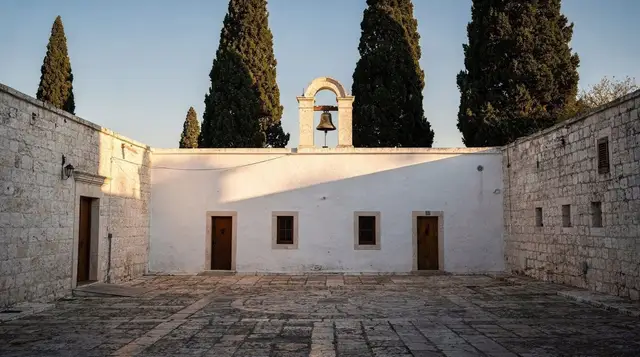
GetYourGuide does not provide a product photo for this activity — the image shows the meeting point, photographed by us.