Morača Monastery: frescoes in a river canyon
Is Morača Monastery worth the detour on the way to Durmitor?
Yes, if you are already driving the Podgorica–Kolašin road: it is a five-minute turn off the main route, the frescoes take 20–30 minutes to see properly, and the canyon views from the nearby bridge cost nothing extra. It is not worth a dedicated round trip from Kotor on its own.
A monastery you pass through, not a destination in itself
Morača Monastery sits in the canyon of the Morača river, on the single main road that connects Podgorica to Kolašin and on to Žabljak and Durmitor National Park. Almost nobody drives here specifically from Kotor. Almost everybody heading north on the mountains route passes within a five-minute turn-off of it, whether they know it or not. That distinction matters for how you should plan around it: as a stop bolted onto a longer day, not a trip of its own.
Founded in 1252 by Stefan Vukanović, a nephew of the Serbian ruler Stefan Nemanja, it is one of the oldest continuously functioning religious sites in the country. The stone church has been repaired, reroofed and repainted across nearly eight centuries, and what survives inside is a layered record of medieval Balkan painting rather than a single, uniform decorative scheme. That is worth knowing before you go in, because the frescoes were not all painted at once, and the differences between the older and later layers are part of what makes the walls interesting.
The easiest way to think about the visit is as a pause in a drive, a place where the road stops being about distance for a little while. Most people arrive after a long stretch of driving, step out of the car into the cooler air of the canyon, and find that the setting does half the work: stone walls, a quiet courtyard, the sound of the river somewhere below. If you arrive with no expectations beyond a short, calm stop, the monastery tends to leave a stronger impression than if you arrive expecting a major sight.
Getting there from Kotor
There is no direct coastal road to Morača. The realistic route is Kotor to Podgorica — about 1 hour 30 minutes, either over the Krstac pass via Cetinje or through the Sozina tunnel toll road — then a further stretch north-east on the M2 towards Kolašin, where the monastery is signed off to the right after roughly 45 minutes. All told, allow close to two hours each way from Kotor, which is why almost every visitor combines it with something further along the same road rather than treating it as a there-and-back trip.
That “something further” is usually Kolašin itself, Biogradska Gora National Park, or the full run up to Durmitor and Žabljak, three to three and a half hours from Kotor in total.
If your itinerary already has you driving toward the mountains — for the Black Lake, the Tara Canyon, or the Đurđevića Tara Bridge — Morača costs you almost nothing extra beyond the stop itself. If your day is built around Lake Skadar or a Podgorica city visit instead, it is a further detour north that only makes sense if you have a spare hour and a half.
A few practical thoughts on pacing the drive. Leave the coast early enough that the monastery falls in the middle of the day rather than at the end of it, because the light inside a small stone church is dim, and you will see far more of the paintings when your eyes are not tired and the day is not running out. Fill the tank and sort out snacks and water in Podgorica, since the stretch beyond the capital is mostly road, river and forest. Traffic through Podgorica itself can slow the start of the run, so build in a little slack rather than treating the journey time as a promise. If you are still deciding between a rental and public transport, the car rental guide and the buses guide lay out what each option means for a day like this.
What you are actually looking at inside
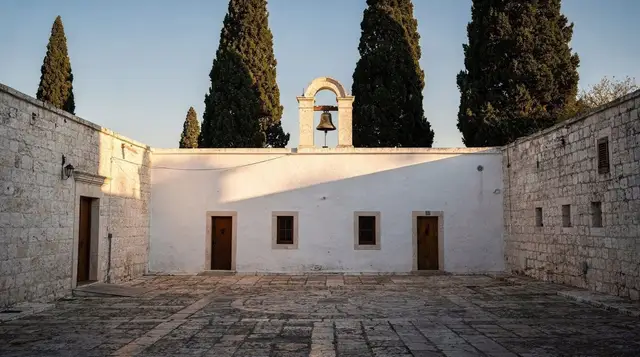
The monastery complex has two churches. The larger one, dedicated to the Dormition of the Virgin, is the original 1252 structure and holds the bulk of the surviving medieval work: painted scenes on the walls and a carved stone iconostasis. Paint has been lost in places over the centuries — plaster does not survive fire, damp and repeated regime changes unscathed — but enough remains to see how figures were composed, how faces were modelled, and how colour was used to separate one register of the story from the next.
The smaller church, dedicated to Saint Nicholas, is where the monastery’s best-known individual scene is found: the prophet Elijah in the wilderness, fed by a raven that carries bread in its beak. It is a subject drawn from the Old Testament that appears only rarely in this much narrative detail in Montenegrin church painting, and it is usually the one image guides point to first. It is worth spending the extra few minutes to find it rather than only looking at the main church and leaving.
Give your eyes a minute to adjust when you step inside. The interior is darker than the courtyard, and the paintings reveal themselves slowly: first the large figures, then the smaller scenes around them, then the details of drapery, hands and faces. Walk the walls in one direction rather than jumping between panels, and look up as well as across, since the story continues above eye level. Notice how the painters used a limited range of colours to give each scene its own mood, and how the gaps and faded patches tell you as much about the building’s long history as the intact sections do. If a monk or a guide offers a word of explanation, listen; the meaning of a scene is often not obvious to a visitor unfamiliar with Orthodox iconography.
Visitors with an interest in painting will find it worthwhile to compare what they see here with the work at Cetinje Monastery and Savina Monastery, which sit in very different settings but belong to the same wider religious tradition. Seeing two or three such sites in one trip helps the visual vocabulary start to make sense.
Photography rules are enforced loosely rather than strictly, but flash is generally discouraged near the older paintings, and it is common courtesy — not just etiquette for its own sake — to avoid photographing anyone at prayer.
Dress code and practical visiting notes
This is a working monastery, and the dress expectations follow from that rather than being a tourist gimmick. Shoulders and knees covered for everyone; women are generally expected to cover their heads inside the church as well. Wraps are sometimes left near the entrance for visitors who arrive underdressed, but supply is inconsistent, especially outside the main season, so bring your own scarf or a light long-sleeved layer if you are travelling in shorts or a sundress.
There is no admission fee and no ticket window. A donation box sits inside, and contributing something is the normal, expected gesture rather than optional. Opening hours track daylight and monastic routine rather than a fixed tourist schedule, so a mid-morning or early-afternoon stop is more reliable than trying to time an early or very late visit.
Parking is informal — a gravel area near the entrance, free, and rarely full because visitor numbers here are modest compared with Ostrog Monastery further west, which draws considerably more pilgrimage traffic and can mean queues on religious holidays. Morača does not have that problem; even in August it is usually a quiet, unhurried stop.
Behaving well in a working monastery
The simplest advice is to treat the place the way you would treat a church in your own town during a quiet weekday: walk slowly, speak softly, and keep phones silent. Do not step into areas that are clearly closed to visitors, do not touch the paintings or the stone, and if a service begins while you are inside, either stand quietly at the back or step out and wait. Children are welcome, but it helps to explain beforehand that this is a place of prayer, and the family guide to Kotor has more ideas for keeping younger travellers engaged on a day of driving and sightseeing.
A small donation is the natural way to say thank you, and many visitors also light a candle, which is a modest and welcome gesture. You do not need to share the faith of the community to be treated courteously; respect for the setting is what counts.
The canyon view from the bridge
The Morača river canyon is the other reason to slow down here, separate from the monastery itself. The road crosses the river on a bridge a short drive from the monastery turn-off, and pulling in at the roadside viewpoint gives a clear look down into the gorge — steep, forested walls with the river visible far below. It costs nothing and takes ten minutes, and it is easy to miss if you are focused only on the monastery car park and drive straight past.
If you have come this far specifically for landscape rather than icons, this stretch of road is also where the M2 starts to feel genuinely mountainous, a useful preview of what the Durmitor approach looks like further north.
Bring a camera with a decent wide angle if you have one, since the canyon is narrow and tall, and a phone panorama rarely captures the sense of depth. Take care at the roadside: pull fully off the carriageway, watch for passing traffic, and keep an eye on children and on your footing near the edge. Early or late light makes the walls and the water look their best, though the shadow inside the canyon means it can feel cooler than the road you left behind, so a light layer is useful even in summer.
Combining Morača with the rest of a mountain day
| Combination | Approx. drive time from Kotor | Best for |
|---|---|---|
| Morača only, there and back | 3.5–4 h round trip | Not recommended as a stand-alone trip |
| Morača + Kolašin town | 4.5–5 h round trip | A half-day taste of the mountains without committing to Durmitor |
| Morača + Biogradska Gora | 5–5.5 h round trip | Forest and lake walk added to the monastery stop |
| Morača + full Durmitor/Žabljak day | Full day, 3–3.5 h each way | Best value per kilometre driven — treat Morača as a 30-minute stop en route |
| Morača + Podgorica city sights | 4–4.5 h round trip | Pairing a short city visit with the canyon stop |
The pattern is consistent: Morača is rarely the reason to make the drive, but it is close to free to add once you are making it anyway.
Which combination suits you depends mostly on how much driving you enjoy. If the road itself is part of the pleasure, the longer mountain day gives the monastery a proper place in a story that builds from sea to canyon to high plateau. If you prefer a lighter day, pair it with a short walk or a coffee in Kolašin and turn back while there is still energy for dinner on the coast. For ideas on how to string several days together, the five-day and beach and mountains itineraries show how a northern excursion can sit between days by the sea, and the guide to travelling without a car is worth a look if you would rather not drive at all.
Self-drive versus a guided tour
Driving yourself is straightforward. The M2 is a well-surfaced main road, the monastery is clearly signed, and there is nothing about the route that requires local knowledge — unlike, say, the old road through Njeguši, where the hairpins genuinely call for a confident driver. The trade-off is that self-drivers get no context on what they are looking at once inside; the frescoes reward at least a little explanation, and a guide who can point out the Elijah panel and the later repaint layers gets considerably more out of the 20 minutes inside the church than wandering in cold.
For travellers without a car, or who would rather not navigate the Podgorica road themselves, a guided day tour bundles the driving, the monastery stop and usually a further mountain destination into one booking. A private day tour from Kolašin that includes Bjelasica and the monastery covers this exact stretch of road with a driver-guide, which removes the two hours of self-navigation entirely.
Travellers based further south can join a full-day tour from Podgorica taking in Biogradska Gora, the monastery and Kolašin, which is the most efficient way to see all three without renting a car.
Morača also comes up as a stop on itineraries built around Lake Skadar rather than the mountains; if that is your priority for the day instead, a panoramic boat tour on Lake Skadar to Kom Monastery covers a comparable Orthodox monastery on the water rather than in a canyon, and the two are not usually combined in one day given the driving involved.
There is also a middle path: drive yourself to the monastery, then use a guide elsewhere on the trip where the context matters more. Many travellers find that one well-chosen guided day, paired with a few independent ones, gives a better balance than either extreme. A broader guided day trip covering the highlights of Montenegro from Kotor is another way to see the country’s variety without planning each leg, though it will not stop at the canyon in the unhurried way a self-drive does.
Where it fits in a longer Montenegro trip
Most visitors reach Morača as part of a multi-day itinerary that pushes north from the coast toward the national parks, rather than as a day trip out and back from Kotor. If Durmitor, Kolašin or Biogradska Gora are already on your route, treat the monastery as a scheduled half-hour stop rather than a separate outing, check the best time to visit for the mountain leg of your trip since spring snowmelt and late-autumn closures affect the roads further north more than they affect the monastery itself, and confirm your route on a map before setting off — mobile signal thins out in the canyon stretch.
For a shorter, city-based alternative that still covers Orthodox monastic architecture without the drive, Podgorica’s cathedral and old town can be seen in an afternoon from Kotor with a much shorter round trip, and a private guided option covering the capital is available as a guided highlights tour of Podgorica for travellers who want context without the extra driving time to the canyon.
Museum & art tours on GetYourGuide
Verified deep-linked GetYourGuide tours. Book through these links and we earn a small commission at no cost to you.
GetYourGuide does not provide a product photo for this activity — the image shows the meeting point, photographed by us.