Budva restaurants: where to eat away from the promenade
Where should I eat in Budva to avoid tourist-trap prices?
Move two or three streets back from the seafront promenade and the marina. Streets around the old town's inner blocks and the residential grid behind Slovenska Obala have grilled-fish and Montenegrin-grill places at local prices, while the waterfront terraces charge a premium for the view and often reheat the same menu.
The promenade is priced for people who won’t come back
Slovenska Obala, the seafront walk that runs past Budva old town and the marina, is where most visitors eat because it is where most visitors walk. That is exactly why the food there is unreliable. Rent on a sea-view terrace is the highest in Budva, and the customer base turns over completely every week or two through the summer, so there is little commercial pressure to keep quality up. A plate of grilled squid that runs 18 to 22 EUR on the promenade is very often the same squid, from the same wholesalers, for 10 to 14 EUR two or three streets inland.
None of this means the promenade restaurants are dishonest exactly. Portions are usually what is advertised and card machines work. The issue is value: you are paying for the view and the location, not for the cooking, and the cooking is frequently mediocre - overcooked fish, risotto reheated rather than made to order, “catch of the day” that has been frozen. If a sea view over dinner matters more to you than the food itself, that is a reasonable trade to make once. It is not one worth making every night of a week in Budva.
Where to actually go: a few streets back
The simplest rule that works in most Montenegrin coastal towns, and Budva is no exception, is to walk two or three streets away from the water before choosing where to eat. Inside the old town walls, the lanes nearest the sea gate and the citadel are priced for footfall in the same way as the outer promenade; a short walk deeper into the old town, away from the main thoroughfare that connects the two gates, brings both prices and quality closer to what residents pay, though the gap there is smaller than outside the walls entirely.
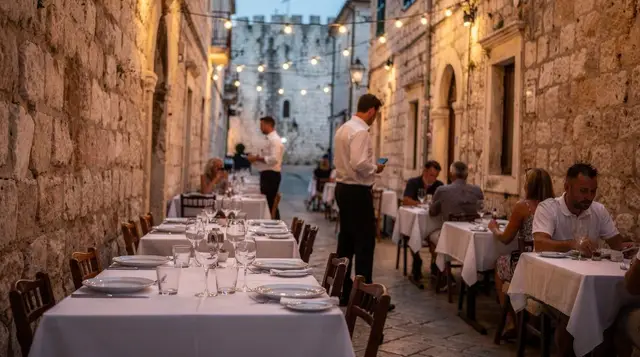
The bigger difference is in the newer town behind the promenade, in the grid of residential streets around Mainski Trg and the roads feeding into it. This is where people who live in Budva year-round, rather than the seasonal staff and visitors, actually order dinner. Menus are shorter, often only in Montenegrin, and the fish on offer depends on what came in that morning rather than what photographs well. Expect plainer rooms, plastic chairs are common, and expect the bill to be noticeably lower for the same or better food.
Bečići and Rafailovići, the beach settlements a short taxi ride or a walk along the coastal promenade east of Budva, are worth considering too. Both have a more residential, less transient population than central Budva in high season, and restaurants there compete more on repeat local custom than on catching a single evening’s passing trade. Neither is a dramatic detour if you are already staying in or near Budva.
What to order
Grilled fish sold by weight is the safest order almost anywhere on this coast, and Budva is no exception - ask what was landed that day rather than pointing at a photo on a laminated menu, since the photo menu is usually a sign the kitchen is not adjusting daily. Squid or octopus salad is a reliable starter, and black risotto (crni rižoto) is worth ordering only where you can see or ask that it is cooked to order, since a reheated version loses most of what makes it good.
Njeguši prosciutto and cheese, from the mountain village above Kotor, appears on menus across the whole coast and is worth ordering as a starter almost anywhere reasonably priced; our guide to Njeguši prosciutto and cheese covers what to look for. Pair it with a glass of Vranac, the dominant local red, or Krstac if you want something white and lighter - our Montenegrin wine guide has more detail on both. A shot of rakija, the local fruit brandy, is often brought unbidden at the end of a meal as a courtesy; our rakija guide explains the different styles you will be offered.
Reading a menu before you sit down
Most of the work of choosing a good restaurant happens on the pavement, before anyone has pulled out a chair. A few signals are reliable in Budva and across the rest of the coast. A short menu usually means a kitchen that cooks what it bought that morning; a menu the size of a booklet, translated into six languages and illustrated with photographs, usually means a freezer. If the fish is displayed on ice at the entrance or the waiter offers to bring it to the table so you can choose, that is a good sign, and so is a price listed per kilo rather than per portion, because it means the fish is weighed in front of you.
Watch who is sitting there. A room with a few tables of local families and older couples at nine in the evening is telling you more than any review site can. A terrace where every table is a couple taking photographs of the sunset is a terrace that depends on passing trade. None of this is a guarantee, but it is a cheap test that costs nothing and takes ten seconds.
Staff who tout from the pavement are worth treating with caution. A restaurant that needs someone to wave people in is rarely one that fills up on its own reputation. Politely keep walking; the places worth eating at in Budva tend to let the room speak for itself.
Ordering fish without being surprised by the bill
Fish sold by weight is the most common source of an unpleasant surprise, and it is easy to avoid. Ask the price per kilo before you agree to anything, ask the waiter to show you the fish, and ask roughly what the whole fish will weigh and therefore cost. A good restaurant will answer without fuss. If the answer is vague, choose something from the grill that is priced per portion instead, such as squid or a fillet.
Sides are usually ordered separately and are not included. Grilled vegetables, boiled chard with potatoes and a simple tomato salad are the classic accompaniments, and sharing two or three between a table is more than enough. Bread and cover charges are sometimes added to the bill, so glance at the receipt before you pay rather than after you have left. This is the same habit that helps when you eat in Kotor, and our seafood and oysters guide for the Bay of Kotor explains what is worth ordering when the fish comes from the bay rather than the open sea.
Timing: when to eat and when to book
Montenegrin dinner runs late. Locals tend to sit down well after most visitors have finished, and the busiest hour in a good restaurant is often later than you would expect. That works in your favour. Arriving early gives you the pick of tables, a calmer room and a kitchen that has not yet been overwhelmed, while arriving at the peak means waiting and a rushed meal.
In July and August, the places that deserve a table are the ones that fill up, so booking a day ahead, or at least that morning, is sensible for a Friday or Saturday. Outside the height of summer, most backstreet restaurants can seat you without a reservation. Lunch is the quieter and cheaper moment to try somewhere new: many kitchens that are hectic in the evening are relaxed at midday, and a long lunch followed by a swim is a very good way to spend a hot afternoon. If you are choosing between Budva and its neighbours for a longer stay, our guide to when to visit Kotor and the coast and the July and August high season guide show how much the rhythm of the town changes through the year.
Coffee, breakfast and something light
Not every meal has to be a sit-down fish dinner. The coffee culture here is serious, and a slow espresso at a table outside is a normal way to spend an hour in the morning. The same rule about distance from the water applies, but it matters less for a coffee, where you are paying for a seat and a view in any case. For something quick, bakeries and small counters in the streets behind the promenade sell savoury pastries that make a good breakfast or beach snack, usually for much less than a hotel buffet.
If you are travelling with children or with a mixed group, a light meal of grilled meat, salad and bread at a simple grill is the easiest option, and our family guide has more ideas for eating well with younger travellers. For a first-timer who is unsure what to order, a mixed grill plate to share is a safe introduction to Montenegrin cooking.
Eating after the beach
Many visitors end up eating wherever they happen to be when they get hungry, which is usually on a beach. Beach restaurants are convenient and some are very good, but they are priced for a captive audience. If you are spending the day at Mogren Beach or on one of the long beaches nearby, such as Jaz Beach, it is worth packing water and a snack, then walking back into town for a proper meal rather than paying beach prices for every coffee and sandwich. Our guide to the best beaches near Kotor and the Mogren Beach guide cover what each stretch offers in the way of facilities.
The reverse also works. Eat lightly in the early evening and swim again afterwards, or take a walk through Budva old town while the stone is still warm and the day trippers have gone home. Our guide to Budva old town highlights suggests a route that fits comfortably around a dinner reservation.
A rainy evening and other changes of plan
Budva is a beach town and the dining scene is designed around good weather. When the weather turns, terraces empty and the best rooms are the indoor ones, which is another reason to favour restaurants with a proper dining room rather than a few tables on the pavement. Our guide to what to do in Budva when it rains is useful for planning a day around a long lunch, and the same logic applies if you have a late arrival and need to find dinner in a hurry: head for the residential streets, where kitchens stay open for locals, rather than the front line, where closing times follow the footfall.
A simple plan for a week in Budva
If you are staying several nights, vary the pattern. Eat once on the promenade if the view matters to you, and treat it as the souvenir meal. Spend the other evenings in the streets behind it, trying a different grill or fish place each time and asking for the day’s catch. Add one evening in Bečići or Rafailovići, and one lunch somewhere inland or in the mountains, where the cooking is different and the pace slower. Our Kotor and Budva base comparison and the Montenegro without a car guide explain how to move between them without a rental.
A rough price comparison
Prices below are for the same or comparable dishes, mid-summer 2026, comparing the seafront promenade and old town’s busiest lanes against streets a few blocks back and the residential grid behind Mainski Trg. Off-season prices run 20 to 30 percent lower across the board.
| Dish | Promenade / busiest old town lanes | A few streets back |
|---|---|---|
| Grilled squid | 18-22 EUR | 10-14 EUR |
| Grilled fish, per kg | 45-60 EUR | 30-45 EUR |
| Black risotto | 14-18 EUR | 9-13 EUR |
| Njeguši prosciutto and cheese platter | 10-14 EUR | 6-9 EUR |
| House wine, glass | 4-6 EUR | 2.50-4 EUR |
| Local beer (Nikšićko) | 3.50-5 EUR | 2.50-3.50 EUR |
These are averages, not quotes for any specific restaurant, and a handful of promenade places do hold reasonable prices - it is a tendency, not a rule with no exceptions.
Nightlife makes some evenings loud, not just expensive
Budva’s restaurant scene sits inside its reputation as the loudest nightlife town on the Montenegrin coast, and that matters for anyone hoping for a quiet dinner. From mid-June through early September, clubs and beach bars along Slovenska Obala and around the Trocadero strip run music well past midnight, and the sound carries into the streets immediately behind them. A table one block back from the water does not guarantee quiet; a table two or three blocks back, or a booking before 8pm before the volume ramps up, usually does. Our Budva nightlife guide covers which streets and venues are loudest and when.
If a calm dinner matters more than proximity to the old town, Bečići and Rafailovići are quieter by a meaningful margin, as is the walk up toward Budva old town’s inner lanes away from the main gate-to-gate route. Outside July and August, the noise problem mostly disappears on its own.
Food-focused day trips out of Budva
If you would rather have someone else choose the good addresses, a handful of small-group tours based in Budva build the meal into the itinerary rather than leaving you to find it. A day trip that combines coastal viewpoints with a wine tasting and a home-cooked lunch away from restaurant menus altogether is one option - a small-group outing pairing local wine and a home-style lunch with stops at viewpoints along the coast - and it removes the guesswork on where to eat that day entirely.
For something built specifically around one ingredient, a half-day excursion to Bar’s Old Olive Tree Park with an olive oil tasting is a reasonable pairing with a Budva-based stay, since Bar’s olive oil turns up on menus across the coast.
Closer to the mountains, a day tour through Njeguši and Cetinje that includes a stop for prosciutto and cheese tasting covers the same food you would otherwise be ordering off a Budva menu, but at its actual source. For a shorter outing that pairs food with sightseeing, a guided walk through Budva that takes in the Sveti Stefan viewpoint is a half-day option that fits around a dinner reservation rather than replacing one.
None of these tours are necessary for a good meal in Budva - the streets described above will get you there on your own - but they are a reasonable shortcut if time is short or you would rather not gamble on an unfamiliar menu.
Comparing Budva to nearby bases
If you are deciding where to stay along this stretch of coast rather than just where to eat one evening, it is worth reading how Budva compares to the alternatives. Our Kotor vs Budva guide weighs up the two as a base for a longer stay, and our Budva daily budget guide breaks down typical daily costs including food, so the restaurant prices above sit inside a wider picture. For contrast, our Kotor old town eating guide covers the same promenade-versus-backstreets problem as it plays out 30 minutes up the coast.
Whichever streets you end up eating on, the pattern holds across this whole coastline: proximity to the sea correlates with price far more reliably than it correlates with quality, and the best plate of grilled fish in Budva is rarely the one with the best view of the water.
Kotor food & drink tours on GetYourGuide
Verified deep-linked GetYourGuide tours. Book through these links and we earn a small commission at no cost to you.
GetYourGuide does not provide a product photo for this activity — the image shows the meeting point, photographed by us.