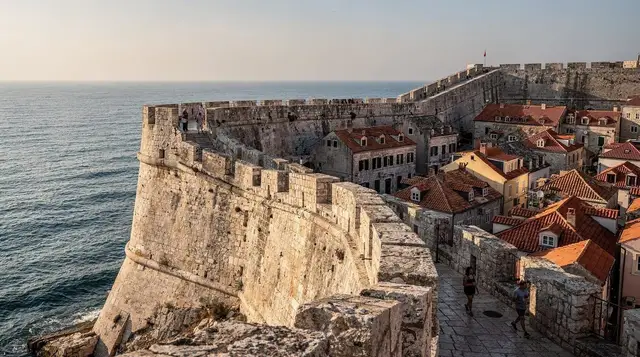
Cavtat gets mentioned constantly in the same breath as Dubrovnik, and for a practical reason: coming from Kotor, it sits directly on the way in, about 10 minutes before you reach Dubrovnik’s old town itself. Most people who stop here are doing it as an add-on to a Dubrovnik day, not instead of one — and that is the right way to think about it. Cavtat is a genuinely pleasant half-day stop. It is not a substitute for the walls, the cathedral and the sheer scale of Dubrovnik’s old town.
Why stop in Cavtat at all
The pitch for Cavtat is simple: a working seafront town with palm trees, a small Renaissance-era old town on its own peninsula, a handful of real sights, and almost none of the bottleneck you get squeezing through Dubrovnik’s Pile Gate at midday. Where Dubrovnik’s old town channels everyone through a few narrow streets between medieval walls, Cavtat is open and low-density — a curved promenade, two harbours either side of a small headland, and enough space that even a moderately busy day doesn’t feel crowded.
What it is not: a walled city, a UNESCO site on Dubrovnik’s scale, or somewhere with enough to fill a full day on its own. If you only have one day for the Croatian side of a Kotor trip and have to choose, Dubrovnik’s old town is the better use of it. Cavtat earns its place as a second stop, a lunch break, or a calmer alternative on a day when Dubrovnik itself is clearly overwhelmed — cruise ship count checked, queue at the Pile Gate visibly long, temperature past 30 degrees in the shade-free parts of the walls.
If you are still deciding how to split your days between the two countries, the Montenegro versus Croatia comparison puts the coast on either side of the border side by side. And if your base is Kotor, it helps to read the Dubrovnik page first, since Cavtat only really makes sense once you know what you are pairing it with.
Getting there from Kotor
The drive is straightforward but the timing is not fixed, because the Croatian border is the real variable in the day.
Route and distance. From Kotor it’s around 45 km, mostly along the coastal road, crossing into Croatia at Debeli Brijeg/Karasovici — the same crossing used for Dubrovnik. Outside peak season this is a drive of roughly 1 hr 30 to 1 hr 45 including the border stop. In July and August, expect 2 to 5 hours of queueing at Debeli Brijeg alone, worse on Saturdays when accommodation changeovers stack up on both sides. The EU’s entry/exit system has added extra processing time on the Croatian side of the border since 2025, on top of the seasonal queue.
The alternative crossing. The smaller Vitaljina crossing, further inland, is usually much faster — often 10 to 20 minutes even when Debeli Brijeg is backed up — but it adds distance and doesn’t suit every route. It’s worth checking on a map or a live border-wait app on the morning you travel rather than assuming either crossing will be quick.
By car. Self-driving is the most flexible option and lets you set your own order for Cavtat and Dubrovnik. Parking in Cavtat itself is limited near the old town peninsula in summer; the car park close to the ferry harbour and the roads slightly back from the seafront are more reliable than trying to find a space right on the promenade.
Without a car. There’s no direct bus link from Kotor to Cavtat, and no centralised online booking system for Montenegrin coastal buses in general. The realistic options are a rental car, a private transfer, or a guided day tour that covers both Dubrovnik and Cavtat in one itinerary. A private guided tour and transport option built specifically for the Cavtat region handles the border crossing and parking logistics, which removes most of the day’s uncertainty.
a private guided tour and transport option covering Dubrovnik and the Cavtat region is worth comparing against a self-drive rental if you’d rather not deal with the border queue yourself, especially in July or August.
What’s actually in Cavtat
The sights cluster on and around a small peninsula, walkable in well under an hour if you don’t stop.
The old town peninsula. Narrow stone streets, a scattering of Renaissance-era buildings, and a much smaller, calmer version of the density you find in Dubrovnik’s old town — without the walls. There is no defensive perimeter to walk here, which is part of why it feels open rather than closed-in.
The Rector’s Palace (Knežev dvor). A 16th-century building that now houses a local museum with archaeological and cultural exhibits. It’s a modest, 20 to 30 minute visit rather than a headline attraction, but it’s the closest thing Cavtat has to an indoor sight if the weather turns.
The Račić family mausoleum. Up on the hill above the town, at the cemetery, this Art Nouveau mausoleum was designed by the sculptor Ivan Meštrović — a name recognisable to anyone who’s seen his work elsewhere in the former Yugoslavia. It’s a short uphill walk from the centre and one of the more distinctive single sights in town, more architecturally interesting than most visitors expect from a cemetery stop.
Two harbours, one headland. Cavtat sits on a small peninsula with a harbour on each side — one facing the open sea, used by day-trip and speedboat traffic, and a quieter marina side. Walking the loop around the headland takes 20 to 30 minutes and gives you both.
The coastal path to Tiha and Sunčana bay
Beyond the old town, a paved coastal path runs along the water toward Tiha Bay and further to Sunčana Bay, both with pebble-and-concrete swimming spots that are noticeably less crowded than the harbour front itself. The walk from the centre to Tiha Bay is about 15 to 20 minutes on flat ground, easy for most fitness levels and doable in normal walking shoes rather than hiking gear. This is the part of a Cavtat stop that makes the most sense as an afternoon activity if you’ve already done the walls and heat of Dubrovnik earlier in the day — a swim rather than another round of sightseeing.
Boat trips and getting on the water
Cavtat’s flatter, calmer waterfront makes it a reasonable base for a short boat trip, whether that’s a rented boat you drive yourself or an organised tour.
| Option | What it covers | Roughly suits |
|---|---|---|
| Self-drive boat rental | No skipper required on smaller boats; explore the coastline and coves at your own pace | Groups who want flexibility over a fixed itinerary |
| Hop-on-hop-off boat, Dubrovnik-Cavtat-Župa | Fixed stops along the coast between Dubrovnik, Cavtat and the Župa riviera | Travellers without a car who want to combine several coastal towns in one ticket |
If you’d rather not deal with mooring or navigation, a self-drive boat rental based in Cavtat is a lower-commitment way to get on the water for an hour or two than booking a full guided excursion. For covering more ground along the coast without driving, the hop-on-hop-off boat linking Dubrovnik, Cavtat and the Župa riviera lets you get off at whichever stop looks least crowded that day.
Neither of these is a substitute for a proper Bay of Kotor boat tour if that’s what you’re after — see the Kotor Bay boat tour guide for that side of things. They’re a Croatia-side add-on, not a Montenegro-side one.
Where to eat, and where the markup is worst
Cavtat’s promenade is lined with restaurants facing the harbour, and pricing follows the same logic as any waterfront strip in this region: the tables closest to the water and the boats cost more for the same plate of grilled fish you’d get for less two streets back. Expect roughly 12-20 EUR for a main at a seafront restaurant in summer, similar to or slightly above prices in Kotor’s old town, and noticeably above what you’d pay a short walk inland in Konavle village restaurants.
If you’re coming from Kotor, the food itself won’t feel unfamiliar — grilled fish and squid, prosciutto and cheese plates, and the same broad Adriatic repertoire you’ll find on the Montenegrin coast, just under Croatian pricing and with Croatian wine lists rather than Montenegrin Vranac and Krstac.
Cavtat versus Dubrovnik old town
Worth being blunt about this, since it’s the actual decision most people are making.
| Cavtat | Dubrovnik old town | |
|---|---|---|
| Walls to walk | None | 4.5 km circuit, the main draw |
| Typical visit length | 2-3 hours | Half a day minimum |
| Crowd density, midday | Low to moderate | High, especially with 2+ cruise ships in port |
| Cost to enter main sights | Free to walk around; museum entry a few euros | City walls ticket required, priced separately |
| Best for | A calm add-on, a swim, a quiet lunch | The actual reason to cross the border |
If you’re weighing the two destinations against each other more broadly rather than just for a single day trip, the Kotor versus Dubrovnik comparison guide covers that at the destination level.
Combining Cavtat with the rest of the day
Realistically, almost nobody drives from Kotor to Cavtat and back for Cavtat alone — the border crossing takes too much of the day to justify it for a two-hour stop. The two common patterns:
Dubrovnik in the morning, Cavtat in the afternoon. Do the walls and old town of Dubrovnik early, before the heat and the cruise crowds peak between 10am and 4pm, then head to Cavtat afterwards for lunch and a swim on the way back toward the border. This is the version that makes the most sense of Cavtat’s flat, walkable waterfront — it’s a good place to be at 3pm when Dubrovnik’s stone streets are radiating heat.
Cavtat as a stop on a wider loop. If you’re continuing further into Croatia or looping back through Bosnia and Herzegovina, Cavtat sits close enough to the border that it works as a first or last stop on a longer day, alongside places like Konavle inland. The Montenegro-Croatia-Bosnia loop itinerary covers that kind of multi-country day in more detail, and the two countries in one day guide is built specifically around this kind of short cross-border trip.
For the Dubrovnik logistics themselves — parking, walls tickets, timing around cruise arrivals — the Dubrovnik day trip from Kotor guide and the Dubrovnik to Kotor transfer guide go into the detail this page doesn’t repeat.
Practical notes for the day
Money. Croatia uses the euro, same as Montenegro, which removes one layer of hassle at the border — no currency to change or reconvert for a day trip.
Passport and Schengen. Montenegro is outside Schengen; Croatia is inside it. Crossing the border means a proper passport check each way, and — unlike time spent in Montenegro — a day in Croatia does count against the 90/180-day Schengen limit if you’re tracking that for the rest of a longer European trip.
Timing the border. If your schedule allows any flexibility, an early morning crossing (before 8am) or a late one (after 7pm) avoids the worst of the Debeli Brijeg queue in July and August. Checking the queue on a live border-crossing app before you leave Kotor is a five-minute habit that can save two or three hours.
Fuel and tolls. No separate toll road is needed for this specific route, unlike the drive toward Podgorica through the Sozina tunnel. Fill up in Montenegro if fuel prices are running lower there that season — worth a glance at the pump price before crossing.
Renting a car for the day. If you’re not already driving a rental from elsewhere in Montenegro, see the car rental in Montenegro guide for what to expect on cross-border insurance — not every rental agreement automatically covers driving into Croatia, and it’s worth confirming before you reach the border rather than at it.
Cruise days. If a big ship is also in Kotor that morning, the old town you are leaving behind will be crowded too, which is one more reason to leave early; the cruise ship days in Kotor guide explains how to read the situation before you set off.
Getting to the car. If your car is parked some way from your accommodation, the taxis in Kotor guide covers the simplest way to bridge that gap at the start and end of a long day.
Cash and cards. For a general sense of what to carry on a day like this, the money and ATMs guide is a useful companion.
Parking in Kotor before you leave. If you’re staying in Kotor’s old town area, sort out where you’re leaving your car for the day before setting off — the parking in Kotor guide covers the marina and Škaljari options that work better than circling the old town looking for a space.
Frequently asked questions about visiting Cavtat from Kotor
Is Cavtat worth visiting instead of Dubrovnik old town?
Cavtat is worth an add-on, not a substitute. It has a pleasant palm-lined waterfront, a small Renaissance old town and none of the cruise-crowd bottleneck of Dubrovnik’s walls, but it lacks the walls, the cathedral and the scale that make Dubrovnik itself worth the trip. Most visitors from Kotor combine the two in one long day rather than choosing between them.
How far is Cavtat from Kotor?
About 45 km and, outside July and August, roughly 1 hr 30 to 1 hr 45 including the Debeli Brijeg/Karasovici border crossing. In peak summer, border queues alone can add 1 to 3 hours, occasionally more on a Saturday, so treat the drive time as a range rather than a fixed number.
Can I visit Cavtat without a car?
Not easily from Kotor. There is no direct bus link, and the practical options are a rental car, a private transfer or a guided day tour that includes Cavtat as a stop alongside Dubrovnik. Once in the Dubrovnik area, a local bus and a passenger boat both connect Dubrovnik’s Gruž harbour to Cavtat.
Do I need a visa or extra documents to cross into Croatia for the day?
No visa is needed for UK, EU/EEA, US, Canadian or Australian passport holders visiting Croatia for the day, but bring your passport and expect a proper document check at the border in both directions, since Montenegro is outside Schengen and the EU. Croatia is a Schengen member, so time spent there does count toward the 90/180-day Schengen allowance if that matters for the rest of your trip.
Is Cavtat busy with cruise passengers too?
Less so, and rarely at Cavtat’s own harbour. The waterfront can still feel fuller in the 10am to 4pm window because some Dubrovnik cruise excursions and hop-on-hop-off boats stop here, but Cavtat never approaches the density of Dubrovnik’s old town on a multi-ship day.
What is there actually to do in Cavtat in a few hours?
A walk around the small peninsula old town, a look at the Rector’s Palace and the Račić family mausoleum, a coastal path walk to Tiha or Sunčana bay for a swim, and a seafront lunch. Two to three hours covers the sights; a half-day lets you add a swim or a short boat trip.
Should I do Cavtat before or after Dubrovnik old town?
After, if you are doing both in one day. Dubrovnik’s walls and old town need the cooler parts of the day and reward an early start; Cavtat’s flat waterfront walk works fine in the early afternoon heat and makes a relaxed way to close out the day before the drive back to Kotor.