Kotor vs Dubrovnik: which one deserves your bed for the night
Should I stay in Kotor or Dubrovnik?
Base yourself in Kotor. It is smaller, cheaper and inside a mountain-ringed bay Dubrovnik does not have, and you can still see Dubrovnik on a day trip. Dubrovnik's old town is larger and its walls are walkable, but it is more expensive and far more crowded with cruise passengers between roughly 10am and 5pm.
Two walled towns, one decision worth getting right
Kotor and Dubrovnik sit about 2 hours apart by road, both fortified, both UNESCO-listed, both photographed from above by everyone who visits. It is tempting to lump them together as interchangeable “old town” stops on an Adriatic itinerary. They are not interchangeable, and the choice of where you sleep changes the shape of your trip more than most guides admit.
This is a straight comparison: cost, crowding, what is actually inside each set of walls, how hard it is to get between them, and which one rewards being your base rather than your day trip. The short version, stated up front, is that Kotor is the better base and Dubrovnik is the better day trip - not the other way round.
Cost: Kotor runs cheaper across the board
Montenegro adopted the euro unilaterally in 2002 despite never joining the EU, so there is no currency conversion between the two countries - Croatia also uses the euro. That makes prices directly comparable, and the comparison favours Kotor.
| Item | Kotor / Bay of Kotor (summer) | Dubrovnik (summer, approx.) |
|---|---|---|
| Coffee | €1.20-2 | €2.50-4 |
| Local beer (Nikšićko) | €2.50-4 | €4-6 |
| Main course, non-touristy restaurant | €8-15 | €15-25 |
| Apartment, per night | €50-100 | €90-160 |
| 3-4 star hotel, per night | €90-180 | €150-280 |
These are order-of-magnitude figures, not fixed rates - both towns swing higher on the harbourfront and lower a short walk inland, and Kotor’s own old town restaurants on the waterfront are its most expensive tables too. But the gap between the two towns is consistent enough to matter for a week-long trip: choosing Kotor as your base and doing Dubrovnik as an excursion, rather than the reverse, saves real money on every night’s accommodation.
Crowds: this is the argument that decides it
Both old towns take cruise ships. Both get uncomfortable between roughly 10am and 4-5pm when ships are in port. But the scale is different. Dubrovnik’s old town can have several large ships in port simultaneously, tens of thousands of day passengers moving through a walled perimeter that, while bigger than Kotor’s, still funnels everyone down the same main street. Kotor logged around 505 cruise-ship calls and more than 700,000 passengers across the 2025 season - a single large ship alone can put 2,000 to 4,000 people through the old town gates in a few hours - which gives a sense of scale, and Dubrovnik’s numbers run well ahead of that.
The practical difference for a traveller basing themselves in one town or the other: if you sleep in Dubrovnik, you are inside the crowd every single evening as ships arrive and day-trippers fill the streets before dispersing back to their coaches and tenders. If you sleep in Kotor and visit Dubrovnik on a single day trip, you absorb the crowding once, on a day you chose, and you retreat every other evening to a town that empties out by early evening once the ships have sailed. Early morning (before 9:30am) and early evening (after 5pm) are calm in both places - the difference is how many of your evenings you get to spend in that calm version of the town.
What is actually inside each set of walls
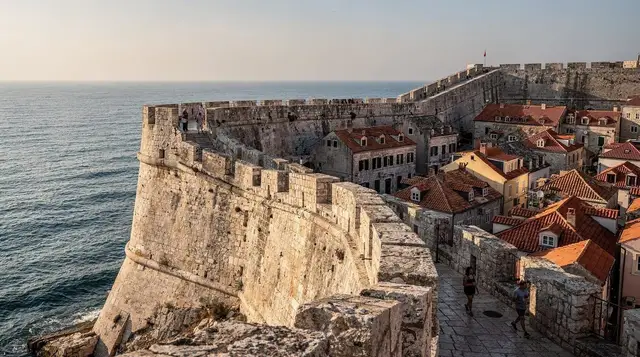
Dubrovnik’s old town is larger and has more to see per square metre: the Stradun (its main limestone street), the full circuit of city walls open for a paid walk with sea views the whole way round, Baroque churches, the Rector’s Palace, several museums, and a denser concentration of shops and restaurants. If your interest is architecture, museums and a long, unhurried wander, Dubrovnik’s old town rewards more hours than Kotor’s does.
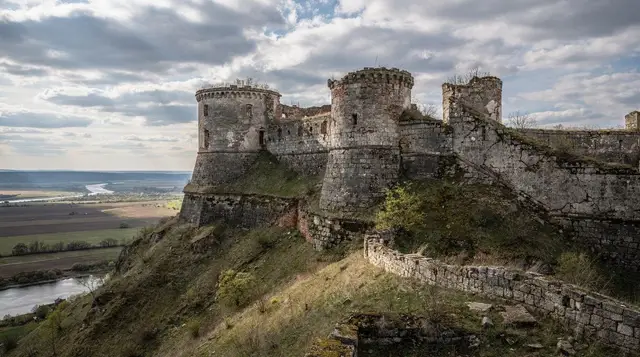
Kotor’s old town is smaller and more compact - its 4.5km of Venetian-era walls enclose a maze that a visitor can cross end to end in 30 to 45 minutes. It has three gates (Sea Gate, River Gate and Gurdić Gate), a central square, and the twin-towered Cathedral of Saint Tryphon, rebuilt asymmetrically after earthquake damage.
What Kotor has that Dubrovnik does not is what lies above and around the walls: the San Giovanni fortress climb straight up the mountainside behind the old town, and a genuine mountain-ringed bay rather than an open coastline. Read more in our Kotor old town walking guide before you go.
The bay Dubrovnik does not have
This is the structural difference that a straight “old town vs old town” comparison misses. Kotor sits at the innermost point of the Bay of Kotor (locally Boka) - a ria, a drowned river valley rather than a fjord, though visually it reads as one, with limestone mountains rising almost straight from the water on both sides. Dubrovnik’s setting is coastal: cliffs, islands offshore, an open Adriatic backdrop, but nothing like Kotor’s enclosed, mountain-walled inlet.
That geography is what fills a Kotor-based itinerary once the old town’s 30-45 minutes are done. From a base in Kotor you can reach Perast and the artificial islet of Our Lady of the Rocks in 20 minutes, climb the San Giovanni fortress’s roughly 1,350 steps for a view over the entire bay, or take a boat around the Kotor Bay boat tour route past Perast, Risan and the Blue Cave. None of that exists on a Dubrovnik base - Dubrovnik’s excursions run to islands and along open coast instead.
What an evening in each town actually feels like
The difference between the two bases is clearest after the ships leave. In Kotor, the lanes of the old town loosen up, tables spill onto the small squares, and the walk back to your room is a few minutes through stone alleys rather than a trek through a crowd. Our guide to where to eat in Kotor’s old town shows how to find the places locals use rather than the ones facing the main gate, and the Kotor nightlife guide covers what happens later on. Dubrovnik is lively too, but it is a larger machine, and the contrast with a small bay town is part of why many travellers who try both end up preferring Kotor for sleeping.
Mornings tell the same story. A walk along the waterfront before the first coaches arrive, a coffee on a quiet square, and the walls to yourself for an hour: this is easier to repeat day after day when your bed is in a small town than when it is inside the most visited walled city on the coast.
Who should choose Dubrovnik as the base anyway
There are honest cases for the other choice. If your flight lands in Croatia, if your trip is mostly about the Croatian islands further north, or if you want museums and long architectural wanders as the centre of your days, sleeping in Dubrovnik removes a border crossing from your plans. Travellers with very little time who want one famous walled city and nothing else will also be well served by it. The argument in this guide is not that Dubrovnik is a disappointment; it is that it works better as a single well-planned visit than as a place you return to every evening.
If you do end up in Dubrovnik, the reverse day trip is easy to build: the same bay, the same villages, seen from the Croatian side. The Montenegro vs Croatia comparison helps you weigh the two countries as a whole before you commit.
Making the Dubrovnik day trip work from Kotor
Treat the Dubrovnik day as a project rather than an afterthought. Leave early so that you arrive before the crowd builds, decide in advance what you want to see inside the walls, and accept that you will not see everything. Most people are happiest with a simple plan: the main street, a stretch of the walls, a lunch away from the busiest corner, and a slow return. Our Dubrovnik day trip from Kotor guide lays this out step by step, and the Dubrovnik to Kotor transfer guide explains the transport options if you are travelling the other way or one-way.
Pick a day outside the busiest cruise times if you can, and avoid planning the crossing for a Saturday in summer. If you prefer to have the logistics handled, the tours listed below exist precisely to absorb the border question. If you would rather add a second country without the hassle of Dubrovnik, two countries in one day from Kotor and the Mostar day trip show other ways to cross a border from your Kotor base.
What to do with the days you keep in Kotor
Basing in Kotor only pays off if you use the bay. A relaxed rhythm is to alternate one big outing with one slow day: the fortress climb early, then the water in the afternoon; a boat day, then a long lunch in a village. The Kotor in one day guide covers the minimum, while the three-day itinerary and the five-day itinerary show how a longer stay fills out without repetition. Quieter corners such as Perast without the crowds and Stoliv and the hidden villages of the Vrmac are exactly what a Dubrovnik base cannot offer on its doorstep, and the Bay of Kotor boat or car question is worth settling early.
Getting between them
The road distance is short - roughly 2 hours outside peak season - but the border adds a variable that a straight kilometre count does not capture. The main coastal crossing at Debeli Brijeg-Karasovići backs up badly in July and August, with waits of 2 to 5 hours reported at the worst points, Saturdays included, when accommodation changeovers cluster traffic in both directions. The EU’s entry/exit system (EES) has added extra processing on the Croatian side since 2025, which has not helped queue times. The inland Vitaljina crossing, further from the coast, usually clears in 10-20 minutes and is worth knowing about even though it adds distance to the route.
Outside July and August, the crossing is typically routine and the 2-hour drive time holds. If you would rather not manage the border yourself, several operators run the route as a guided day trip - see the tour options below.
| Direction | Approx. drive time (outside high season) | High-season addition |
|---|---|---|
| Kotor to Dubrovnik | ~2 hours | +1-3 hours at the border, worse on Saturdays |
| Dubrovnik to Kotor | ~2 hours | Same border, same risk |
Which base actually works better
Putting the pieces together: Dubrovnik is bigger, has more to see inside its walls, and costs more. Kotor is smaller, cheaper, and sits inside a mountain bay that gives you two or three additional days of things to do without repeating yourself. Basing in Kotor and visiting Dubrovnik as a single, well-timed day trip captures what Dubrovnik does well - the walls, the Stradun, the museums - without paying Dubrovnik’s nightly rates or absorbing its crowd every evening. Basing in Dubrovnik and day-tripping to Kotor works logistically too, but you would be paying more for accommodation to see less on your doorstep, since Dubrovnik’s own surroundings do not match Kotor’s bay for variety.
If your trip is genuinely split between the two - a few nights each - that is a reasonable compromise, but weight the split toward Kotor if crowd tolerance and budget both matter to you.
Booking the crossing as a tour instead of self-driving
For travellers who would rather skip the border-crossing calculation altogether, several operators run the Kotor-Dubrovnik route as a guided outing rather than requiring self-driving:
From the Dubrovnik side, a full-day Dubrovnik day trip that combines Perast, Kotor and Budva covers all three coastal stops without you managing logistics, and a private car and guide option to Kotor and Perast suits a family or small group wanting their own pace and pickup time. A small-group tour from Dubrovnik to Kotor and Perast sits between those two in price and flexibility.
Going the other way, from a Kotor base, a guided day trip pairing Kotor and Perast is the mirror option, and travellers who would rather skip the road entirely can look at the fast ferry connection between Dubrovnik and Kotor, which sidesteps the Debeli Brijeg queue altogether in exchange for a fixed sailing schedule. If you are coming from a cruise ship calling at Dubrovnik, a shorter Cavtat and Dubrovnik old town walking excursion is worth considering if Kotor and Perast do not fit your port call.
A simple rule of thumb
If you remember one thing from this comparison, make it this: sleep where the setting gives you the most to do without a car, and visit where the monuments are densest. In this pair, that means the bay for your nights and the walled city on Croatia’s coast for a single carefully chosen day. Travellers who reverse the order tend to spend more, queue more and see less variety, while those who follow it usually find that Dubrovnik is more enjoyable precisely because they only have to face it once. Whatever you decide, book accommodation early for the summer months, keep a flexible day in your plan for weather or border delays, and let the rest of the trip stay unhurried.
Planning either base
Whichever town you sleep in, the practicalities are similar: both accept euros, both run on CET/CEST (the same time as Paris and Rome outside Montenegro’s own quirks), and both fill up fast in July and August. For the Montenegro side specifically, our guides on where to stay in Kotor Bay, how many days to spend in Kotor and the bay and Montenegro’s daily budget fill in the detail this comparison does not have room for.
If timing is your main concern, our cruise ship days in Kotor guide and the best time to visit Kotor guide both help you dodge the worst of the crowding on either side of the border.
For a wider frame on how Montenegro compares with Croatia generally, not just these two towns, see our Montenegro vs Croatia comparison, and for the Montenegro coast’s other base-town question, Kotor vs Budva covers the more local trade-off.
Best day trips from Kotor on GetYourGuide
Verified deep-linked GetYourGuide tours. Book through these links and we earn a small commission at no cost to you.
GetYourGuide does not provide a product photo for this activity — the image shows the meeting point, photographed by us.