Seven days from Kotor: bay, coast, mountains, and Croatia
Kotor makes a workable base for a full week only if the week is planned as a loop rather than a string of day trips radiating from the same bed. This one moves you along the bay, down the coast, up into the mountains, and across an international border, then back. It’s a moderate-difficulty week: comfortable walking shoes, a driver or reliable transfers, and one day — the last one — that has more logistics in it than sightseeing.
| Day | Focus | Overnight |
|---|---|---|
| 1 | Arrival, Kotor Old Town | Kotor |
| 2 | Bay of Kotor by boat, Perast | Kotor |
| 3 | Budva and the Budva Riviera | Kotor |
| 4 | Lake Skadar | Kotor |
| 5 | Transfer to Durmitor National Park | Žabljak |
| 6 | Black Lake, morning hike, return to Kotor | Kotor |
| 7 | Day trip to Croatia via Debeli Brijeg | Kotor |
Day 1: Arrival and Kotor Old Town
Wherever you fly into shapes how relaxed this first day feels. Tivat (TIV) is closest at roughly 7km and 15-20 minutes by taxi (20-30 EUR), but its schedule is mostly seasonal. Podgorica (TGD) is about 90km and 1h15-1h30 away and runs year-round, with no direct bus into Kotor. Dubrovnik (DBV) is 75-95km and 1h45-2h outside the summer months — in July and August, add another one to three hours for the same border crossing you’ll use again on Day 7.
Once you’re settled, walk Kotor Old Town: the UNESCO-listed centre inside 4.5km of city walls, which takes 30-45 minutes to cross end to end without stops. Come in through the Sea Gate, take in the Square of Arms, and step into the Cathedral of Saint Tryphon, consecrated in 1166 and still visibly asymmetric — its two towers were rebuilt differently after earthquake damage, most recently in 1979.
If you’re arriving on a cruise-heavy day, note the old town is busiest 10am-4pm; after 5pm it empties out and is genuinely pleasant. For a slower first evening, see the one-day Kotor guide and don’t be surprised by the resident cat population — it has its own history, covered in the cats of Kotor guide.
Day 2: The bay by boat, and Perast
The Bay of Kotor is a ria — a drowned river valley, not a fjord — and the easiest way to understand that is from the water. A half-day or sunset boat tour out to Perast and Our Lady of the Rocks covers the two things worth seeing on the inner bay without a car:
a two-hour boat tour to Perast and Our Lady of the Rocks at sunsetPerast itself is 12km and about 20 minutes from Kotor by road if you’d rather go by land first and take a shorter boat hop to the island. Perast without the crowds is worth reading before you go, since the town is small and fills up fast once tour buses arrive. Our Lady of the Rocks is an artificial islet, built up over centuries on submerged rocks; the shuttle boat from Perast’s waterfront costs a few euros each way — see the visit guide for what’s actually inside the chapel versus what’s skippable.
Day 3: Budva and the Riviera
Budva is a 30-minute drive or transfer from Kotor along the coastal corniche — scenic, but narrow in places, with blind curves that catch drivers unused to Adriatic coast roads. A boat tour is the calmer option and gets you a look at the coastline you’d otherwise only see from a car window:
a boat tour along the coast to BudvaBudva Old Town is smaller and more built-up around it than Kotor’s, with a livelier beach and nightlife scene. You’ll pass close to Sveti Stefan on this leg — the islet hotel has been closed to the public since 2021, so treat it as a photo stop from the road or from Milocer beach, not a destination. Prices here run a notch above Kotor for anything on the waterfront; a coffee is 1.20-2 EUR either way, but a beachfront lunch in Budva tends toward the top of the 8-15 EUR range for a main.
Day 4: Lake Skadar
Lake Skadar is roughly 1h15 from Kotor via Cetinje or the coastal route through Budva and inland to Virpazar, the lake’s main gateway village. This is the one day on the itinerary that trades sea views for wetlands, birdlife, and a genuinely different landscape — reed channels, floating villages, and the source of the carp and eel that show up on menus across the coast.
a scenic Skadar Lake boat cruise with swimming stopsBase yourself around Virpazar for the boat departure point, and check the Lake Skadar boat tour guide for morning-versus-afternoon light — mornings are calmer and cooler, and the wildlife is more active before the heat sets in. Return to Kotor for the night; this is a long but manageable day without a rental car if you book a transfer alongside the boat trip.
Day 5: Transfer to Durmitor National Park
This is the itinerary’s hinge day, and it’s worth being honest about it: Žabljak, the base town for Durmitor, is 3h to 3h30 from Kotor by road, mostly on mountain routes through Nikšić. Without a car, the interior bus network is the least reliable part of Montenegro’s transport system — expect a change in Nikšić rather than a direct service, and no centralised online booking to check times in advance. A private transfer or a Durmitor day-tour operator that includes coast pickup is the more dependable route if you’re not driving yourself.
The payoff is a landscape that has nothing in common with the coast: alpine peaks, pine forest, and air that’s noticeably cooler even in August. Settle into Žabljak in the afternoon and keep the evening light for a first look at Durmitor National Park — the tourist information point in town is a reasonable source for trail conditions, which change fast at this altitude.
Day 6: The Black Lake, then back to the coast
Spend the morning at the Black Lake (Crno Jezero), Durmitor’s most accessible highlight — a roughly 3.6km loop trail around the lake that takes most people 1.5-2 hours at an easy pace, no technical hiking required. For a longer look at the wider park, the Black Lake and Žabljak hiking guide covers route options, and the Tara Canyon guide is worth a read even if you don’t have time for rafting this trip — the canyon and the Đurđevića Tara Bridge are visible from the road out.
a Durmitor Black Lake and Tara Canyon day tourBy early afternoon, start the drive back to Kotor. It’s the same 3-3.5 hours in reverse, so plan the return to land before dark — mountain roads at night are not where you want to be learning the route. This puts you back on the coast for Day 7, which needs an early start.
Day 7: A day in Croatia — Dubrovnik or Cavtat
This is not a rest day. It’s the most logistical day of the trip, and it works best if you treat it that way from the first alarm.
Montenegro is not in the EU, the Schengen area, or the eurozone (it uses the euro unilaterally, adopted in 2002), while Croatia has been fully inside Schengen since January 2023. That mismatch means every crossing at Debeli Brijeg/Karasovici is a full passport check in both directions — EU citizens included, despite the common assumption that EU passports mean no checks. The days you spend in Montenegro also don’t count against the Schengen 90/180-day allowance, which matters if you’re combining this trip with time elsewhere in the Schengen zone.
Timing is the real variable. Off-season, Kotor to Dubrovnik is about 2 hours door to door. In July and August, add 2-5 hours of queue at Debeli Brijeg, worse on Saturdays when weekly accommodation turnovers spike traffic; the EU’s EES system has added further delay on the Croatian side since 2025. Build in at least an hour of margin either way, more in peak summer. The Vitaljina crossing, further inland, often clears in 10-20 minutes and is worth the small detour if the coastal crossing looks backed up — check current wait estimates before you commit to a route. Background on just how bad a bad Saturday can get is in this account of a summer border crossing.
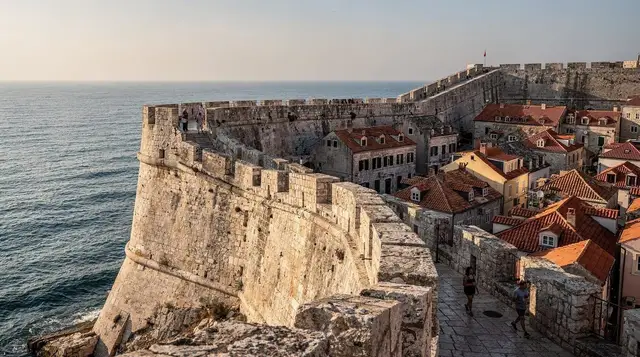
Once across, Dubrovnik in a single day comes down to timing, not stamina: walk the 1.9km of city walls and the old town before roughly 9:30am, ahead of the cruise-passenger arrivals that fill the streets from mid-morning through late afternoon. After that window, the old town is crowded and slow to move through until early evening. If the border delay eats your morning, or you’d rather skip the crowd management entirely, Cavtat is a calmer alternative about 20 minutes from the border — a smaller waterfront town with its own old core and none of the cruise-day crush.
Return to Kotor in the late afternoon or evening, factoring the border queue a second time. Given the crossing uncertainty, this day rewards a flexible plan over a tightly booked one — a fixed dinner reservation back in Kotor is a risk not worth taking in peak season.
Budget and practicalities for the week
| Item | Typical range |
|---|---|
| Coffee | 1.20-2 EUR |
| Local beer (Nikšićko) | 2.50-4 EUR |
| Main course, non-touristy restaurant | 8-15 EUR |
| Apartment, summer | 50-100 EUR/night |
| Hotel, 3-4 star, summer | 90-180 EUR/night |
| Kamenari-Lepetane ferry, car | 5 EUR |
Power sockets are type C/F at 230V/50Hz. Tap water is safe to drink, including in Kotor. Emergency number is 112 (police 122, ambulance 124, fire 123), and Montenegro’s country code is +382, with 032 for the Kotor area. If you’re staying in private accommodation rather than a hotel, confirm your host has registered you with police within 24 hours — hotels handle this automatically, private rentals don’t always.
Frequently asked questions about this seven-day Kotor loop
Do I need a passport for the Croatia day trip if I’m an EU citizen?
Yes. Montenegro is not in the EU, Schengen, or the eurozone despite using the euro, so every crossing is a genuine passport check in both directions regardless of nationality. Croatia joined Schengen fully in January 2023, which affects its other borders, not this one.
How long is the wait at the Debeli Brijeg border in summer?
Two to five hours is typical in mid-July and August at Debeli Brijeg/Karasovici, worse on Saturdays. The inland Vitaljina crossing usually takes 10-20 minutes and is a reasonable detour if the coastal one is backed up.
Can this itinerary be done without renting a car?
Mostly. The coast and the Croatia day work well with transfers and tours. Durmitor is the hard part — the interior bus network is thin and unreliable, so a private transfer or organised day tour is the practical choice.
Is Sveti Stefan worth visiting on this route?
You can’t visit it — the islet hotel has been closed to the public since 2021. You’ll see it from the road or from Milocer beach during the Budva day, which is the standard way to experience it now.
What’s the best way to see Dubrovnik in one day?
Cross the border as early as possible and walk the walls and old town before 9:30am, ahead of cruise arrivals. The old town stays crowded from mid-morning until late afternoon. Cavtat, 20 minutes from the border, is a quieter fallback.
Should I do Durmitor if I only have a few days?
Only with a full week to spare, since Žabljak is 3-3.5 hours from Kotor each way. On a shorter trip, a single long day tour to the Black Lake and Tara Canyon is the more realistic option.
Is the Blue Cave included in this itinerary?
No — it’s near Herceg Novi on the Lustica peninsula, off this route entirely. It can be added as a half-day swap if you extend the trip.
Best months to do this exact seven-day loop?
Late May to mid-June, and September, offer warm enough weather with shorter border queues and open Durmitor trails. July and August are workable but add real time to the mountain transfer and the Croatia day.
tours.7 days
Verified deep-linked GetYourGuide tours. Book through these links and we earn a small commission at no cost to you.
GetYourGuide does not provide a product photo for this activity — the image shows the meeting point, photographed by us.