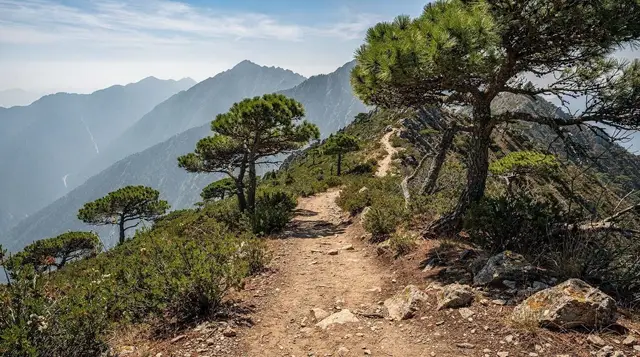
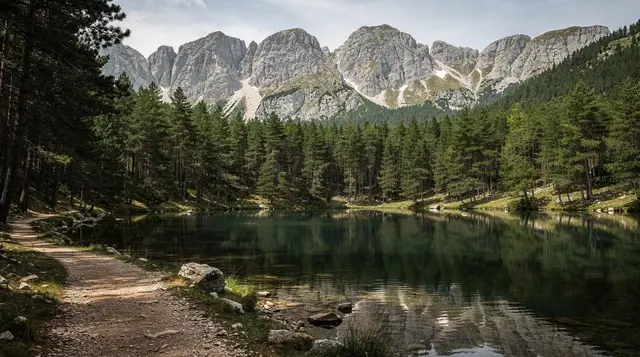
Black Lake, Žabljak: the walk everyone in Durmitor can do
How long does it take to walk around Black Lake?
The loop path around Black Lake (Crno Jezero) is a little over 4 km and mostly flat, and it takes most people a bit over an hour at an easy pace with stops. It needs no hiking experience or special gear, unlike Durmitor's higher trails such as Bobotov Kuk or the ridge routes above the lake.
The one trail in Durmitor almost anyone can walk
Black Lake, or Crno Jezero, sits just outside Žabljak and is the single most visited spot inside Durmitor National Park. The reason isn’t scenery alone — Durmitor has plenty of dramatic viewpoints — it’s that the walk around the lake is flat, short and clearly marked, while most of the park’s other trails climb steeply into alpine terrain that needs proper boots, water, and a full day. If you’ve driven three hours from the coast and want one payoff without a mountain expedition, this is it.
The lake is actually two connected bodies of water, Crno Jezero and the smaller Malo Jezero, joined by a narrow neck of land. Most visitors only walk the loop around the larger lake, and that’s what this guide covers. The path hugs the shoreline through pine forest, with the peaks of the Durmitor massif, including Meded and the ridge toward Bobotov Kuk, visible across the water for most of the walk.
The walk itself
The main loop is a little over 4 km, on packed gravel and dirt paths with almost no elevation change. Budget 70 to 90 minutes at an easy pace with stops for photos; fast walkers do it in under an hour, families with small children and frequent stops can take two. There’s no technical difficulty and no exposure — this is a walk in the woods beside a lake, not a mountain hike, and it’s the reason Black Lake works for people who wouldn’t attempt Durmitor’s higher routes.
That distinction matters because it’s easy to conflate this walk with the rest of the park’s reputation. Durmitor is a serious hiking destination: the climb to Bobotov Kuk, at 2,523 m the highest peak in the massif, is a full-day undertaking on exposed terrain, and the ridge trails above the lake require route-finding experience and proper footwear. The lake loop shares a trailhead area with some of those routes, which occasionally confuses first-time visitors into thinking they need hiking boots and poles for a walk that’s actually flat gravel the whole way round.
Surface is compacted earth and gravel, fine in trainers or sturdy sandals in dry weather; it gets muddy in patches after rain, particularly on the shaded northern side. There’s minimal shade relief from the midsummer sun on the more open southern stretch, so a hat and water matter even on a walk this short.
What to bring and how to pace the loop
Because the path is so easy, most people turn up carrying nothing, and that is usually fine. A bottle of water, a light layer, sunglasses and a charged phone for photographs cover almost everything. If you are travelling with children, a small snack is worth having, since the food stalls near the entrance are only there in season and the far side of the loop has nothing at all.
The loop works in either direction, but the two halves feel different. The side near the entrance is wide, busy and sociable, with families, couples and tour groups sharing the path. Once you pass the first stretch, the track narrows, the forest closes in and the sound of other people fades. Walking the near half quickly and slowing down on the far half is a sensible way to spend your time, because that is where the lake looks most like the pictures people hope to take.
Take your time at the narrow neck of land between the two lakes. It is the best place to see how Crno Jezero and Malo Jezero relate to each other, and it gives a good angle on the mountains behind. Pause there rather than rushing through on the way to the car park.
Who this walk suits
This is a good outing for several kinds of traveller. Families with young children can manage it without any fuss, since there is no exposure and no steep ground. Older visitors and anyone who prefers a gentle pace will find the flat surface forgiving. Photographers get plenty of reasons to stop, and people who find the long drive from the coast tiring appreciate a walk that asks very little in return.
It suits people less if you are hoping for a workout or a summit. Those visitors are better served by the harder routes described in our Durmitor National Park guide, or by a more active outing such as the mountain biking in Durmitor guide describes. If you want something longer on foot but still in a forest setting, the Biogradska Gora hiking guide describes a quieter alternative.
Getting there from Kotor
It’s around 3 hours to 3 hours 30 minutes by car from Kotor, roughly 130 km, mostly on mountain roads through Cetinje or via Nikšić, depending on the route. There’s no direct bus from Kotor to Žabljak, so realistic options are driving yourself, an organised day tour, or breaking the trip with an overnight stay.
Given the distance, a single long day trip from Kotor to Black Lake and back is a full day on the road for a comparatively short walk at the destination — doable, but it means arriving around midday, which is exactly when the trailhead area is busiest. Staying overnight in Žabljak lets you walk the loop early or late in the day when it’s quiet, and pairs naturally with visiting Tara Canyon and the Đurđevića Tara Bridge the same trip, both a short drive from town.
a guided day tour from the coast that combines Black Lake with a stop at Tara Canyon covers the driving and the park logistics in one booking, which is worth weighing against renting a car if you’d rather not do a 6-hour round trip behind the wheel in one day. For details on self-driving instead, see our car rental in Montenegro guide.
Boat hire on the lake
From roughly June to September, small rowing boats can be hired at a stand near the main beach area close to the eastern entrance, usually charged by the half hour. It’s a simple, low-key thing to do rather than an attraction in itself — rowing out a short way and looking back at the peaks reflected in the water, weather permitting. There’s no fixed year-round timetable; it depends on the operator being open that particular day, so treat it as a bonus rather than something to plan a visit around. Outside the summer months, don’t expect it to be running.
Why the lake looks the way it does
The name Black Lake comes from the dark, still water that reflects the surrounding pines and gives the surface a deep, almost inky tone on a calm day. On a windy afternoon the colour shifts and the reflections break up, so the same walk can feel quite different from one visit to the next. Early or late light tends to give the strongest mirror effect, which is one more reason to avoid the midday window if photographs matter to you.
The setting is part of Durmitor National Park, so the shoreline is a protected landscape rather than a landscaped promenade. That is why the path stays simple and why you will see few fences, kiosks or signs beyond the essentials. Staying on the track, taking rubbish with you and keeping noise down all help the place stay pleasant for the next group coming round the bend.
A rainy or cool day at the lake
Weather in the mountains does not follow the coast. A sunny morning in Kotor can turn into a cool, damp afternoon at Žabljak, and the walk is still worth doing in those conditions, with a few adjustments. The shaded northern side holds mud after rain, so shoes with some grip are better than smooth soles. A waterproof layer weighs very little and saves the day. Mist drifting over the water can make the lake look even more atmospheric, and the crowds are usually thinner when the sky is grey.
If the weather truly turns, remember that the loop is short enough to shorten or abandon without any difficulty, and the town of Žabljak is close by for a warm drink and a rest.
Crowds and timing
Black Lake earns its status as Durmitor’s busiest site, and it shows at the trailhead. The car park, the beach near the main entrance, and the first few hundred metres of path get genuinely crowded in July and August, especially from late morning through mid-afternoon, when day-trip minibuses from the coast and from Žabljak’s own hotels tend to arrive in clusters. Photographs of the lake with nobody in them are usually taken either very early or on the far side of the loop, away from the main entrance, where foot traffic thins out noticeably even in peak season.
| Time | Crowd level | Notes |
|---|---|---|
| Before 9am | Low | Best light, coolest temperatures, boat stand not yet open |
| 10am–3pm | High | Day-trip groups from the coast overlap with Žabljak’s own visitors |
| 4pm–7pm | Moderate to low | Boat stand still running in summer, coach groups gone |
| Winter (Nov–Apr) | Very low | Boat hire closed, some access paths can be icy or snow-covered |
If your visit is a single long day from the coast, arriving as close to opening as realistic — or timing the drive to reach Black Lake after 4pm — avoids the worst of the midday overlap. If you’re staying in Žabljak, an early-morning walk before breakfast is the single best way to see the lake without the crowds.
What else is worth doing from Žabljak
Black Lake is the easiest win in the park, but it’s a small part of what Durmitor and the surrounding area offer if you have more than a couple of hours. Tara Canyon is close by and one of Europe’s deepest river canyons, with rafting trips run from spring through summer — see our Tara Canyon rafting guide for what a run actually involves.
The Đurđevića Tara Bridge has a zipline crossing the canyon for anyone who wants a shorter adrenaline stop; details in our zipline at Tara Bridge guide. Mountain biking around the park’s forestry tracks is another option covered in our mountain biking in Durmitor guide.
Further afield, Kolašin and Biogradska Gora National Park make a reasonable extension if you’re touring the northern mountains rather than doing a single out-and-back from the coast — our Biogradska Gora hiking guide covers its own, quieter glacial lake, which draws a fraction of Black Lake’s visitor numbers. For a different kind of water entirely, a boat trip on Lake Skadar shows a completely different Montenegrin landscape of reed beds and fishing villages, worth comparing against the mountain lakes if you’re deciding how to split limited time.
If a single day trip from Kotor to Black Lake feels like too much driving for too little time at the destination, it’s worth reading our broader guide on how many days to spend in Kotor and the bay before committing, since a Durmitor detour changes the shape of a short coastal trip considerably.
Our Montenegro daily budget guide also covers what an overnight in Žabljak adds to a coastal itinerary, and the national parks grand tour itinerary lays out a multi-day route through Durmitor and Biogradska Gora for anyone building a full mountain leg rather than a single detour. If you’re still deciding where to base a coastal stay before heading inland, Kotor versus Budva as a base is worth a look too.
For visitors who’d rather see Durmitor’s old town flavour before or after the mountains, note that a walking tour of Kotor’s own old town is a very different kind of morning — a guided walk through Kotor’s old town makes a good bookend to a mountain trip if you’re based on the coast either side of it. And for anyone weighing Durmitor against a wider regional loop, a multi-day private tour covering several Balkan countries is one way to see the mountains alongside Bosnia and beyond, rather than as a single detour from Kotor.
Fitting Black Lake into a wider Montenegro trip
Many visitors treat Black Lake as a single stop, but it fits naturally into a longer route. A trip that starts on the bay, climbs through the mountains and returns by another road gives a fuller sense of the country than a straight out-and-back. If you are building that kind of journey, the Montenegro without a car guide explains the realistic options when you do not drive, and the buses in Montenegro guide covers what public transport can and cannot do.
Pairing the lake with another landscape also helps balance the day. The coast offers walled towns, boat trips and beaches, while the north offers forest, cold air and mountain views. Comparing the two is easier if you have seen both, and our Lake Skadar versus Durmitor comparison sets them side by side for anyone choosing between a lowland and a highland lake. For a longer plan, the Kotor in 3 days itinerary and the Kotor in 5 days itinerary show how much of the coast you can see before heading inland, and the Montenegro without a car itinerary offers a route that avoids driving altogether.
Finally, think about what you want from the day. If a calm hour beside a lake is the goal, Black Lake delivers it reliably. If you want more drama, the canyon and the bridge nearby add it. Deciding that in advance makes the long drive from Kotor feel purposeful rather than rushed.
Practical notes
Parking at the main entrance fills up in midsummer; arriving before 10am or after 4pm makes finding a space considerably easier. There’s a Durmitor National Park entrance fee payable per person at a booth near the car park in season, separate from any parking charge and from boat hire, which is paid directly to the boat stand operator. Facilities near the main entrance include basic food stalls and toilets in season; expect much less once you’re on the trail itself.
Weather changes quickly at this altitude even in summer — Žabljak sits around 1,450 m — so a light layer is worth carrying even on a warm day on the coast. Winter access is possible but the boat hire is closed, some sections can ice over, and the town itself runs on a much smaller scale outside the ski and summer seasons; see our Montenegro by season guide for what to expect at different times of year.
Hiking & nature tours on GetYourGuide
Verified deep-linked GetYourGuide tours. Book through these links and we earn a small commission at no cost to you.
GetYourGuide does not provide a product photo for this activity — the image shows the meeting point, photographed by us.