A mausoleum built for a view, not a tomb
Petar II Petrović Njegoš ruled Montenegro as prince-bishop from 1830 to 1851, and wrote The Mountain Wreath, the epic poem still taught in every Montenegrin school. He asked to be buried on Lovćen, the mountain that had sheltered his people for centuries, rather than in a church crypt. What stands there now isn’t his original 19th-century chapel-tomb, which was replaced in the 1970s by a granite mausoleum designed by the Croatian sculptor Ivan Meštrović. It sits on the Jezerski vrh peak, at 1,657m, inside Lovćen National Park, and it is one of the few genuinely worthwhile half-day trips from Kotor that isn’t a beach or a boat.
The reason to come isn’t really the tomb itself. It’s the 360-degree platform behind it, and the fact that getting there means driving one of the most dramatic roads in the region and climbing 461 steps through solid rock to reach it.
Getting there from Kotor
There are two realistic routes, and they’re different enough in character that the choice matters.
The old road runs up through Njeguši village, climbing out of the Bay of Kotor in roughly 25 hairpin bends carved into the mountainside in the 19th century. It’s narrow, has almost no barriers in places, and is not a road for a nervous driver or a low-clearance rental doing it for the first time in low light. It is, however, spectacular: you watch the whole bay unfold below you switchback by switchback, and it passes directly through Njeguši, meaning you can stop for prosciutto and cheese on the way. The full account of just how many bends there are, and why, is worth reading before you set off — see 25 hairpins on the old Njeguši road.
The newer route goes via Cetinje, Montenegro’s old royal capital, and joins the park from the south side. It’s a gentler drive, adds some distance, and works well if you’re combining the mausoleum with a stop in Cetinje itself, at the Cetinje Monastery or the National Museum.
| Route | From Kotor | Character | Best paired with |
|---|---|---|---|
| Old road via Njeguši | ~1h15 | Narrow, ~25 hairpins, no shoulder in places | Njeguši prosciutto and cheese lunch |
| New road via Cetinje | ~1h30 | Wider, gentler gradient, longer | Cetinje monastery and museums |
Either way, once you’re inside the national park there’s a further stretch of mountain road to the upper car park near the mausoleum, plus a small park entrance fee separate from the mausoleum ticket. If you don’t want to drive the hairpins yourself, a guided option removes the decision entirely: a private day tour up to Lovćen and the mausoleum handles both routes and usually adds a stop in Njeguši or Cetinje.
Renting your own car is the more flexible option if you’re combining several stops in one day; see car rental in Montenegro for what to expect on insurance and mountain-road exclusions before you sign.
The climb: 461 steps
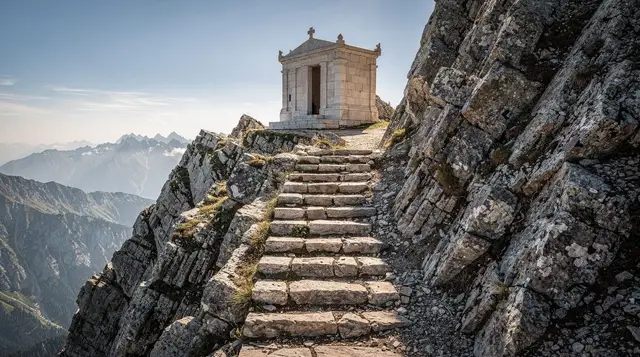
From the upper car park, a path leads to a stone archway and then into a tunnel bored through the summit rock — this is where most of the 461 steps are, out of direct sun and noticeably cooler than the open path either side of it. It emerges onto a stepped approach that climbs the last stretch to the mausoleum terrace.
Fifteen to twenty-five minutes covers it for most people at a normal pace. It’s a genuine climb, not a stroll — steady stairs the whole way, no flat sections to recover on — but it’s shorter and less punishing than Kotor’s San Giovanni fortress climb, and shaded for a good part of the route inside the tunnel, which the fortress steps are not. Anyone reasonably mobile manages it without difficulty; pushchairs and wheelchairs cannot, since the tunnel has stairs throughout, not a ramp.
Bring water regardless of the tunnel shade — the open stretch at the top, right where you want to linger for the view, has none.
Inside the mausoleum
The tomb chamber holds Njegoš’s sarcophagus beneath a granite canopy, flanked by two caryatid figures carved by Meštrović in his characteristic heavy, monumental style — closer in feel to his war memorials elsewhere in the Balkans than to a conventional church interior. It’s a single room, plainly lit, and most visitors spend five to ten minutes there before continuing out to the viewing terrace, which is really the point of the visit.
The view
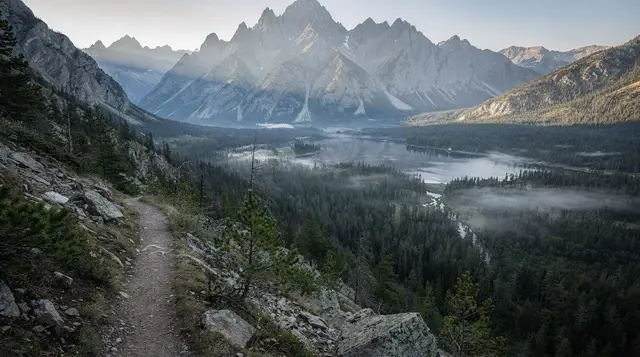
This is what the climb is for. On a clear day the terrace behind the mausoleum gives an open 360-degree panorama: the Adriatic coast and the Bay of Kotor to the south and west, the folded ranges of Lovćen’s own national park immediately around you, and, in the far distance to the north, the silhouette of the Durmitor massif when visibility allows. How much of that you actually see depends entirely on the weather — Lovćen’s summit collects cloud and haze often enough that a hazy day reduces the view to the immediate ridgeline, while a clear morning after rain can deliver genuinely long sightlines in both directions. Coming up before midday, and ideally not in the thick heat-haze of a July or August afternoon, meaningfully improves your odds.
If the summit view is the priority rather than the mausoleum itself, a hiking-focused visit gets you onto the ridge trails around it rather than just the platform — a private hiking tour of Lovćen covers more of the park’s trail network, and for a longer walk with a specific target, the hike up to Pestingrad peak near Njeguši is a step beyond the mausoleum crowds. The full trail options for the park are set out in the Lovćen National Park hiking guide.
Combining the mausoleum with Njeguši, Cetinje, and Lipa Cave
Almost nobody drives up purely for the mausoleum and back. The old road puts Njeguši directly on your route, and it’s worth 45 minutes to an hour for the smoked prosciutto and hard cheese the village is known for across the region — the Njeguši prosciutto and cheese guide covers where to try it, and a village tour with a household tasting in Njeguši is the easiest way to do it properly rather than guessing which roadside stall is worth stopping at. The Njeguši village guide has the fuller picture of the village itself.
Cetinje works as the other half of the day. It’s Montenegro’s former royal capital, with the Cetinje Monastery holding relics regarded as among the country’s most significant religious artefacts — see the Cetinje monastery relics guide — plus museums and former royal residences that fill out an afternoon. The Cetinje day trip from Kotor guide lays out a route that takes in both the mausoleum and the town in one loop.
A short detour toward Lipa Cave, near Cetinje, adds an underground contrast to a day otherwise spent on mountain roads and stairs — a guided entrance ticket for Lipa Cave covers the walking tour through its chambers. It’s a reasonable add-on if you’re already routing through Cetinje rather than a separate trip in its own right.
Anyone planning several of these stops across one visit to the bay should look at how many days that actually needs — the how many days in Kotor and the bay guide and the three-day Kotor itinerary both work Lovćen in as a half-day slot rather than a rushed add-on to a beach day.
Why Njegoš matters to the people who climb here
Most Montenegrins arrive with a different mindset from foreign visitors. For them this is closer to a pilgrimage than a viewpoint stop: the poet-ruler who wanted to lie on the mountain is honoured here as the figure who tied language, faith and landscape together. You will see families pausing in the tunnel, older visitors going quiet at the sarcophagus, and school groups being told which lines of The Mountain Wreath to remember. Knowing a little of that background changes how the place feels, and the Njegoš Mausoleum visit guide goes further into the practicalities and the story behind the monument.
It also helps to see Lovćen as the heart of the old Montenegro, long before the coast became a holiday destination. The royal town of Cetinje lies just below the mountain, and the villages on the way up, Njeguši above all, were the family home of the ruling dynasty. Climbing the steps is, in that sense, the last chapter of a story you can follow from the bay upward.
A realistic plan for the day
Treat the mausoleum as the centrepiece of a slow loop rather than a sprint. A comfortable order starts early from Kotor, takes the old road up with a pause at one or two hairpins for photographs, spends the middle of the morning on the steps and the terrace, and then drops toward Cetinje or back through Njeguši for lunch. If you are staying in the old town, the Kotor Old Town walking guide is a good way to use the evening you get back, since a day of mountain driving leaves you wanting a flat, shaded walk.
Travellers with only a single day in the area can still fit it in: the one day in Kotor plan is better kept for the old town, while the two-day Kotor itinerary leaves a full second day for Lovćen and one of its neighbours. Those with more time can pair it with the Cetinje day trip on a separate day and keep each outing unhurried.
Getting the best out of the terrace
Once you reach the top, resist the urge to photograph and leave. Walk the whole terrace slowly, because the view changes with every side: the bay and coast on one edge, the folded mountain country on another, and the long northern horizon on a third. Orient yourself first by finding the Bay of Kotor, then the line of the coast toward Budva, and only then look for the faint northern outline. Visitors who arrive without a plan often miss half of what is on offer simply because they stand at the first gap in the wall.
Wind is part of the experience. On a still day in the bay it can be blowing hard up here, so a layer you can pull on quickly matters more than a heavy coat. If you plan to stay a while, choose a spot sheltered behind the stonework and give your eyes a few minutes to adjust, since the contrast with the dim tunnel can make the first look washed out.
If you are travelling without a car
Not everyone wants to take the hairpins. If you are not renting, the Montenegro without a car guide explains the realistic options, and the buses in Montenegro guide shows why public transport rarely reaches the summit area on a schedule that suits a morning climb. A guided day, a shared car or a taxi in Kotor arranged in advance usually works better. The Montenegro without a car itinerary shows how Lovćen fits into a trip built around tours and transfers rather than your own vehicle.
For those who drive, the parking in Kotor guide is worth reading for the other end of the day, since a car left in the bay overnight is a different problem from a car left at the summit.
Pairing Lovćen with other days
The mountain sits comfortably alongside the rest of the region. A boat day on the bay, such as the Kotor Bay boat tour, balances a day of altitude with a day at sea level, and the Kotor Bay by boat itinerary shows how to sequence them. For a wider tour of the country’s high ground, the national parks grand tour places Lovćen alongside the other protected areas, and the Durmitor National Park guide is useful if the distant silhouette you saw from the terrace makes you curious about what it looks like up close.
If you came for the poetry and the history rather than the scenery, the Boka captains of the 18th century story and the Njeguši prosciutto and the wind that dries it article make good companion reading for the evening before or after.
Practical details
| Item | Detail |
|---|---|
| Elevation | 1,657m at Jezerski vrh, inside Lovćen National Park |
| Steps | 461, mostly through a rock tunnel |
| Climb time | 15–25 minutes each way from the upper car park |
| Mausoleum entry | Roughly €3–5 per person, cash at the gate, seasonal hours |
| Park entrance | Separate small fee for driving into Lovćen National Park |
| Parking | Upper car park near the tunnel entrance; limited spaces in peak season |
| Closures | Snow, ice, or fog can close the road and site, mainly November–April |
Sturdy shoes matter more than they seem to on paper — the tunnel steps are uneven stone, and the open terrace at the top can be windy even when Kotor itself is still and hot. A light jacket earns its place in the boot even in August, since the summit runs noticeably cooler than the coast.
Timing your visit
Morning generally beats afternoon on Lovćen, for the same reason it beats afternoon almost everywhere in this region: heat haze thickens through the day and cuts the long sightlines that make the climb worth it. Arriving by mid-morning, after the coastal humidity has cleared but before afternoon cloud has built over the ridge, gives the best odds of an open view. Weekends and July–August afternoons bring more coach groups doing Lovćen as one stop on a longer circuit, which mainly affects the upper car park and the tunnel queue rather than the view itself.
If the weather looks uncertain, do not cancel; decide on the morning. Conditions on the coast and on the summit can differ completely, and a grey bay sometimes sits under a bright ridge. Ask your accommodation or a local driver what the mountain looks like before you set off, and keep the plan flexible enough to swap the mausoleum with a Cetinje day if the summit is in cloud. The best time to visit Kotor guide and the Montenegro by season guide explain how the weather pattern shifts through the year, and the what to pack for Montenegro guide covers the layers that make a cool summit comfortable. In the colder months, the winter in Kotor Bay guide is the better starting point, since the summit road is the first thing to be affected.