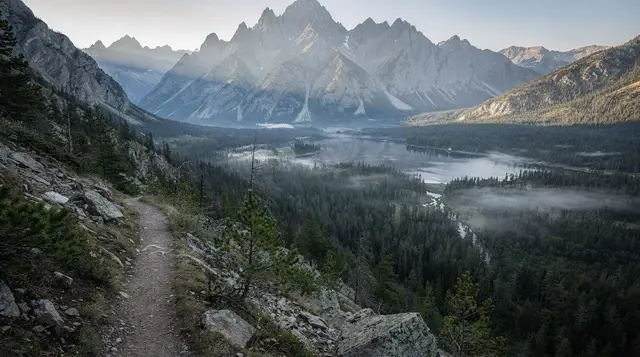
A mountain town built for one purpose
Žabljak doesn’t try to be a destination in its own right, and it shouldn’t. At around 1,450m above sea level, it’s the highest town in the Balkans, and it exists almost entirely to serve people heading into Durmitor National Park. There’s a compact centre, a scatter of guesthouses and small hotels, a supermarket or two, a handful of restaurants serving mountain food, and outdoor shops renting exactly what you need for whatever you came to do. That’s the whole offer — and for most visitors, it’s the right one.
The distinction matters when you’re planning from Kotor. This page is about Žabljak as a logistics base — where to sleep, where to hire gear, how to get here and what to expect on the ground — rather than a tour of the national park’s landscapes, which belongs to the Durmitor National Park guide and the Black Lake hiking guide. If you’re deciding whether Durmitor fits your itinerary at all, start there. If you’ve already decided you’re going and need to work out where to stay and how to get organised once you arrive, this is the page.
Getting to Žabljak from Kotor
Budget 3 to 3.5 hours by car from Kotor, which puts Žabljak firmly in “stay over” territory rather than a comfortable day trip. There are two realistic routes. The more direct one runs inland through Njeguši, Cetinje and Nikšić before climbing into the Durmitor massif — this is the route most car rentals and transfer services default to. The alternative loops further east, following the Tara river valley and passing near Đurđevića Tara Bridge, which adds time but means you see the canyon on the way in rather than as a separate excursion.
Public transport exists but is thin: buses connect Žabljak to Podgorica, with onward connections from there, but there’s no dense local network once you’re in the mountains, and no direct bus service from Kotor. If you’re not driving yourself, see the guide to getting around Montenegro without a car before committing to Durmitor — it’s the one part of an itinerary where a rental car or a booked tour genuinely earns its cost. The car rental guide covers what to expect on mountain roads, which are narrower and slower than coastal driving suggests on a map.
Whichever route you take, treat the drive itself as part of the day, not a formality. Mountain roads mean lower average speeds than the distance implies, and winter conditions can close or seriously slow sections — check conditions before setting out between December and March.
Where to stay in Žabljak
Accommodation in Žabljak is dominated by small, family-run guesthouses and pansions, with a handful of larger hotels nearer the ski lifts and Black Lake. This is not a resort town with international chain hotels; expect simple, clean rooms, often with half-board options that make sense given how few restaurant choices there are once you’re outside the town centre.
| Area | What it’s like | Best for |
|---|---|---|
| Town centre | Guesthouses, small hotels, walk to shops and restaurants | First-timers, no car dependency for food |
| Near Black Lake | Slightly more removed, quieter, closer to trailheads | Early starts for hiking |
| Near Savin Kuk | Ski-season focused, closer to lifts | Winter visitors |
Book ahead for the ski season and for July–August, when both mountain and coastal Montenegrins escape the heat here — rooms in the town centre sell out faster than the overall look of a quiet mountain village suggests. Outside those windows, especially in the May–June and September shoulder months, availability is easier and prices drop noticeably.
For a wider view of where to base a Durmitor trip against the rest of the country, the where to stay in the Kotor Bay guide and the national parks grand tour itinerary both help place Žabljak inside a longer trip rather than as an isolated stop.
Renting gear once you’re here
The reason to base yourself in Žabljak rather than just driving through is access to the right equipment without hauling it from the coast. Outdoor shops around the town centre and near Black Lake rent hiking poles, snowshoes, cross-country skis, downhill ski and snowboard sets in winter, and mountain bikes in summer. Rafting and canoeing operators on the Tara supply all safety and paddling equipment as part of organised trips — you don’t need to own or bring anything beyond suitable clothing and footwear.
This is also where booking an organised activity earns its keep over improvising. A guided Tara Canyon day covers transport to the put-in point, safety briefing and all gear; doing it independently means sourcing your own permits, transport and equipment in a town where none of that is set up for casual walk-ins. A Tara Canyon canoe day with a picnic stop is a lower-intensity alternative to whitewater rafting if you want the scenery without the rapids.
Summer in Žabljak: hiking, rafting and canyoning
Summer is when Žabljak is busiest with hikers. Black Lake, a short walk from the town centre, is the easiest orientation point and the start of several marked trails into the wider massif — full route detail is in the Black Lake hiking guide. Longer routes head towards the higher peaks and require proper boots, water, and a realistic read of your own fitness; mountain weather here changes faster than on the coast, and afternoon storms are common in July and August.
The Tara River, running through Europe’s deepest canyon, is the other headline draw, and rafting season generally runs from spring meltwater through summer. Both the Tara Canyon rafting guide and the canyoning guide go into route grades and what to expect on the water. If you’d rather cover ground on two wheels than on foot, the mountain biking in Durmitor guide and a Sedlo Pass and Devil’s Lake e-bike route are lower-effort ways to see the high plateau without a full-day trek.
For visitors who want the highlights in a single organised day rather than piecing together transport and permits themselves, a Black Lake and Tara Canyon day tour covers both in one outing, and works well as an add-on if you’re only staying one night. Serious hikers aiming for one of the higher peaks in the wider Prokletije range should look at a private hike up Vasojevićki Kom, which is a full-day undertaking best done with a guide who knows the route and current conditions.
Winter in Žabljak: skiing at Savin Kuk
Between December and March, Žabljak switches to a ski base. The Savin Kuk ski centre, a short drive from town, has modest lift-served downhill terrain alongside cross-country tracks across the plateau near Black Lake — this is a small, low-key operation compared with Alpine resorts, and it suits intermediate skiers and families more than anyone chasing challenging terrain. Ski and snowboard rental is available in town and near the lifts; buying a lift pass and gear on arrival is standard practice rather than something you need to arrange in advance.
Winter also closes or slows some of the roads into Durmitor, and daylight hours are short. If you’re combining a ski stop in Žabljak with time on the coast, check the Montenegro by season guide and the off-season Montenegro guide for how weather and road conditions interact across the country at that time of year — coastal mildness doesn’t tell you anything about what the mountains are doing.
Eating in Žabljak
Food here is mountain cooking, not coastal seafood: cheese and cured meats from the surrounding villages, hearty stews, grilled meat, and trout from local rivers and lakes rather than the sea bream and squid you’d find in Kotor’s old town. Portions tend to be generous and prices noticeably lower than coastal restaurant prices in high season — a main course in an ordinary Žabljak restaurant typically runs below what the same dish would cost on a Kotor waterfront terrace. Options are limited outside the town centre, which is another reason half-board arrangements are common and sensible here.
Practicalities: altitude, weather and connectivity
At close to 1,450m, Žabljak’s climate is meaningfully cooler than the coast at every time of year — pack layers even for a midsummer visit, since evenings can turn cold quickly after a warm hiking day. Mobile signal and wifi are generally reliable in the town itself but patchy once you’re on trails or deep in the canyon, so download maps and any tour confirmations before setting out. Cash is still useful in smaller guesthouses and rural shops, even though card acceptance has improved in town.
If Žabljak is one stop on a wider northern loop, Kolašin and Biogradska Gora make sensible next stops for more national park scenery without doubling back to the coast, and the Biogradska Gora hiking guide covers that route in more depth. For budgeting the wider trip, the Montenegro daily budget guide breaks down how mountain-town costs compare with the coast.
Shaping your days around the weather
Because the forecast on the coast tells you nothing about the mountains, the most useful habit in Žabljak is to keep one day loose. Plan the activity that depends on clear skies, a long hike or a high-plateau ride, for the first morning, and leave the more forgiving options, such as a canyon viewpoint or a slow lunch in town, as the fallback. If the afternoon turns stormy, as it often can in July and August, you will already have done the part that mattered.
A sensible rhythm for two nights is simple. Arrive, settle into your guesthouse and walk to Black Lake to get your bearings. Spend the full middle day on one bigger outing, either a hike, a ride or a day on the water. Use the last morning for a short walk or a viewpoint before the long drive back towards the coast. With a third night you can slow all of this down, add the canyon rim and the bridge, and let a bad-weather day pass without losing the trip.
Choosing between a guided day and doing it yourself
Žabljak rewards both approaches, and the choice mostly comes down to how much logistics you want to carry. Walking to Black Lake and following marked trails needs nothing more than good boots, water and a map downloaded in advance. Anything that involves the river, a long transfer or a route where conditions change, such as the canyon or a high peak, is easier with a guide who handles transport and knows the current state of the ground.
If you are travelling as a family or with mixed fitness levels, the gentler options are worth considering first: a canoe day with a picnic, or an e-bike route across the plateau, keeps everyone together without anyone being left behind on the climb. Keen walkers who want something harder can pair a few easy days around town with one demanding outing, rather than stacking several hard days in a row at altitude.
Linking Žabljak with the rest of your trip
Most visitors reach Žabljak from the coast and return the same way, but the town also works as the hinge of a longer route. Building it into a loop means the long drive earns more than a single stop. The Kotor in three days itinerary and the Kotor in five days itinerary show how to leave room on the coast for a mountain detour, and the how many days in Kotor and the bay guide helps you decide how many of your nights to spend inland rather than by the sea.
If you are weighing Durmitor against the other large body of water in the country, the Lake Skadar versus Durmitor comparison sets out what each offers. And if you want a lower-key option for the same trip, Lake Skadar makes an easier, warmer counterpart to the cold clear air of the mountains.
FAQ: staying in Žabljak and visiting Durmitor
How far is Žabljak from Kotor, and is it worth the drive?
It’s roughly 3 to 3.5 hours by car, mostly on mountain roads through Njeguši and Nikšić or via the Tara Canyon side. It’s worth it if you want more than a glimpse of Durmitor — a proper hike, a rafting day on the Tara, or skiing — but it is not a realistic day trip from the coast.
Can I visit Durmitor as a day trip from Kotor instead of staying in Žabljak?
Physically yes, but it means roughly 6 to 7 hours of driving for a handful of hours on the ground, which defeats the point of a mountain park. Staying at least one night in Žabljak turns a rushed drive-by into actual hiking or rafting time.
Do I need a car to base myself in Žabljak?
You need one, or a booked tour with transfers included. Public buses reach Žabljak from Podgorica and occasionally Nikšić, but there is no reliable local network for reaching Black Lake trailheads, the Tara Canyon rim or Sedlo Pass without your own transport or an organised tour.
Is Žabljak cold, even in summer?
Evenings are noticeably cooler than the coast because of the altitude — pack a fleece or light jacket even in July and August. Summer days are pleasant for hiking, but mornings and nights can feel more alpine than Mediterranean.
Where does everyone ski in Žabljak?
The Savin Kuk ski centre, a short drive from the town centre, is the main lift-served area, with modest but genuine downhill runs and cross-country tracks around Black Lake and the surrounding plateau. It’s a small, low-key resort by Alpine standards, not a purpose-built ski town.
How many days do I actually need in Žabljak?
Two nights covers Black Lake and one longer hike or a rafting day. Three or more nights lets you add Tara Canyon viewpoints, Đurđevića Tara Bridge, and a slower pace that accounts for mountain weather changing your plans.
Is Žabljak expensive compared to Kotor or Budva?
No — it’s generally cheaper. Guesthouses and simple hotels run below coastal high-season prices, and food leans towards hearty mountain cooking rather than seafood-restaurant prices. Ski season and the height of summer hiking season push rates up, but rarely to coastal peak levels.
What should I pack that I wouldn’t need in Kotor?
Proper hiking boots, layers for cold mornings and evenings, and a rain shell — mountain weather changes fast and the forecast on the coast tells you nothing about conditions at 1,450m. In winter, you need genuine cold-weather and snow gear, not a coastal-trip packing list.