Cetinje's cafés: where the old capital actually eats
Where should I eat in Cetinje?
Stick to the streets around Njegoševa and the old parliament building, where cafés and konobas serve grilled meat, burek and Ottoman-influenced pastries rather than coastal seafood. Pair lunch with the Cetinje Monastery and the National Museum, both a short walk away, and you can cover the food and the sights in half a day.
A slower kitchen, an hour up the hill
Cetinje is the old royal capital of Montenegro, and it feels like it the moment you park: fewer tour buses, wider pavements, and cafés with regulars rather than menus translated into six languages. It sits inland at altitude, reached from Kotor by the old road through Njeguši — about an hour of driving, most of it on the switchbacks that also serve as the classic viewpoint over the Bay of Kotor. That drive alone is a reason plenty of visitors treat Cetinje as a half-day trip rather than a quick stop.
What matters for a meal here is that Cetinje’s food doesn’t try to be coastal. There’s no bay outside the window, so nobody is grilling the day’s catch of sea bass. Instead the kitchens follow the continental Montenegrin tradition shared with the interior towns and villages: grilled and roasted meat, thick soups, bread-based street food, and pastries carrying an Ottoman-era imprint that the coast’s Venetian-influenced cooking mostly skipped. If you’ve eaten your way through Kotor’s old town or the seafood and oysters of the bay, Cetinje is a genuinely different plate.
Where to find the cafés
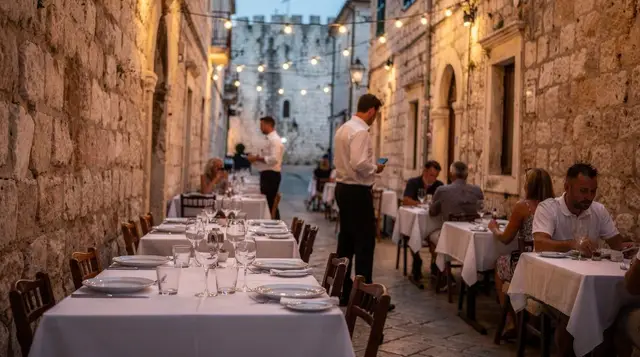
The café life concentrates on and around Njegoševa, the pedestrianised stretch that runs past the old government buildings and the National Museum complex. Outdoor tables spill onto the street from spring through autumn, and the pace is unmistakably slower than Kotor’s old town at midday: people sit for an hour over a single coffee, and nobody is rushing you off a table for the next cruise-day sitting.
A few streets back from the main strip, smaller konobas (family-run taverns) serve the same continental menu at slightly lower prices, aimed at locals and day-tripping Montenegrins rather than at coach groups. These are worth seeking out if you want a meal rather than a coffee stop — ask at your accommodation or simply walk a block off the main pedestrian street and look for a handwritten menu board.
What’s actually on the menu
| Dish | What it is | Typical price |
|---|---|---|
| Ćevapi | Grilled minced-meat fingers, served with flatbread and onion | 5-9 EUR |
| Ražnjići | Grilled meat skewers | 7-12 EUR |
| Pljeskavica | Grilled meat patty, often stuffed with cheese | 6-10 EUR |
| Čorba | Bean or vegetable soup, sometimes with meat | 3-5 EUR |
| Burek | Filo pastry filled with cheese, meat or spinach | 2-4 EUR |
| Baklava / tulumba | Syrup-soaked pastries with Ottoman-era roots | 1.50-3 EUR |
| Coffee (domaća kafa or espresso) | Turkish-style or espresso | 1.20-2 EUR |
These prices track close to what you’d pay in Kotor, sometimes a little lower, because Cetinje doesn’t carry the cruise-day markup that hits the old town’s waterfront tables between 10am and 4pm.
If you want the wider context on the region’s meat and cheese specialities — the cured ham and cheese that come down from the villages around Njeguši — Cetinje’s kitchens are a natural place to try them, since the town sits closer to that production than the coast does.
How to read a konoba menu
Menus in the smaller places are short and written around what the kitchen does well, not around what a visitor might expect. Grilled meat is the backbone, and portions tend to arrive with bread, raw onion and sometimes a spoonful of a sharp cheese spread on the side. If a dish is listed as the house speciality, it is usually the safest order: it is what the regulars at the next table are eating, and the kitchen makes it often enough to get it right.
Vegetarians will find the choice thinner than on the coast, but not empty. Bean soup, cheese-filled pastry, grilled vegetables and salads built from tomato, cucumber and white cheese are on most menus, and staff will generally tell you plainly what contains meat if you ask. It is worth asking about soups in particular, since a čorba that looks meatless is sometimes cooked with a bone or a piece of smoked meat.
Service is relaxed. Food arrives when it is ready rather than on a timer, and the bill usually comes only when you ask for it. That rhythm is part of the appeal after a morning on the road, but it means you should not book a tight connection straight after lunch. For the habits around paying and leaving a little extra, the tipping etiquette guide covers what is normal, and the money and ATMs guide is useful if you want to be sure you have small cash for a café table.
What to drink
Coffee culture in Cetinje runs deep — this was the seat of Montenegrin government for over a century, and the café habit that comes with a capital city never left. Expect either Turkish-style domaća kafa, served in a small copper pot with grounds settled at the bottom, or standard espresso-based drinks that wouldn’t look out of place in Rome.
For something stronger, this is also a reasonable place to try Montenegrin wine and rakija without the tourist pricing you sometimes hit on the coast. The reds and whites — Vranac and Krstac — turn up on most restaurant lists, and a shot of rakija, the regional fruit brandy, is a common way to finish a meal rather than start one.
Coffee stop or full lunch: choosing your pace
Cetinje rewards deciding early which kind of visit you want. A coffee stop is the lighter option: sit at a street table, watch the town go by, and carry on with the sights. It suits travellers who have already eaten well in the bay, perhaps after a long evening in Kotor’s old town, and who mainly want to feel what an old capital is like when it is not performing for visitors.
A full lunch suits those who treat the trip as a food day. In that case, leave the sights short and let the meal be the centre: a soup to start, a grilled main, a pastry and a coffee, then a slow walk to settle it. Travelling with children is easy in either mode, since the menus are simple and familiar, and the Kotor with kids guide has more on pacing a day for younger travellers.
Whichever you choose, avoid the instinct to squeeze in every museum. A relaxed hour at the table does more to show you what the town is like than a seventh gallery, and the cafés are where the old capital’s character is easiest to read.
Pairing lunch with the monastery and the museum
Cetinje’s main sights sit within easy walking distance of the café streets, which is what makes a food stop here worth building a short itinerary around rather than treating as an afterthought.
- Cetinje Monastery: the working Orthodox monastery that holds some of Montenegro’s most significant religious relics. Modest dress is expected, and visits are generally quick — 20 to 30 minutes unless you’re waiting for a service to end.
- National Museum complex: covers Montenegrin history and the royal era in a cluster of buildings around the old palace, an hour or two depending on how many of the individual museums you go into.
- Old government buildings: several foreign embassies from the pre-unification kingdom era still stand along the main streets, worth a slow walk rather than a dedicated stop.
A sensible order is monastery first, since visiting hours can be tighter around services, then the museum, then a sit-down lunch once you’ve covered the sights on foot and have an appetite for it. The whole loop — monastery, museum, lunch — comfortably fits into two to three hours, which is why Cetinje works well as a half-day addition to a longer day trip rather than requiring an overnight stay.
Getting here from Kotor
The direct route from Kotor to Cetinje runs over the old Njeguši road, roughly an hour of driving with the switchback climb out of the bay as the main event before the road levels out onto the plateau. It’s a narrow, twisting stretch, and drivers who aren’t used to mountain roads should budget extra time and expect to pull over for oncoming traffic on some of the tighter bends.
If you’d rather not drive it yourself, day tours from Kotor typically bundle Cetinje in with Njeguši and Lovćen National Park, often stopping at a working household along the way for a taste of cured meat and cheese before continuing into town. A private city tour is the more flexible option if food and the monastery are your priority and you’d rather skip the mountain stops.
a private city tour of Cetinje that focuses on the old capital itself covers the monastery, museum and old town on your own schedule, which leaves room to build in a proper sit-down lunch rather than a rushed coffee.
For a broader day that combines the drive over Njeguši with a taste of village food before you even reach Cetinje, a household visit near Cetinje with a hands-on food experience puts you in a working kitchen rather than a restaurant, which is a different way to get at the same continental cooking described above.
If you’d rather see Lovćen, Njeguši and Cetinje together in one organised loop, a full-day trip covering Lovćen, Njeguši and Cetinje handles the mountain driving for you and typically builds in time at the monastery as well.
Eating your way up the mountain road
The best meal of the day is not always the one in town. Many visitors reach Cetinje after stopping in Njeguši, where cured ham and cheese are the local pride, and arrive already partly fed. If that is your plan, keep lunch in Cetinje lighter, perhaps a soup or a pastry and a coffee, and save the grill for another day. The Njeguši old road story gives a sense of what the drive itself is like, and of why people stop along the way.
If you would rather keep the food side of the trip on the coast, a guided tasting in town is an alternative. a guided food walk through Kotor is a good companion to a Cetinje day: one gives you the Venetian-influenced, seafood-leaning side of the region, the other the continental, meat-and-pastry side. Doing both over a stay lets you taste the contrast the two kitchens make.
Pairing the food with a drink is a natural next step. A glass of local red with grilled meat is the classic match, and the wine tasting in the Crmnica region guide is worth reading if the wines catch your interest and you want to go further than a restaurant list. For sweet things, the Ottoman-era pastries are best eaten fresh and with a small coffee, not carried around in a bag.
A sample half-day, built around the table
A simple shape for the day, without fixed times: set off from the bay early enough to take the mountain road without hurrying, stop briefly where the view opens over the bay, and arrive in Cetinje with the town still quiet. Begin with the monastery while your energy is fresh, move to the museum complex, and let hunger decide where you sit down. Choose a place on or just off Njegoševa if you want the atmosphere, or a street further back if you want the quieter, cheaper tables.
After lunch, resist rushing straight back. Walk the old government buildings slowly, take a second coffee, and only then turn towards the car. If you are not driving, the Montenegro without a car guide and the taxis in Kotor guide help you plan a return that does not depend on a bus timetable, and the Kotor in three days itinerary shows where a Cetinje day can sit in a slightly longer stay.
Beyond food: what else is nearby
Cetinje also works as a base for reaching further inland without doubling back to Kotor first. The Njegoš Mausoleum sits on the summit of Lovćen above the town, and Lipa Cave is a short drive away if you want to add an underground stop to the same day. Neither requires a separate trip from Kotor if you’re already up on the plateau.
For anyone building a longer stay around the bay rather than a single day trip, it’s worth reading how Cetinje compares to a full day trip covering more ground — see the Cetinje day trip guide from Kotor for a fuller itinerary, or the Kotor two-day itinerary if you’re deciding how to slot Cetinje in against the coast and the old town.
Seasons and weather at the table
Cetinje sits high and inland, so it feels different from the coast through the year. In warm months the street tables are the place to be, and a long coffee outdoors is half the point of coming. When the weather turns cooler or wet, the same cafés move you indoors, and a bowl of hot soup makes more sense than a cold drink. The Montenegro by season guide and the what to pack guide are worth a look before you go, since a light layer is often welcome on the plateau even when the bay was warm that morning.
Out of season, the town is quieter still, and some smaller places keep shorter hours, so a café on the main street is the safer fallback if a konoba is closed. The Kotor off-season itinerary is a useful companion if you are travelling outside the summer months.
Practical notes
Cetinje doesn’t run on cruise-ship hours the way Kotor’s old town does, so there’s no equivalent 10am-4pm crush to plan around. The town is busiest around midday on weekends when Montenegrin families come up for lunch, but even then it rarely feels crowded compared with the coast in July and August.
If you’re driving yourself, parking around the pedestrian centre is generally easier to find than in Kotor — see the car rental guide if you haven’t arranged one yet. Public buses connect Cetinje to Kotor and Podgorica, though schedules aren’t centrally bookable online; check the buses in Montenegro guide before relying on one for a same-day return.
Kotor food & drink tours on GetYourGuide
Verified deep-linked GetYourGuide tours. Book through these links and we earn a small commission at no cost to you.
GetYourGuide does not provide a product photo for this activity — the image shows the meeting point, photographed by us.