A working monastery on the road, not a destination in itself
Morača Monastery sits in the canyon of the Morača river, on the main road that connects Podgorica to Kolašin and, beyond that, to Durmitor National Park and Žabljak. Nobody bases a Montenegro trip here. It is a walled complex with one 13th-century church, a handful of monastic buildings, and a courtyard — the kind of place you stop the car for, walk around for half an hour, and get back on the road.
That is not a criticism. Judged as what it actually is — a genuine historical site directly on a route most north-bound visitors already drive — it is one of the better-value 30-minute stops in the country. Judged as a day-trip destination in its own right, it is not one, and no amount of description will make the visit last longer than it does.
What you’re actually looking at
The monastery was founded in 1252 by Stefan Vukanović, a nephew of the Serbian king, as the seat of a small Orthodox community in what was then the medieval Serbian state. The main church, dedicated to the Dormition of the Mother of God, is built from a warm, pale stone that has held up better than most of Montenegro’s other medieval buildings — the walls and roofline you see today are largely the original 13th-century structure, not a later reconstruction, which is unusual for a region that has been through repeated earthquakes and Ottoman-era conflict.
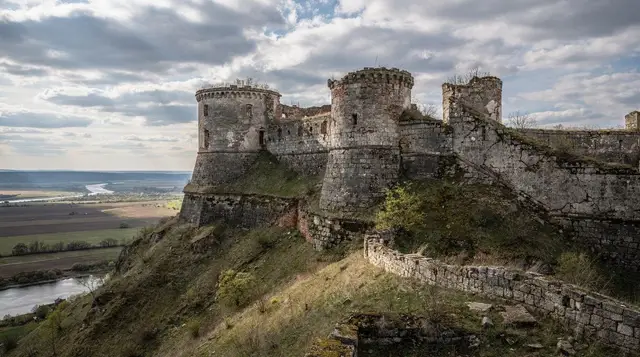
The complex is small: one main church, a bell tower, monks’ quarters arranged around a courtyard, and a defensive wall that was necessary in an era when this canyon was a contested border zone rather than a scenic drive. You can walk the entire footprint in ten minutes. The reason to stop is what is on the inside walls, not the size of the site.
The frescoes, in plain terms
Morača is known specifically for its frescoes, and they are the actual reason to get out of the car. The oldest layer dates to the 13th century, painted not long after the church itself was built; a second layer was added in the 16th century when the monastery was renovated after Ottoman-era damage. The two periods are visually distinct if you know to look for it — the older work is more austere and Byzantine in style, the later layer noticeably more expressive.
The best-known individual work is a fresco of the Prophet Elijah in the desert, often singled out by art historians as one of the more sophisticated pieces of medieval fresco painting to survive in this part of the Balkans. You do not need any background in Orthodox iconography to notice it: it is the panel most guides will point out first, and the one most reproduced on postcards sold at the gate. Lighting inside the church is dim by design — these are 700-plus-year-old pigments, not spot-lit museum pieces — so give your eyes thirty seconds to adjust rather than assuming the interior is underwhelming from the doorway.
If frescoes and medieval Orthodox art genuinely interest you rather than being a box to tick, the longer write-up in the Morača Monastery guide goes into which panels are worth the extra five minutes and which side chapel is usually overlooked.
How to spend your thirty minutes inside the walls
A short visit goes better with a loose order. Start in the courtyard rather than rushing straight into the church: look at the stonework from outside first, because the proportions of the building and the way it sits against the canyon wall are part of what the monks who built it were working with. Then go in, let your eyes adjust, and work around the interior slowly, one wall at a time, instead of scanning for the single famous panel and leaving.
The two painted layers are easier to separate once you stop trying to take in the whole interior at once. Pick one wall, find the older, quieter figures, and then look for where the later, more animated work takes over. That small exercise is what turns a quick stop into something you remember, and it costs no extra time.
When you come back out, walk the inside of the defensive wall once. It is a short loop, and it gives you the clearest sense of why a community would have wanted a wall here at all, in a narrow canyon where the river and the road have always been the main way through. The honey and rakija stand by the gate is the natural last stop, and if the second of those interests you, the rakija guide explains what you are actually buying and how locals drink it.
Etiquette in a place that is still a monastery
Morača is not a museum that happens to have a church in it. The community lives here, and visitors are guests. That shapes a few small habits that make the stop easier for everyone: keep your voice low in the courtyard, do not walk through a service, and do not point a camera at the monks or sisters going about their day. If a service is under way when you arrive, wait outside or walk the wall first; it rarely takes long to finish, and watching from the back of the church with respect is far better than hovering near the door.
If this kind of visit appeals, you may also like the more pilgrimage-focused Ostrog Monastery guide, the Savina Monastery guide in the bay itself, and the Cetinje Monastery relics guide, which approaches the same tradition from a very different setting.
Getting there from Kotor
There is no direct route — you go via Podgorica. From Kotor, the standard drive is through the Sozina tunnel toward Podgorica (around 1 hour 30 minutes on its own, per the tunnel’s €2.50 car toll), then north out of Podgorica on the road that follows the Morača canyon toward Kolašin. The monastery sits roughly 20–25 minutes before you reach Kolašin itself. All told, budget 2 hours to 2 hours 15 minutes from central Kotor to the monastery gate, traffic and the Podgorica ring road permitting.
There’s a car park directly outside the walls, free and generally uncrowded except around midday when a tour coach or two is parked up. This is not a stop that needs advance planning for parking the way the old town does.
If you’d rather not drive the canyon road yourself, a guided option that already includes Morača as a stop saves the navigation: a private day tour from the Kolašin and Bjelasica side that builds in a proper stop at the monastery covers the drive and the context in one booking, which is worth it if frescoes and medieval history are the actual reason for the detour rather than an afterthought.
Where Morača fits on the road north
Treat Morača as a waypoint, not a plan. It works in three realistic scenarios:
Heading to Durmitor and Žabljak. If you’re driving the 3 to 3.5 hours from Kotor to Žabljak for the Black Lake, the Tara Canyon, or the Đurđevića Tara Bridge, Morača sits almost exactly on your route, a little over halfway. Thirty minutes here barely extends the day.
A loop through Kolašin and Biogradska Gora. Combine the monastery with Kolašin and Biogradska Gora National Park for a mountains-and- history day that starts and ends in Podgorica or continues back to Kotor.
A Podgorica day with a canyon detour. If you’re spending a day around Podgorica — worth doing per the Podgorica day guide — adding an hour each way north to Morača and back is a reasonable half-day extension rather than a separate trip.
What doesn’t make sense is driving from Kotor specifically to see Morača and then turning straight back. That’s roughly four hours behind the wheel for thirty minutes on foot — a poor trade unless the monastery is genuinely the point of the day, which for most visitors it isn’t.
Visiting practicalities: hours, dress code, donations
The church is generally open to visitors during daylight hours, roughly 8am to 6pm in summer and shorter in winter, though as an active monastic community it can close briefly around services — there’s no published fixed schedule you can rely on, so treat any specific opening time as approximate rather than guaranteed. Entry is free in the sense that there’s no ticket booth; a donation box sits near the entrance and a couple of euros per person is the customary amount.
Dress modestly: shoulders and knees covered, both for men and women. Wraps are usually available at the gate for anyone who turns up in beach clothes, but on a day when a coach group has already borrowed them all, you’ll be waiting. Bring a light scarf or trousers if you’re coming straight from a beach day on the coast.
There’s a small stand outside the walls selling honey, rakija, and dried herbs produced locally — reasonable prices, no pressure to buy, and a fair way to spend five of your thirty minutes if you want a souvenir that isn’t a fridge magnet.
When to go, and what the season changes
The monastery is easy to visit in most months, but the experience shifts with the season. In high summer the main variable is the coach window around midday, so an earlier or later arrival gives you the church almost to yourself. In spring and autumn the light in the canyon is softer and the courtyard is quieter, which suits slow looking at the frescoes. The Montenegro by season guide helps you decide how the rest of the route north will feel at the same time of year, and the winter guide is worth reading if you are thinking of the colder months, when the road beyond the monastery needs more care than the monastery itself.
What to skip, or at least not oversell
Don’t expect a cafe, a gift shop, or interpretive panels in English — this is a functioning monastery, not a heritage attraction built for tourism, and that’s part of what makes it feel genuine rather than staged. Don’t expect the frescoes to be as immediately dazzling in photographs as they are in person; low light and smartphone cameras don’t do the pigments justice, and the panels reward slow looking more than quick photographing.
If your actual interest is medieval Orthodox pilgrimage sites and you can only fit in one on a Kotor-based trip, weigh Morača against Ostrog Monastery: Ostrog is more dramatic (built into a cliff face), busier, and roughly the same drive time from Kotor. Morača is quieter, better for the frescoes specifically, and makes more sense if you’re already driving north rather than as a dedicated pilgrimage trip on its own — see the Ostrog pilgrimage guide for that comparison in full.
Distances and drive times
| From | Distance / time | Notes |
|---|---|---|
| Kotor | ~130 km, 2h–2h15 | Via the Sozina tunnel and Podgorica |
| Podgorica | ~55 km, 50–60 min | North on the canyon road |
| Kolašin | ~25 km, 20–25 min | Monastery sits south of the town |
| Žabljak / Durmitor | ~95 km, 1h30–1h45 | Continue north past Kolašin |
| Biogradska Gora | ~35 km, 30–35 min | Just past Kolašin |
If you’re weighing the whole day rather than just this stop, the Kotor to Durmitor and Bay itinerary planning and the Montenegro daily budget guide are useful for sanity-checking fuel, tolls, and time against what else you want to see that day. A rental car is close to essential for this route — public buses run the Podgorica–Kolašin road but not on a schedule built around a monastery stop; the car rental guide covers what to expect on pricing and pickup.
Building it into a longer trip
For visitors spending several days around Kotor and considering a run north, the national parks grand tour itinerary and the Montenegro without a car itinerary (useful mainly to see what you’d be giving up by not driving) both sketch how a stop like Morača slots between the coast and the mountains.
Pair it with Kolašin for lunch, or with Podgorica if you want a city stop either side of the canyon drive — a guided walk through Podgorica’s mix of Austro-Hungarian, socialist, and post-independence architecture fills the city half of that day well, and if the itinerary tilts toward water rather than mountains, a boat trip on Lake Skadar is a realistic alternative half-day from the same Podgorica base.
Planning the rest of the day around the stop
Because Morača is a short stop, the quality of the day depends on what surrounds it. The simplest pattern is to treat the monastery as a pause in a longer drive and to decide the real destination first. If that destination is the north, the Durmitor National Park guide and the Black Lake and Žabljak hiking guide cover what to do once you arrive, and the Tara Canyon rafting guide is the option for a more active day. If you prefer forest to high mountains, the Biogradska Gora hiking guide fits the same road well.
If the day ends back on the coast, the return drive is long enough that it is worth leaving the monastery with plenty of daylight in hand. A rental car makes all of this simple; if you are weighing public transport instead, the buses in Montenegro guide is honest about what a bus can and cannot do on a route like this one. For a different kind of excursion from the same Podgorica side, the Lake Skadar boat tour guide and the Lake Skadar destination page show what a water-based day looks like, while the Cetinje day trip is the easier choice if you want culture without a long drive.
Finally, if you are still deciding how many days to give the whole region, the Kotor in one day guide and the four-day Kotor itinerary show what you would be trading away for a day inland. Morača rewards travellers who have already seen the bay and want a quieter, older layer of the country; it works less well as a first-day priority for someone who has only just arrived.